
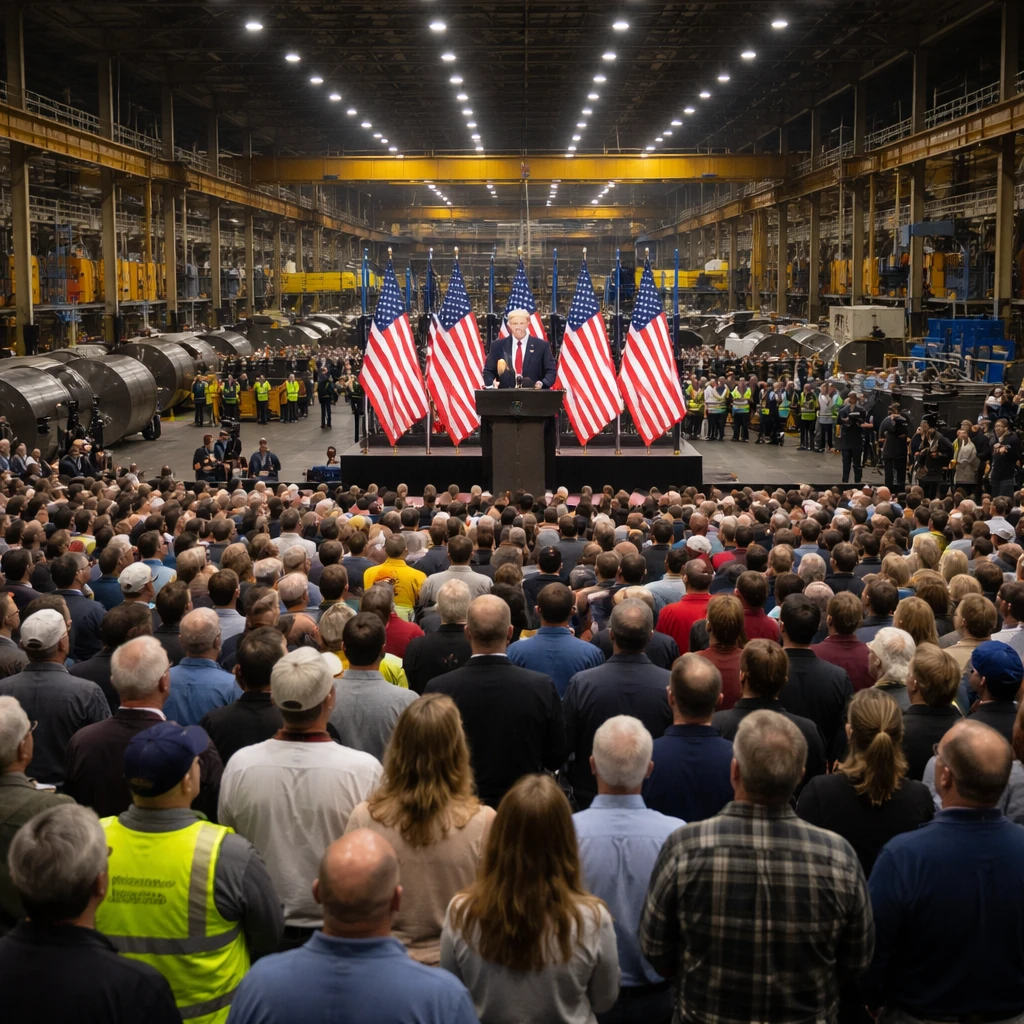
President Donald Trump will deliver another economic address in Rome, Georgia on Thursday as he renews efforts to convince voters that he and Congressional Republicans have concrete steps to curb high prices ahead of the November midterm elections.
White House Press Secretary Karoline Leavitt told reporters the speech will outline plans "to make life affordable for working people." According to a Republican Party promotional posting online, Trump is expected to speak at the Coosa Steel Corporation.
Although he is not a candidate on this year’s ballot, Trump has become his party’s principal messenger on the cost of living. He campaigned in 2024 on a promise to reduce inflation, a pledge that helped secure his reelection, but public opinion data indicate he has struggled to persuade many Americans that prices are falling.
Recent addresses by the president on economic topics have at times wandered from a focused message and have generally not directly addressed the financial strain some voters report experiencing at the grocery store. An analysis this month of five speeches on the economy that Trump has given since December found he repeatedly asserted that inflation had been defeated or was substantially lower, and made frequent claims that prices were falling - statements that contrast with data and many consumers’ everyday experiences.
Official inflation figures show the annual overall inflation rate in January at 2.4 percent, down from 2.7 percent in December. But food inflation was almost 3 percent over the past year, indicating higher costs for grocery staples, and housing costs have continued to rise. Those trends have kept pocketbook concerns at the forefront of voter sentiment.
Republican strategists have told party officials that mixed messaging on the issue of inflation could open a credibility gap for Trump and his allies, increasing political risk for Republicans ahead of the midterm contests. The GOP currently holds a razor-thin majority in the U.S. House of Representatives and is vulnerable to losing seats. Democrats, for their part, need a net gain of four seats to retake the Senate, a more challenging objective given the number of incumbent seats they must defend.
Recent polling on Mr. Trump’s economic stewardship reflects those political headwinds. A new poll released this week showed 34 percent approval of his handling of the economy, down from 36 percent the prior month, while 57 percent of respondents disapprove of his economic performance.
In his Georgia address, Trump is expected to tout tax measures that recently took effect and that the White House says will generate larger take-home pay for tens of millions of families. The administration is highlighting the implementation last month of tax cuts and the elimination of taxes on tips, overtime and certain Social Security payments as elements designed to deliver immediate savings.
Trump has also outlined plans and proposals aimed at lowering mortgage interest rates and housing prices, and said he has negotiated with health insurance companies to bring down drug costs. Details on the timing and implementation of some of those proposals have been presented in previous remarks, and they are expected to be reiterated in the Georgia speech.
The venue for the speech is a heavily Republican district formerly represented by Marjorie Taylor Greene. Greene, once a vocal Trump ally, resigned her congressional seat in January after a public split with the president. A special election to fill that seat is scheduled for March 10.
Trump has endorsed a local prosecutor in the special election in an effort to shape the field, but his backing has not deterred a large number of Republican hopefuls: 14 other Republicans have entered the race. That crowded contest has been cast by observers as a test of Trump’s continuing influence within the Make America Great Again movement.
As the campaign season unfolds, economic messaging will remain central to Republican and Democratic strategies. The interplay between measured inflation statistics and voters’ lived experience of rising grocery and housing costs creates a communications challenge for party leaders who must reconcile macroeconomic indicators with immediate household concerns.
Summary
President Trump will speak in Rome, Georgia, at Coosa Steel to promote an economic agenda aimed at lowering costs for working families. The speech comes amid modest overall inflation easing but persistent food and housing price pressure, declining approval on economic management, and political uncertainty for Republicans in tight midterm races.