
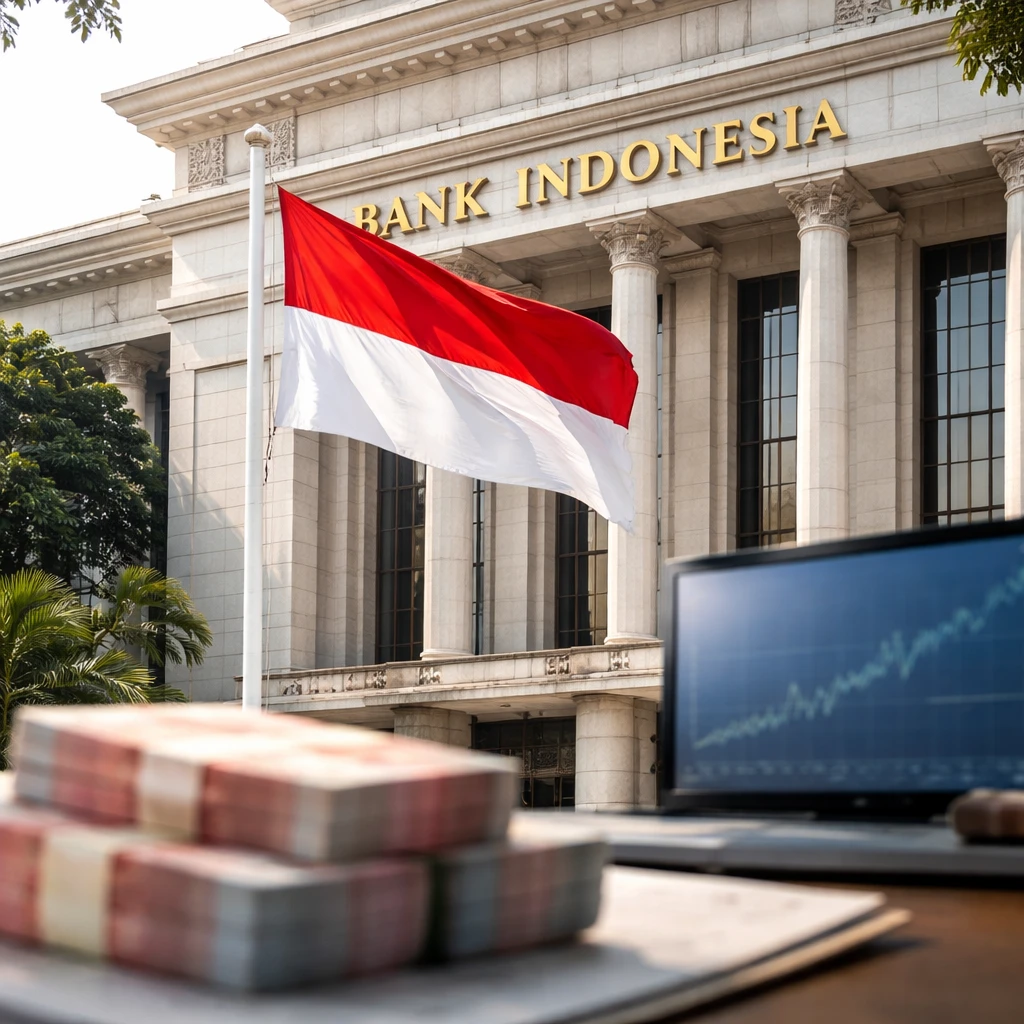
Bank Indonesia held its policy rate steady at 4.75% on Thursday, delivering a fifth consecutive meeting without any adjustment. The central bank said the decision was aimed at supporting the rupiah while maintaining a cautious approach to policy settings.
The result was widely predicted by market participants. In a poll of analysts conducted by LSEG, 27 out of 29 respondents forecast that Bank Indonesia would keep the rate unchanged; only two analysts expected a 25 basis point cut.
This meeting was notable for the participation of Thomas Djiwandono, who attended as Deputy Governor for the first time. Mr. Djiwandono is identified in public reporting as President Prabowo’s nephew. Some market observers interpreted the decision to hold rates as a potential positive indication of the central bank’s independence.
Despite the hold, the central bank’s board reiterated an easing bias in its messaging. Analysts tracking the bank’s stance have noted that the bias leaves open the prospect of future rate reductions, but they link any move to the behavior of the rupiah. Specifically, analysts say that if the rupiah stabilizes in the coming months, a restart of the monetary easing cycle appears more likely than not.
The central bank’s choice to prioritize the currency while signalling a readiness to ease when conditions permit reflects a balancing act between supporting the exchange rate and retaining optionality on broader monetary stimulus. Observers and market participants will be watching exchange-rate developments closely in the near term as a key determinant of any shift in policy direction.
Summary
- Bank Indonesia maintained the policy rate at 4.75% for a fifth meeting.
- The decision matched the expectations of 27 of 29 analysts polled by LSEG.
- The meeting was the first with Thomas Djiwandono serving as Deputy Governor; the board maintained an easing bias.
Context and market view
Market participants interpreted the unchanged rate as consistent with the central bank’s stated priority of supporting the rupiah, while the continued easing bias leaves the door open for lower rates should currency conditions improve.