
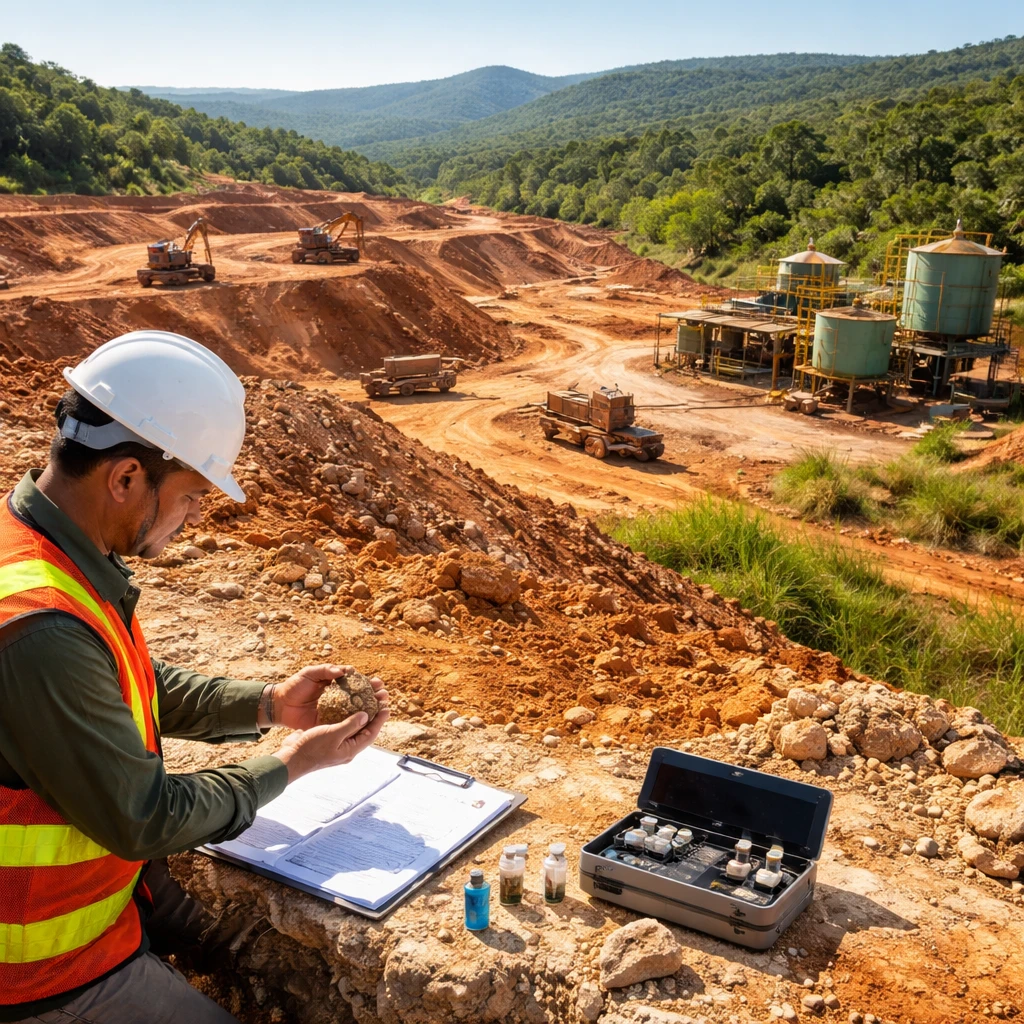
Brazil holds one of the largest known endowments of rare earth oxides, yet it plays a marginal role in global supply. The contrast stems not from geology but from where value is captured along the mineral chain - and from policy, financing and industrial shortfalls that prevent the country from advancing beyond the mine gate.
At the global level China maintains a dominant position in the technically demanding separation phase that turns mined concentrate into usable oxides. China controls about 49% of global reserves, and it produces roughly 69% of unseparated rare earth oxide output. It undertakes most light rare earth separation and all heavy rare earth separation, and that control extends further downstream into alloying and permanent magnet manufacture.
By comparison, Brazil is estimated to hold about 23% to 24% of global rare earth oxide reserves - equivalent to roughly 21 million tonnes, according to U.S. Geological Survey data - but it supplies less than 1% of global output. This gap between resource endowment and market share largely reflects structural constraints rather than a lack of raw material.
Mining itself captures a relatively small slice of total rare earth value. Estimates indicate mining accounts for roughly 10% to 20% of the full value chain, while separation and refining contribute about 40% to 50%, and permanent magnet production represents another 30% to 40%. Brazil’s industry remains concentrated almost entirely in the upstream, leaving most value-added stages unserved domestically.
Serra Verde, the country’s only commercial-scale rare earth operation, has been the primary driver of recent export growth. Even so, national output is small relative to global demand and to the potential implied by reserve estimates.
Geology offers Brazil a comparative advantage in certain deposit types. Ionic adsorption clay deposits - where rare earth elements are loosely adsorbed to clay particles rather than locked into hard rock - can lower mining costs and simplify plant design. These deposits may also reduce energy use and lower upfront capital needs compared with other deposit types. A pipeline of projects, particularly in ionic clays, is progressing from exploration into pilot and development phases.
Policy attention has increased: in recent years Brazilian authorities have begun to treat rare earths as strategic minerals, directing public capital and coordinating regulatory efforts. That activity, however, has not yet overcome other binding constraints.
Financing is a central bottleneck. Brazilian firms cannot use mining rights or future production as collateral, which limits access to domestic credit and raises reliance on external funding. Public institutions such as BNDES and Finep have launched programs aimed at strategic minerals, but eligibility rules restrict which projects can tap those resources.
Critically, the sector lacks an integrated national strategy that ties extraction to processing and manufacturing. Without domestic separation, refining and metallization capacity, Brazil cannot capture the higher-margin segments of the value chain - the stages that account for the bulk of value added in rare earths.
China’s concentration of processing capacity underscores the fragility of the current global supply chain. Whether Brazil can evolve into a meaningful alternative supplier depends less on its reserve figures and more on its ability to develop processing infrastructure, secure sustained investment, and sequence project development beyond mining into separation and downstream production.