
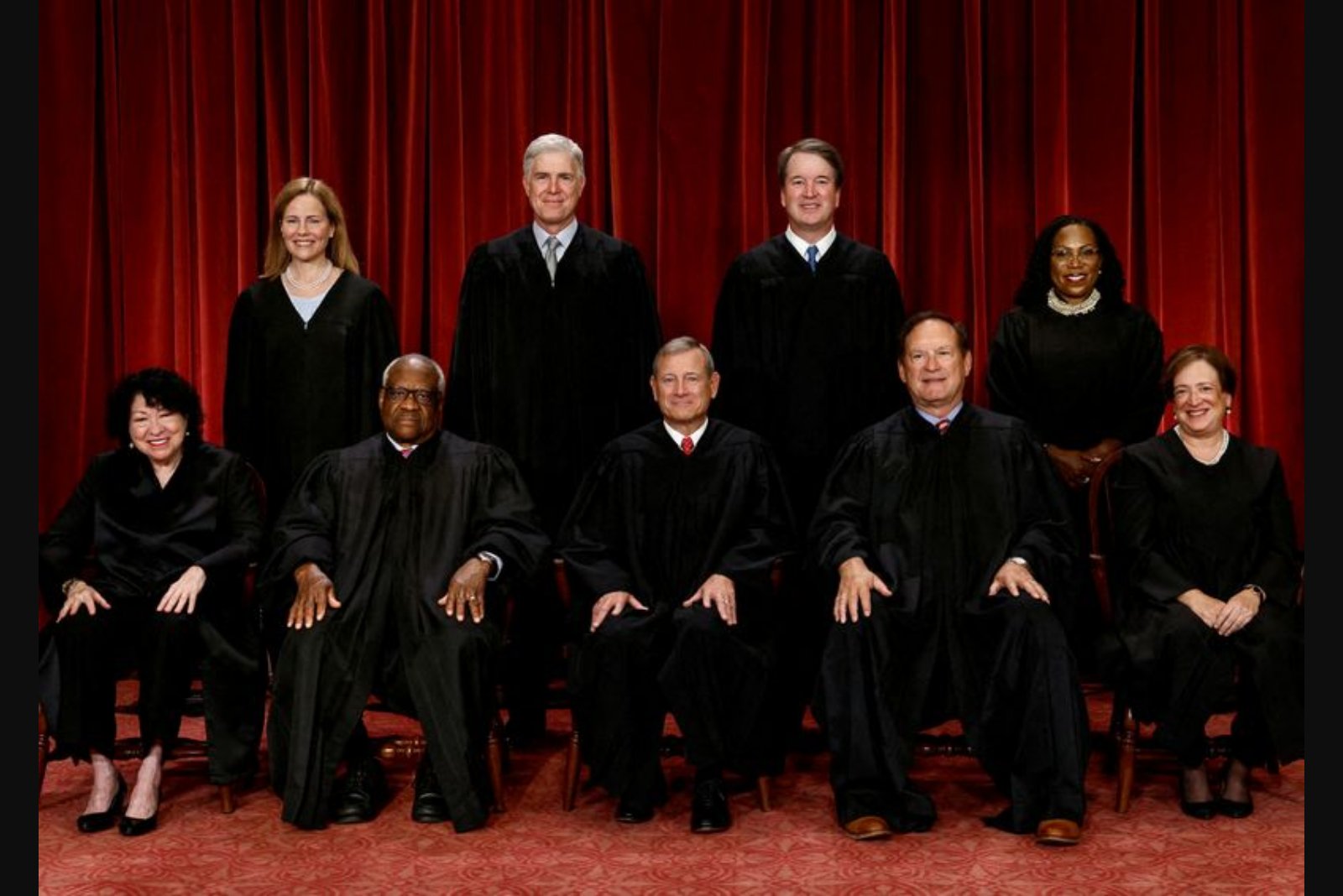
When asked about the possibility that Justices Samuel Alito or Clarence Thomas might leave the bench, the president expressed a clear wish that the two oldest members of the Supreme Court remain in place. He said he hoped they would "be around a long time," that they would "stay healthy," and called them "great people." Both justices sided with him in a dissent to the Court's 6-3 ruling that struck down his sweeping global tariffs.
Alito, aged 76, and Thomas, 77, have not offered any public signals that they plan to vacate their lifetime posts on the nation’s highest court. They did not respond to questions about whether they intended to retire this year. Nonetheless, discussion among legal observers and political analysts has intensified as both men near the average retirement age for justices since 2000 - roughly 80 years old - and as the midterm contests approach in November. Any vacancy would present the president with an opportunity to nominate a fourth justice to the Court.
Current composition and the prize of a vacancy
The president has already made three appointments during his first term, resulting in a 6-3 conservative majority on the Supreme Court. That alignment has steered American jurisprudence to the right on a variety of issues since 2020. Replacing either Alito or Thomas with another conservative would not alter the Court's overall ideological tilt, but it could allow for a younger conservative jurist to be installed - one who might serve for decades.
The Constitution gives the Senate the authority to confirm presidential judicial nominations. Republicans currently hold a majority in the Senate, but control of the chamber could shift following the upcoming congressional elections. If the opposing party were to take control of the Senate, it could be expected to oppose and potentially block a president’s nominee to fill any vacancy created by retirement or death.
Legal scholars note that the opportunity for the president to nominate judges with a friendly Senate could narrow if electoral outcomes change by the end of the year. One former Justice Department lawyer observed that a conservative justice would likely prefer to step down when an originalist successor - a judge committed to interpreting the Constitution according to its original meaning - was poised to follow, and that time is most likely while both the presidency and Senate are aligned with their ideological preferences.
Why political timing matters
In recent decades, the decision of when to retire from the Supreme Court has increasingly factored in political considerations in addition to age and health. The political alignment of the White House and the Senate at the moment of a vacancy can determine whether a successor reflects the departing justice’s ideology.
There are historical examples where timing shaped the Court's composition: a justice who retired amid health concerns opened the door to a successor from a different ideological background, and other departures occasioned contentious confirmation fights or strategic refusals to consider nominees. Justices who have remained on the bench through administrations of an opposing party have, in some cases, been seen as shaping future legal outcomes by their timing choices.
Where Alito and Thomas stand
Observers have directed more retirement speculation at Justice Alito than at Justice Thomas. Some court watchers point to several signs that could indicate Alito may be preparing for an eventual departure - though none is definitive. Alito authored the landmark 2022 opinion that overruled the 1973 decision recognizing a constitutional right to abortion, a ruling that many expect will define his legacy. That decision is often cited as his defining contribution to the Court’s recent jurisprudence, along with his influence on issues from affirmative action to gun rights to presidential power.
Alito has completed 20 years on the bench. He joined the Court in 2006 after being appointed by President George W. Bush. Chief Justice John Roberts also reached the 20-year mark last September.
Justice Thomas, appointed in 1991 by President George H.W. Bush, has a different set of chronological milestones looming. He is on course next month to become the second-longest-serving justice in Supreme Court history, trailing only Justice William O. Douglas, who served from 1939 to 1975. Thomas’s tenure has spanned more than three decades and he remains a central figure in conservative jurisprudence.
Neither Alito nor Thomas has publicly reported serious health concerns. Each was briefly hospitalized in recent years: Alito was treated for dehydration after feeling ill during an event in Philadelphia but returned to work the following Monday; Thomas missed arguments in 2022 when he was hospitalized with flu-like symptoms. Beyond those incidents, there are no public indicators of significant health problems for either justice.
Broader Court demographics and retirement expectations
The Court includes two other justices in their seventies: Chief Justice John Roberts and Justice Sonia Sotomayor, both aged 71. Among the Court’s liberal bloc, Sotomayor, Elena Kagan (65), and Ketanji Brown Jackson (55) are not expected to retire in the near term. Likewise, the president’s three appointees - Brett Kavanaugh (61), Neil Gorsuch (58) and Amy Coney Barrett (54) - are not seen as likely to step down soon.
Since 2000, five justices have retired while three have died in office. Among retirees, the oldest to leave was Justice John Paul Stevens, who stepped down at age 90 in 2010. The youngest retiree this century was Justice David Souter, who departed at age 69 in 2009. Chief Justice William Rehnquist died at age 80 in 2005, and was succeeded by John Roberts. Justice Antonin Scalia died at age 79 in 2016 and was replaced by Neil Gorsuch in 2017 after the Senate declined to consider a nominee in the final year of an outgoing president’s term. Justice Ruth Bader Ginsburg died at age 87 in 2020; her decision not to retire during an earlier administration became a focal point of debate over the strategic timing of departures.
A longstanding lesson cited by commentators is that the timing of retirement can have consequences for the ideological composition of the Court for years to come. Some academics suggest that the memory of prior decisions about when to step down still hangs over the choices of current justices.
Voices within conservative circles
Public calls from conservative commentators urging Alito or Thomas to retire have been muted. By contrast, liberal pressure once mounted on a senior liberal justice to vacate the bench before an election so that a like-minded successor might be confirmed; that justice ultimately retired, enabling a change on the Court.
Some conservative voices have signaled that, while they admire both Alito and Thomas and do not wish to advise them personally, the political environment could be right for one or both to consider stepping down if the goal is to secure another conservative appointment. One commentator, speaking on a podcast, described Alito and Thomas as "the two greatest justices on the U.S. Supreme Court" and added that, from a risk-averse strategic perspective, the present was as good a time as any for one or both to step aside, noting the reality that justices will not live forever.
A former clerk to Justice Thomas, now a law professor, said he expected that public calls from conservatives for either justice to retire would remain subdued so long as they have the support of the president. He observed that the broader movement aligned with the president tends to follow public signals set by him, and that calls for retirement have been quiet in the absence of such a signal.
Signals and practical constraints
Analysts have noted practical indicators that might hint at a justice's plans without constituting proof. For example, the planned publication of a justice's book has been pointed to as a potential sign of forthcoming retirement because it is difficult to promote a new title during the Court's argument term. Justice Alito’s forthcoming book, "So Ordered: An Originalist’s View of the Constitution, the Court, and Our Country," is scheduled for release on October 6. That publication date, which falls one day after the start of the Court’s next nine-month argument term, could limit the justice’s ability to do promotional appearances as a sitting member of the Court, according to some observers.
Still, such scheduling facts do not amount to a definitive indicator of imminent retirement. The decision to leave the bench is an individual one, shaped by personal, institutional, and political considerations. Observers acknowledge that any inference based on a single signal should be treated cautiously.
Implications of a vacancy
If either Alito or Thomas were to depart, the president would have the opportunity to nominate a successor who could potentially serve for decades, thereby extending the current conservative approach on the Court. The confirmation process would depend on Senate control at the time a nomination is made; a Senate majority aligned with the president would increase the odds of confirmation, while an opposition-controlled Senate could block or delay a nominee.
For conservatives seeking to preserve and extend originalist jurisprudence on the Court, the political calculus of retirement is straightforward: encourage departures when a successor likely to follow the same interpretive approach can be confirmed. For those of different legal philosophies, the opposite is true - the timing of retirements represents a period of vulnerability for the jurisprudential direction of the Court.
Conclusion
As Justices Alito and Thomas continue on the bench with no explicit retirement plans, their ages and recent jurisprudential contributions keep the issue of possible vacancies live in legal and political circles. The interplay between personal health, legacy-defining rulings, publication schedules, and the electoral calendar has converged to make the next vacancy - should one arise - a decisive moment for the Supreme Court and for the broader legal order.
Until a justice announces a departure or other definitive signal emerges, speculation will remain a prominent feature of political and legal discourse. What is clear is that the timing of any retirement would carry consequences well beyond the immediate replacement, shaping the Court's makeup for years to come.