
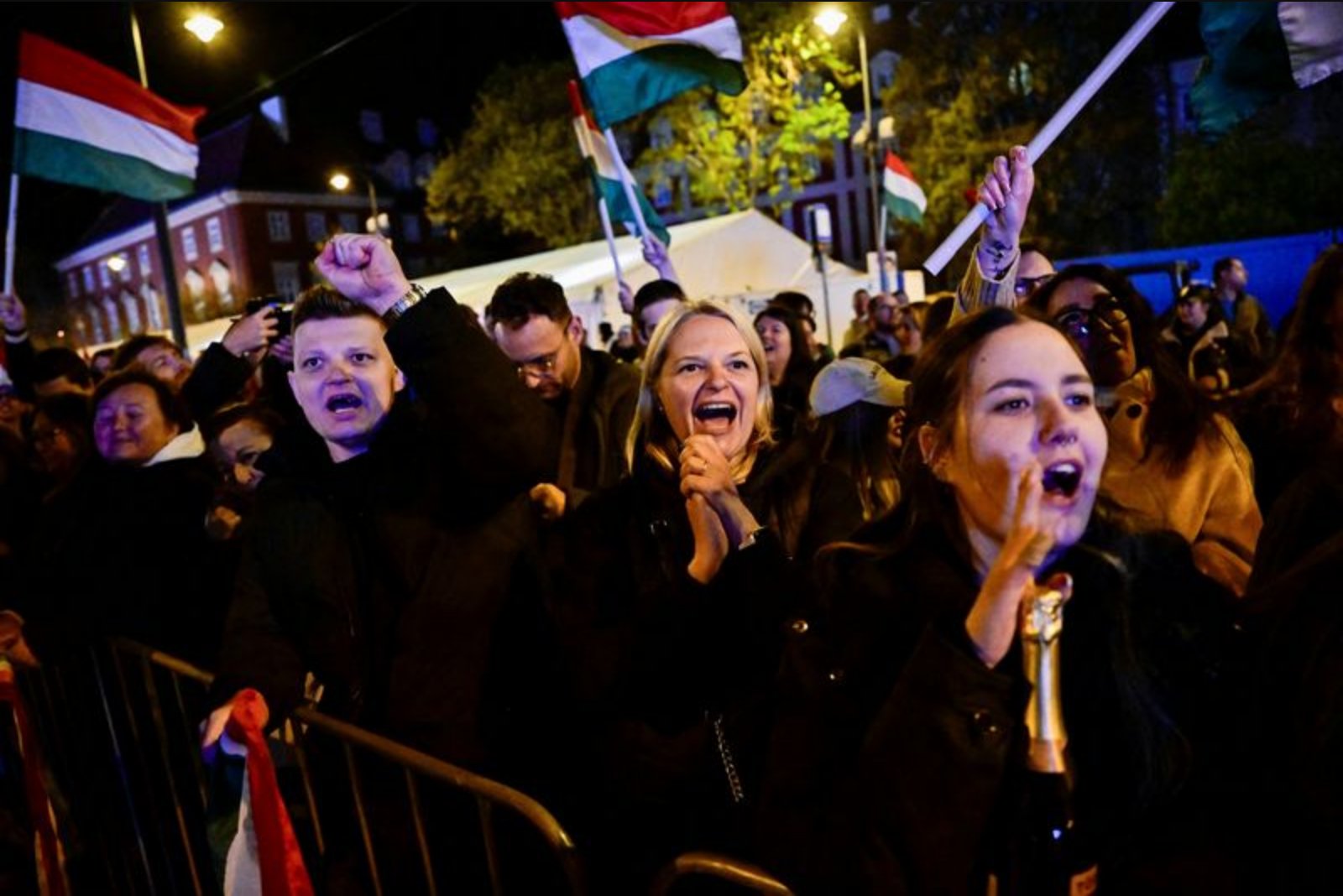
Viktor Orban conceded on Sunday night after preliminary returns indicated a sweeping victory for the opposition Tisza party, a result that marks the likely end of his 16-year tenure. With 81.5% of votes tallied, the centre-right, pro-EU coalition led by Peter Magyar was reported to have won 137 seats in Hungary's 199-member parliament, enough for a crucial two-thirds majority and an emphatic defeat for Orban’s Fidesz party.
Speaking at his party’s campaign headquarters, Orban, 62, said: "The election results are not final yet, but the situation is understandable and clear." Some Fidesz supporters who had gathered outside the offices wept as they watched his remarks on television screens. "The election result is painful for us, but clear," he added.
Election officials estimated turnout at a record 79% or higher in a vote that many Hungarians framed as a turning point for the country. Peter Magyar, 45, who led the Tisza campaign, cast the choice before voters as one between "East and West," arguing that Orban’s combative posture toward Brussels had pushed Hungary away from the European mainstream.
Orban pushed back against that framing, warning that the Tisza alliance would drag Hungary into an unwanted war with Russia - an allegation Magyar denied.
At the Tisza election night event, 24-year-old Dorina Nyul described the atmosphere: "It’s incredibly exciting. It feels like this is our first and last chance in a really long time to actually change the system. And it’s, I can’t even describe the feeling." Her remarks captured the sense of urgency among many voters who turned out in large numbers.
Analysts and officials noted that the consequences of Orban’s departure would extend beyond domestic politics. The likely change of government could end Hungary’s recent adversarial stance within the European Union and open the way for a previously blocked 90 billion euro loan to war-damaged Ukraine. That loan had been held up while Budapest opposed certain EU positions.
Defeat for Orban could also clear a path to the release of EU funds to Hungary that Brussels had suspended, citing concerns that democratic standards in the country had eroded under his leadership. After partial results were published, European Commission President Ursula von der Leyen said: "Hungary has chosen Europe. Europe has always chosen Hungary."
Observers suggested Orban’s exit would remove one of Moscow’s principal allies inside the EU and reverberate through right-wing political networks in the West, including supporters in the White House.
Inside Hungary, a Tisza-led government says it will pursue institutional repairs it argues are needed to tackle corruption and to restore judicial independence and the autonomy of other public bodies. Those pledges formed a central pillar of the party’s campaign messaging.
Orban, a eurosceptic who over the past decade and a half implemented a governing model he has described as "illiberal democracy," had become a reference point for similar movements abroad. Yet the article’s reporting indicates growing domestic dissatisfaction with his rule after three years of economic stagnation, a spike in living costs, and reporting that oligarchs close to the government had increased their wealth.
During the campaign, Orban received public endorsements from high-profile international figures and administrations, including backing from elements of the U.S. administration in recent weeks, culminating in a visit to Budapest by the U.S. Vice President last week, as well as support from Moscow and some far-right European leaders.
However, his campaign was unsettled by media reports alleging that his government had cooperated with Russia on diplomatic and political matters. Orban has denied any wrongdoing, saying his objective was to protect Hungary’s national identity and traditional Christian values within the EU, and to safeguard the country’s security in a dangerous world.
For markets and policy watchers, the election outcome introduces immediate questions about the flow of EU budgetary transfers and larger geopolitical alignments. The potential unblocking of major funding for Ukraine and the resumption of previously suspended aid to Hungary would directly affect public finance, cross-border assistance programs, and related sectors that depend on EU disbursements.
Domestically, a change in government could lead to institutional reform efforts with implications for legal certainty, anticorruption measures, and the business environment. Those shifts would be relevant for investors and companies operating in Hungary, particularly in sectors sensitive to regulatory and judicial independence.
At the same time, lingering allegations about ties with Moscow and the uncertainty around final certification of results underscore ongoing political and reputational risks for Hungary’s international relationships and its domestic economic trajectory.
How these developments translate into policy will hinge on formal confirmation of the results and the new coalition’s ability to implement its agenda. For now, provisional returns and strong turnout point to a meaningful change in direction after nearly two decades under Orban’s leadership.