
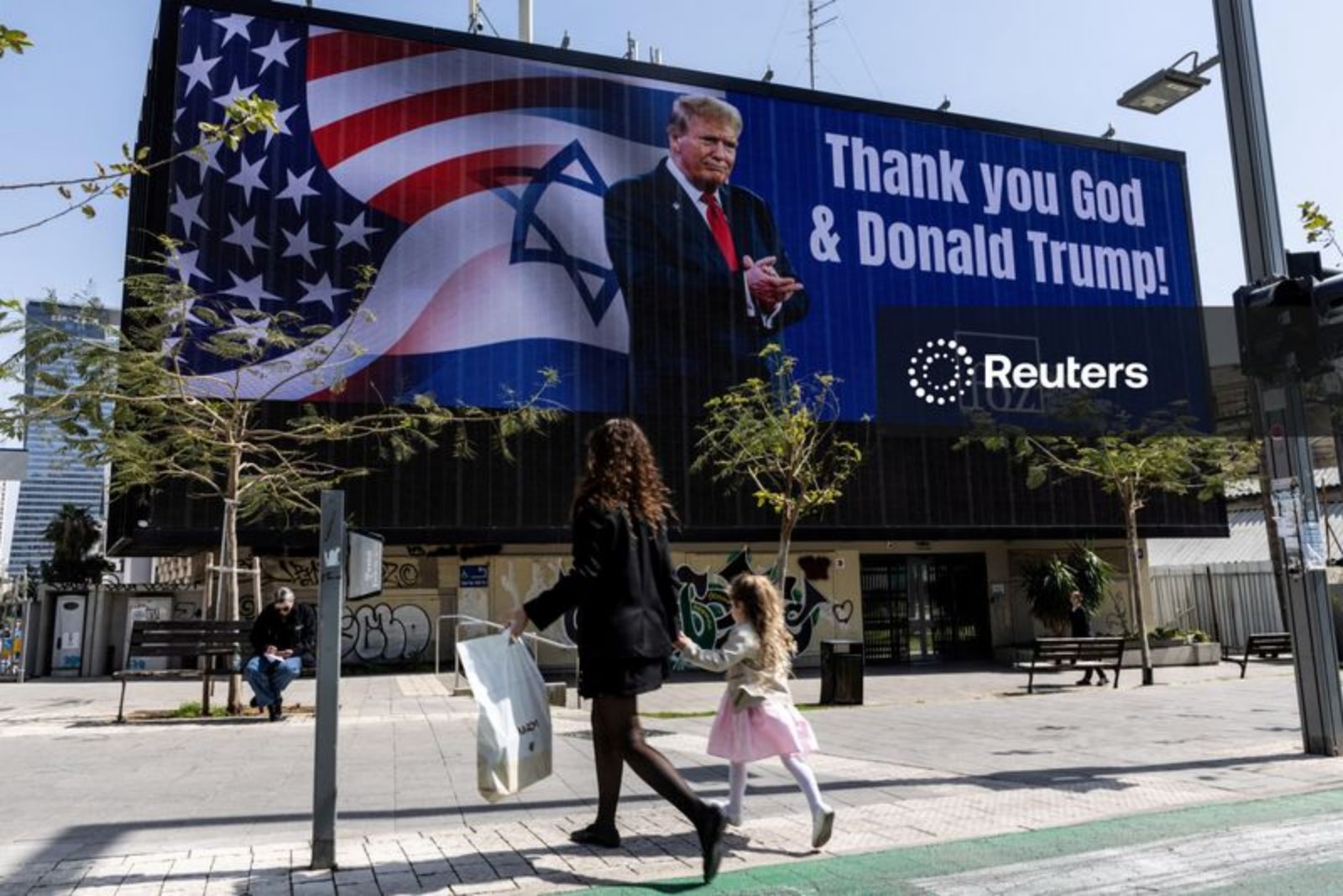
President Donald Trump and several allied conservative Christian leaders have leaned into overtly religious rhetoric to frame the United States' military actions in Iran, presenting the confrontation as a contest rooted in biblical concepts of good and evil.
The administration’s messaging strategy has intensified in recent days, even as Americans grow less supportive of the campaign. The president on Tuesday announced a two-week ceasefire, and officials have continued to characterize recent battlefield events in religious language. Trump called the rescue of a downed U.S. airman inside Iran an "Easter miracle" and suggested some U.S.-Israeli strikes carry God’s blessing.
Defense Secretary Pete Hegseth has used scripture to defend the use of severe force, explicitly endorsing what he described as "overwhelming violence" against foes he said "deserve no mercy." That tone has been reflected from high-profile pastors with ties to the White House to smaller local clerics, many of whom emphasize the biblical resonance of the modern state of Israel for evangelical audiences.
Evangelical leaders portraying the conflict in religious terms point to the scriptural narratives that cast present-day struggles as part of a larger spiritual story. Jackson Lahmeyer, an evangelical pastor, Trump supporter and congressional candidate, said he has told his Tulsa, Oklahoma, congregation that wars often present a struggle between good and evil and that Iran fits that pattern. "Evil people exist, and if you don’t deal with them, they’ll deal with you," he said. "Good and evil, that’s the story of the Bible. The good news is that at the end good always wins."
White evangelicals are a substantial component of the president’s political base: exit polls indicated more than 80% voted for him in 2024, and surveys have suggested they make up roughly one-third of his supporters. Political and religious experts say that composition helps explain why the White House and members of the cabinet have increasingly employed religious language when discussing the conflict.
Jim Guth, a political science professor who studies religion in U.S. politics, framed the calculation plainly: with the president’s approval ratings showing he commands slightly more than a third of public support, a disproportionate share of that core constituency consists of white evangelical Christians. That, experts say, creates a strong incentive to address that audience directly through faith-oriented rhetoric.
The White House has not responded to questions about the religious framing, but a spokeswoman said in a statement that the president had taken bold action "to eliminate the threat of this terrorist regime, which will protect the American people for generations to come."
Scholars and observers note that invoking Christian faith in wartime is not without precedent among U.S. presidents. Still, several commentators argue that the present administration’s explicit linkage of military violence and religious mission - including uncompromising language that leaves little room for moral ambiguity - represents a distinct tone.
John Fea, a history professor who has written extensively on evangelicals and politics, compared the language to medieval crusading rhetoric, saying: "It’s the same language as the crusades of the Middle Ages. You know, we must stop the infidel, we must defeat the wicked." He added, "We’ve never seen anything like this in American history."
The use of overtly religious messaging has drawn public criticism from Democrats and from Christian leaders on the left who view it as an inappropriate invocation of faith to support a controversial military campaign. Those critics have pointed to the human and geopolitical costs of the confrontation: the war, now several weeks old, has coincided with rising energy prices, resulted in the deaths of American service members and thousands of Iranians, and contributed to a decline in the president’s standing among voters.
Addressing worshippers gathered in St. Peter’s Square on Palm Sunday, a pontiff identified in public remarks as Pope Leo denounced the conflict as "atrocious" and warned that the name of Jesus should never be used to propagate war. Progressive evangelical voices have echoed concerns that the administration is deploying a targeted Christian narrative to hold evangelical support and prevent fragmentation within the Make America Great Again coalition.
Doug Pagitt, a progressive evangelical pastor, said he believes that narrative aims to reassure the evangelical base that the president is on God’s side. "What they are saying is Trump is on God’s side. You can rest easy at night," he said. "Because without the Christian coalition, the MAGA support base gets very fractured."
Public sentiment about military strikes on Iran shows broad skepticism. A recent poll indicated 60% of respondents opposed U.S. military strikes, while revealing a sharp partisan split: 74% of Republicans expressed support for the strikes compared with 22% of Democrats.
Religious leaders supportive of the administration’s approach have used biblical analogies to praise recent actions. Franklin Graham, a prominent evangelist, framed the strikes in biblical terms and compared the president to the biblical figure Esther, who is depicted in scripture as a Jewish queen elevated by God to save her people from annihilation in ancient Persia - a region corresponding to modern-day Iran.
Ken Peters, who leads the Patriot Church in Tennessee, conveyed to his congregation a similar interpretation, expressing hope that the conflict could ultimately produce a "pro-Israel, pro-America Iran." That remark drew applause in a service and was captured on a video recording the pro-Trump pastor shared.
Defense Secretary Hegseth, in his public remarks, likened the rescue of the downed American pilot to the resurrection of Jesus on Easter Sunday, saying: "A pilot reborn, all home and accounted for, a nation rejoicing," and adding, "God is good."
When asked to comment on the administration’s religious language, a senior Pentagon spokesman noted that wartime leaders have long invoked Christian faith, citing historical examples and underscoring that Secretary Hegseth is, like many Americans, a practicing Christian. "Secretary Hegseth, along with millions of Americans, is a proud Christian. Encouraging the American people to pray for our troops is not controversial," the spokesman said.
Religious messaging continued at a White House Easter event that included conservative faith leaders. Televangelist Paula White-Cain, a senior adviser to the White House Faith Office, drew a parallel between the president and Jesus, asserting both had been "betrayed and arrested and falsely accused." Robert Jeffress, pastor at First Baptist Church in Texas and among the faith leaders who participated in the White House event, said he did not view the conflict as an attack on Islam or Muslims but instead as "a spiritual war between good and evil, between the kingdom of God and the kingdom of Satan."
The administration’s increasingly religious framing of the conflict underscores how tightly intertwined faith-based appeals are with the president’s political strategy. With strong evangelical support constituting a large portion of his base, the blending of military messaging and religious imagery appears aimed at maintaining coalition cohesion even as public opposition and the human toll of hostilities create political and economic headwinds.
Summary: The Trump administration and allied evangelical leaders have framed recent military actions in Iran using explicitly Christian language, portraying the conflict as a moral or spiritual struggle. This rhetoric is intended in part to sustain support among white evangelical voters, a key element of the president’s base, despite broad public opposition to strikes and rising economic consequences tied to the conflict.
Key points:
- Senior officials and prominent evangelical pastors have described the Iran conflict in biblical terms, calling events such as the rescue of a downed airman an "Easter miracle" and suggesting divine approval for certain strikes.
- White evangelicals remain a central pillar of the president’s political coalition, with exit polls showing more than 80% voted for him in 2024 and surveys indicating they represent about one-third of his supporters; this demographic reality shapes the administration’s messaging choices.
- The conflict has produced economic and political effects: it has contributed to higher energy prices and has coincided with casualties among U.S. service members and large numbers of Iranian deaths, while public opinion polling shows majority opposition to U.S. strikes and a pronounced partisan split.
Risks and uncertainties:
- Public opposition to military strikes is substantial, which risks broader political backlash and could affect support for the administration across the electorate - a political risk with implications for governance and policy.
- Rising energy prices linked to the conflict pose economic risks, potentially affecting markets and sectors sensitive to fuel costs such as transportation and manufacturing.
- Religious framing of military action may deepen social and political polarization, potentially destabilizing the coherence of coalitions that drive legislative and electoral outcomes.