
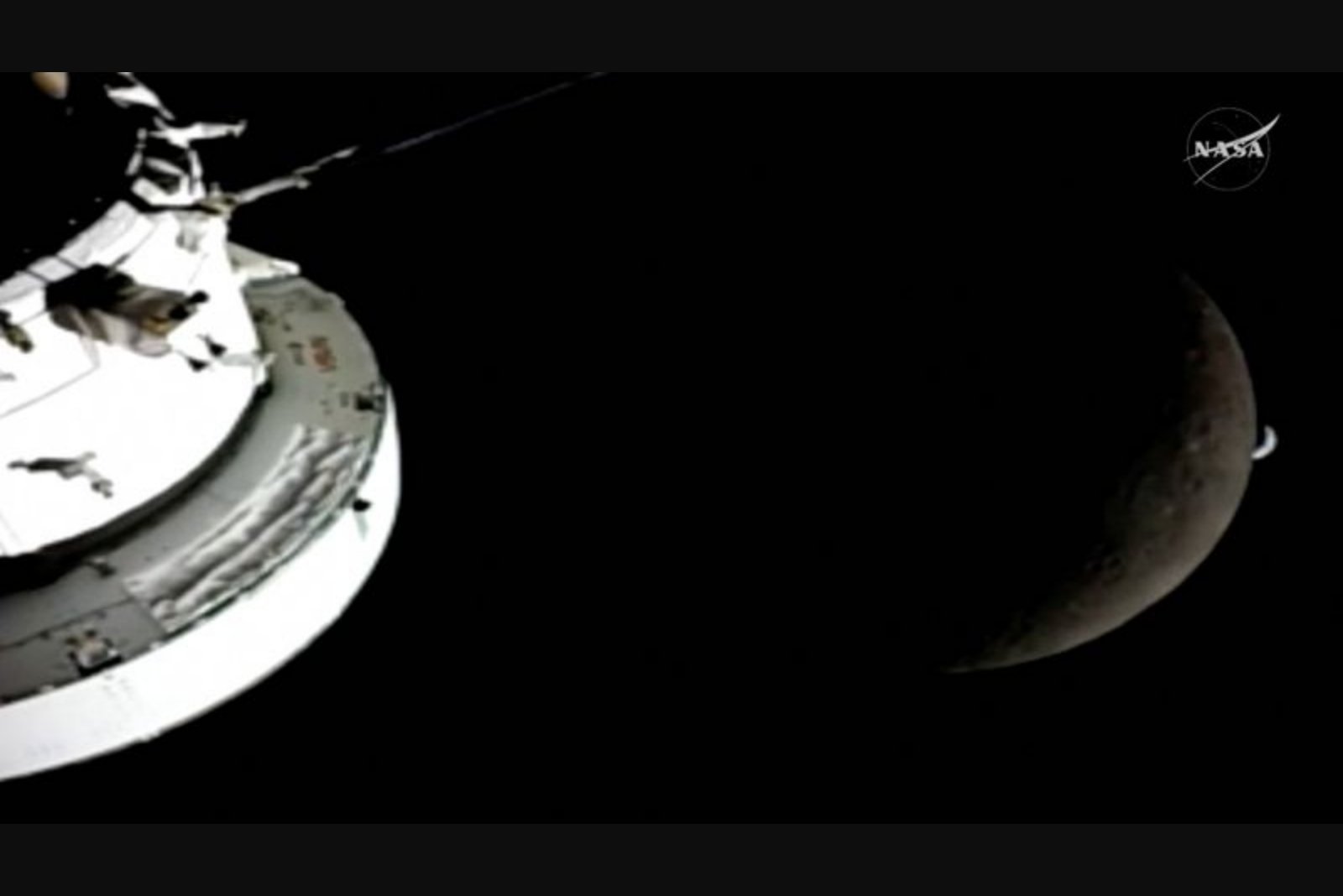
The four-member Artemis II crew reached a new human distance milestone on Monday, traveling farther from Earth than anyone before them as their Orion spacecraft executed a six-hour survey of the Moon’s far side. The passage offered direct visual evidence of meteoroid impacts on the heavily cratered, shadowed hemisphere of Earth’s only natural satellite.
Scientists in a conference room adjacent to mission control at NASA’s Johnson Space Center in Houston watched in real time as the astronauts, riding inside an Orion capsule about the size of an SUV, transmitted observations from roughly a quarter million miles - about 402,000 km - from Earth. During the roughly six-hour flyby the crew recorded so-called impact flashes, bright streaks and sparks produced when meteors struck the lunar surface.
The flyby took the spacecraft to within 4,070 miles of the lunar surface and occurred on the sixth day of a mission that marks the first time astronauts have traveled to the vicinity of the Moon since the Apollo program more than half a century ago. Between 1969 and 1972, six Apollo missions landed two-person teams on the Moon - the only 12 people to have walked there to date.
Artemis is positioned as a successor to Apollo with ambitions to return humans to the lunar surface by 2028 and to build a persistent U.S. presence on the Moon over the following decade, including a potential lunar base to serve as a proving ground for possible future missions to Mars.
Although Artemis II is intended primarily as a crewed dress rehearsal for later lunar landings, the mission already has produced substantive scientific observations. The meteor impact flashes photographed during Monday’s transit resembled the brief bursts of light noted by some Apollo astronauts, providing fresh material for lunar researchers to analyze.
The crew woke on Monday morning to a pre-recorded message from the late NASA astronaut Jim Lovell, who flew on Apollo 8 and Apollo 13 and who died last year at age 97. In the message Lovell said, "Welcome to my old neighborhood. It’s a historic day, and I know how busy you’ll be, but don’t forget to enjoy the view... good luck and Godspeed."
Hours later the four-person crew - U.S. astronauts Reid Wiseman, Victor Glover and Christina Koch, together with Canadian astronaut Jeremy Hansen - set a new human distance record when Orion reached 252,756 miles from Earth. That surpassed the prior human distance record of roughly 248,000 miles, set in 1970 by Apollo 13 after a near-catastrophic spacecraft malfunction forced that crew to use the Moon’s gravity to assist their return to Earth.
While passing to the Moon’s far side the astronauts took time to assign provisional, informal names to lunar features that previously lacked official designations. In radio transmissions to mission control Hansen proposed naming one crater Integrity, after the crew’s Orion capsule, and suggested another be called Carroll, in honor of the late wife of commander Reid Wiseman, who died of cancer in 2020.
"A number of years ago we started this journey, our close-knit astronaut family, and we lost a loved one," Hansen said, his voice choking with emotion as he described the proposed location of Wiseman’s lunar namesake. "It’s a bright spot on the Moon, and we would like to call that Carroll."
Hansen later told mission control that the crew had observed a number of lunar features "no human has ever seen before, not even in Apollo." As Orion swept around the darkened hemisphere, the astronauts photographed moments in which Earth, diminished by the record-breaking distance, set and rose along the lunar horizon - an inversion of the familiar Moon-rise and Moon-set phenomena seen from Earth.
Because the Moon is tidally locked to Earth, the same near side always faces our planet and the far side remains hidden from terrestrial view. Only the crews on Artemis II and on Apollo-era missions have looked directly at that hemisphere.
The lunar flyby plunged the crew into darkness and triggered a roughly 40-minute communications blackout while the Moon blocked direct radio links to NASA’s Deep Space Network - the global array of large antennas the agency uses to maintain contact with deep-space missions.
Following the flyby, the astronauts appeared on camera by live satellite feed and accepted congratulations from U.S. President Donald Trump, who spoke to them from the White House. "Today, you’ve made history and made all America really proud, incredibly proud," Trump said. "You’ve really inspired the entire world. Really, everybody’s watching." Koch told the president that one of her most indelible memories from the flyby was "coming back from the far side of the moon and having the first glimpses of planet Earth again." When asked how it felt to be out of communication as Orion passed behind the Moon, Glover replied, "I said a little prayer, but then I had to keep rolling."
Scientists who observed the crew’s live reports emphasized the rarity of the data captured during the transit. The combination of direct human observation and high-resolution photography from the Orion capsule provides material that mission teams and planetary scientists can study to better understand meteoroid impacts on the lunar surface and to map terrain that has been out of reach of ground-based telescopes.
As Artemis II continues its mission, the data gathered during Monday’s far-side survey will become part of a broader effort to validate crewed operations beyond low Earth orbit and to inform planning for future missions that aim to land astronauts on the Moon once more and to develop longer-term infrastructure there.
Context and next steps
The Artemis II mission is both a symbolic and operational milestone. It demonstrates the ability to carry a crew beyond low Earth orbit, to operate cameras and observational equipment in deep space, and to manage communication interruptions inherent to lunar flybys. The mission’s observations of impact flashes add to the empirical record of how meteoroids interact with the airless, cratered lunar surface.
In the weeks and months ahead, mission teams will analyze the images and telemetry from the flyby, and scientists who were able to watch the live observations will collate their notes and recordings to build a clearer picture of the impacts and terrain captured by the crew. Those analyses will inform not only scientific understanding but also operational planning for lunar surface activity and longer-term human presence on the Moon.