
Hook / Thesis
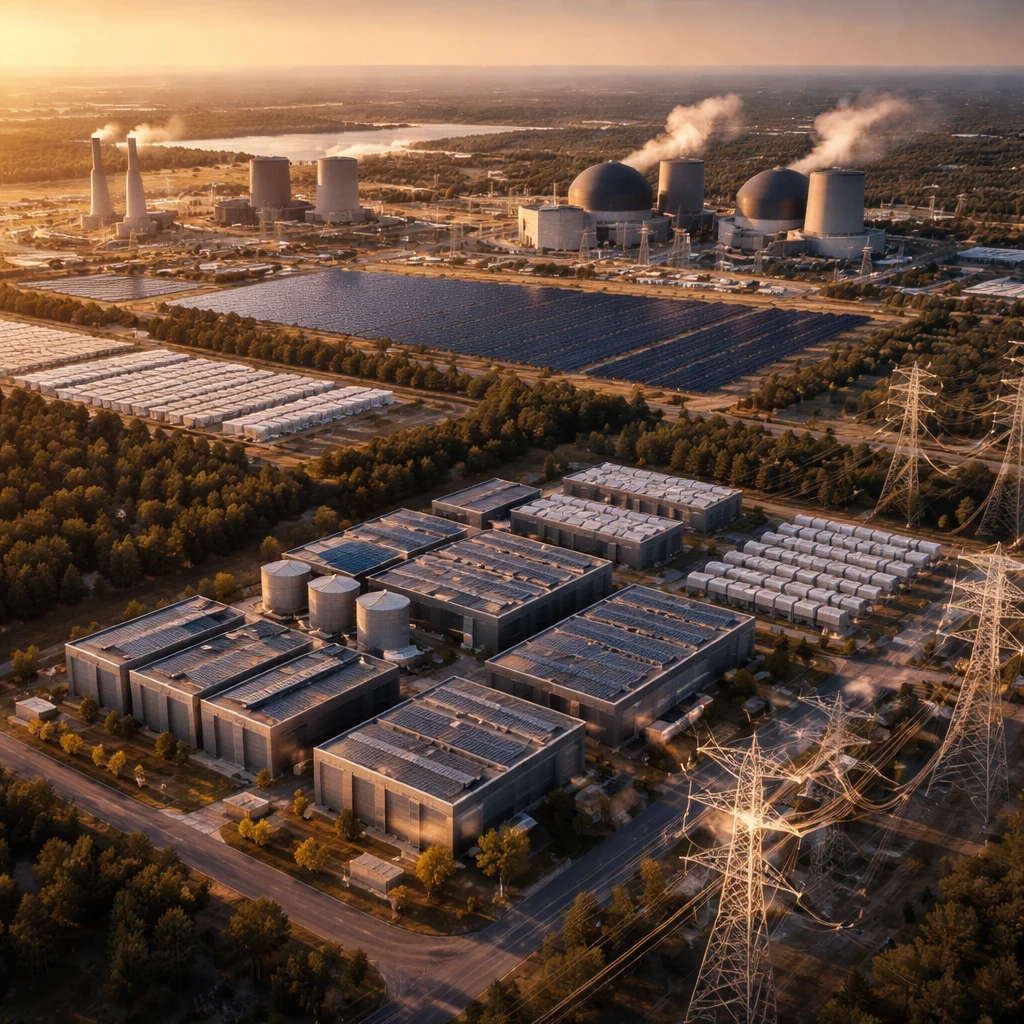
Vistra is no longer just a legacy power generator. Over the past 12-18 months the company has converted scale into strategic optionality: long-duration power purchase agreements (PPAs) with hyperscalers, nuclear supply deals and a growing battery/storage footprint are shifting revenue mix from volatile merchant exposure to contracted, baseload cash flow. The market has already rewarded the transformation — shares have outperformed dramatically over multi-year windows — but uneven near-term sentiment and regulatory noise have created a pullback that looks tradeable.
In plain terms: rising AI data center demand and corporate PPAs provide a clear growth vector that should expand Vistra’s EBITDA and compress headline multiples. That makes a controlled long position attractive now, with a stop to protect against regulatory surprises and a target that assumes multiples move toward a lower, more reasonable level as growth proves out.
What Vistra Does and Why it Matters
Vistra is an integrated independent power producer and retail electricity provider. The company operates roughly 44 GW of diverse capacity (natural gas, nuclear, solar and battery storage) and serves about 5 million retail customers. That scale allows Vistra to sell both wholesale power and long-term contracted energy to large buyers. A recent high-profile example: a multi-gigawatt PPA footprint tied to Meta, which signals the type of multi-decade cash flow Vistra can lock in as AI infrastructure demands firm, 24/7 baseload power.
Why the market should care: AI data centers and other digital infrastructure create predictable, high-utilization demand that favors large, flexible generators and owners of long-duration assets like nuclear and battery storage. Vistra’s ability to sign long-term deals with creditworthy counterparties converts uncertain merchant volatility into contracted revenue streams that are easier to value and finance.
Key numbers that support the thesis
- Market capitalization: about $51.3 billion.
- Enterprise value: approximately $70.8 billion, with EV/EBITDA roughly 13.9x on reported metrics.
- Trailing earnings per share: $2.22; trailing P/E sits near 68x (GAAP); note adjusted EBITDA multiples are lower and more relevant for asset-heavy utilities.
- Free cash flow: $1.318 billion — meaningful cash generation to fund growth and pay down or service debt.
- Balance sheet: debt-to-equity is elevated at ~3.97x and current ratio is 0.68, highlighting leverage and working-capital sensitivity.
- Share range: 52-week high $219.82 and low $90.51, showing volatility and a wide re-rating window.
How the underlying trend turns valuation into an opportunity
At present headline trailing P/E is high because GAAP earnings reflect non-cash items and cyclical effects. The market is instead likely to re-rate Vistra on adjusted EBITDA as contracted revenue grows. Vistra’s EV/EBITDA sits at about 13.9x today — elevated but within a sensible band for a large U.S. generator that is adding contracted, long-duration cash flows. Some outlets have cited adjusted EBITDA multiples closer to 10x for the company after accounting for stable long-term contracts; whether you assume 10x or 14x, the lever is clear: add meaningful contracted EBITDA and you materially improve valuation without relying on a multiple expansion alone.
Technical and market context
Price action shows the stock has pulled back from the $220 area to about $151.60 today. Short-term indicators are neutral-to-bearish: RSI is ~44 and MACD shows bearish momentum. The 10-day SMA is $151.79, 20-day SMA $156.67 and 50-day SMA $160.47, consistent with a corrective phase after a multi-quarter run.
Catalysts (what to watch)
- Delivery and ramp of PPAs with hyperscalers (notably Meta) and any incremental long-term contracts announced - these convert development-driven capex into contracted EBITDA.
- Nuclear plant license extensions and announced upgrades or long-term fuel deals that secure decades of baseload supply, which materially raise visible contracted cash flow.
- Expansion of battery/storage deployments and commercial contracts for ancillary services and capacity markets — higher-margin revenue pockets.
- Quarterly results that show rising adjusted EBITDA and stronger FCF conversion (beat-and-raise type prints).
- Regulatory clarity in key markets (e.g., PJM) that reduces the risk of price caps or retroactive limits on merchant revenue.
Trade plan (actionable)
Stance: Long, tactical position to catch a mid-term re-rating as contracted revenue scales.
Entry: buy at $150.00.
Stop loss: $135.00. This protects the trade against downside triggered by unexpected regulatory action or a material miss on operating results.
Target: $190.00. This represents roughly a 26% upside from entry and assumes modest multiple compression on higher adjusted EBITDA and visible long-term contracts.
Horizon: mid term (45 trading days). I expect the initial re-rating or a meaningful news-driven move (new PPAs, earnings beat, regulatory clarity) within ~45 trading days. If visible EBITDA acceleration becomes confirmed, convert part of the position into a longer-term hold and re-evaluate the stop.
Position sizing & risk management
Limit position size so a full-stop hit equates to a manageable capital loss in your portfolio (e.g., 1-2% of total capital). Given balance sheet leverage and regulatory exposure, this is not a buy-and-forget trade — actively manage into material fundamental news.
Risks and counterarguments
- Regulatory risk: proposed or actual price caps in key markets (PJM and others) can compress merchant margins and force downward revisions to forward EBITDA. A policy change can cause immediate re-rating and justify the stop at $135.00.
- Balance sheet & interest-rate sensitivity: debt-to-equity near 3.97x and a current ratio below 1 (0.68) leave Vistra exposed to funding and working-capital stress if earnings disappoint or capex runs hotter than expected.
- Execution and capex risk: nuclear upgrades, license extensions and large battery rollouts require capital, permitting and timelines. Delays or cost overruns will push out the EBITDA realization the thesis depends on.
- Commodity exposure: while Vistra is shifting to contracted power, fuel (natural gas) and wholesale price volatility can still hit near-term results and cash flow before contracts fully ramp.
- Valuation vulnerability: trailing GAAP multiples are high (P/E near 68x). If the market focuses on GAAP metrics or growth disappoints, multiple compression could wipe out gains even if EBITDA is growing more slowly than expected.
- Short-term technical weakness: momentum indicators are not supportive today; a failing to reclaim the $156-$160 area could invite another leg down, validating the stop and arguing for waiting for a better risk/reward.
Counterargument to the bullish case
One reasonable counterargument is that much of Vistra’s upside is already priced in, and the company’s leverage plus regulatory uncertainty argue for patience. If regulator-driven price caps or capacity-market changes occur, the company’s merchant upside could be structurally impaired despite new PPAs. For investors who want less headline risk, waiting for proof that adjusted EBITDA from contracted deals is showing up in quarterly results (and a lower debt-to-EBITDA ratio) is a defensible alternative to entering now.
Conclusion - what would change my mind
My base case is that Vistra’s deals with hyperscalers, nuclear arrangements and storage deployments will lift adjusted EBITDA meaningfully in the next 6-12 months and that the market will give the company a lower-risk multiple. That justifies a tactical long at $150.00 with a $135.00 stop and a $190.00 target over a mid-term window (45 trading days). I’ll downgrade the trade if any of the following occur: (1) regulators implement binding, retroactive price caps that materially reduce forward merchant revenue; (2) the company guides materially below consensus on contracted EBITDA growth; or (3) execution failures on nuclear and storage expansions push out revenue recognition by multiple quarters.
Conversely, I'll add or roll the position longer if Vistra reports sequential EBITDA growth tied to new PPAs, shows improved FCF conversion (above the $1.318 billion trailing figure), and demonstrates traction in lowering net leverage.
Bottom line
Vistra has transformed into a strategic play on the electrification and AI-driven baseload cycle. Near-term noise and leverage warrant discipline, but the right-sized, stop-protected long captures upside from visible contract-driven growth and the potential for a multiple re-rate as EBITDA becomes more predictable.