
Hook & thesis
Sprouts Farmers Market has been through a difficult earnings arc since late 2025: weaker comparable store sales, a guidance cut and the subsequent headline risk of class-action suits. The sell-off pushed the stock to a valuation that, on the surface, looks disconnected from the company's underlying cash generation and balance-sheet strength. At roughly $77.59 today, Sprouts trades at about 14x reported earnings and an EV/EBITDA near 8.5x while still producing meaningful free cash flow. That combination argues for an upgrade from a tactical perspective.
My base thesis is straightforward: if Sprouts stabilizes comps and stops margin erosion, the market should re-rate the shares toward a mid-teens EV/EBITDA multiple for a specialty grocer with expansion optionality. Given the company's low net leverage and strong returns on capital, downside is contained relative to upside — which is why I'm upgrading the rating and laying out a concrete trade plan below.
What Sprouts does and why investors should care
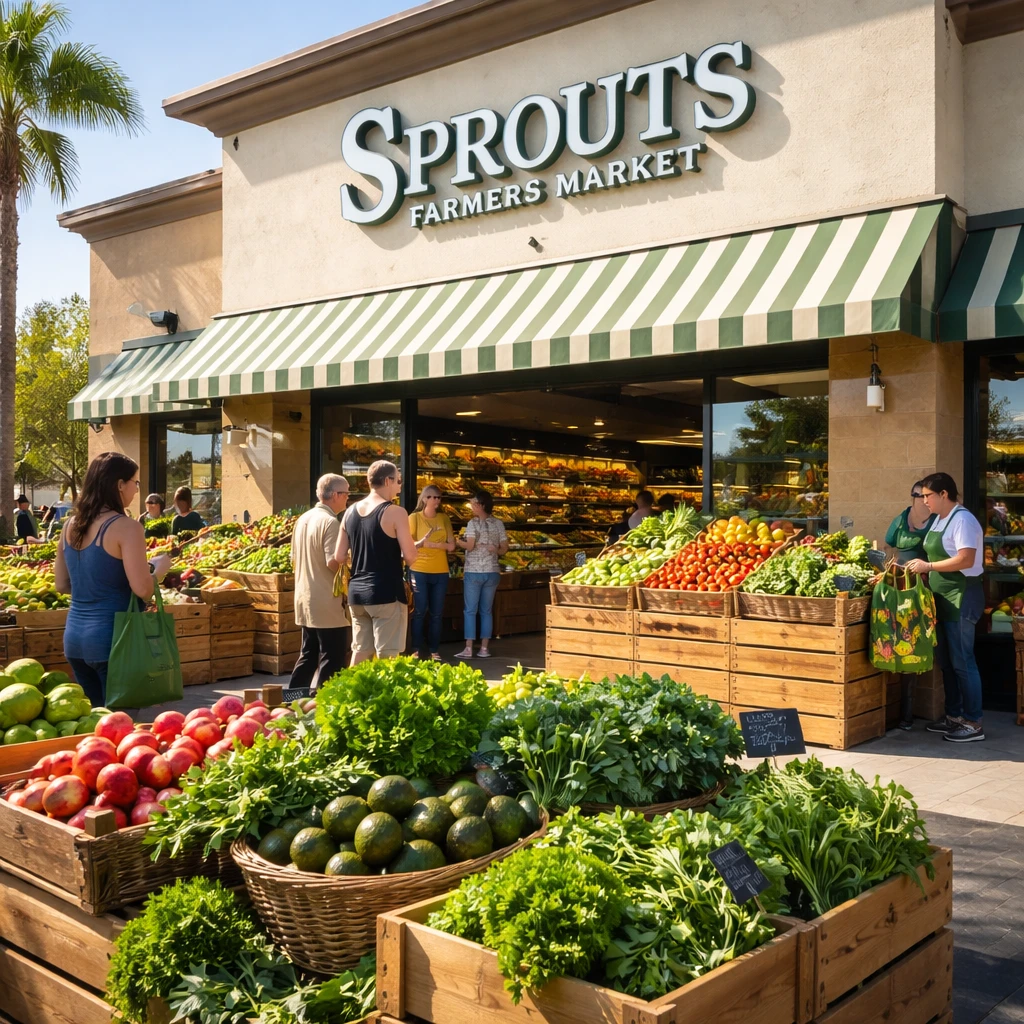
Sprouts operates a chain of healthy grocery stores focused on fresh produce, bulk foods, vitamins, supplements and natural household goods. The business is simple: grocery retail with a differentiated assortment and price/value positioning in the natural and organic segment. Investors should care for three reasons:
- Cash generation: Sprouts produced approximately $468M of free cash flow in the latest reported period. Strong FCF provides optionality for share buybacks, debt paydown or funding new store openings.
- Low leverage: Debt-to-equity is minimal (about 0.06), which reduces financial risk if consumer spending softens further.
- Valuation vs. recovery potential: At a market cap near $7.34B and EV roughly $7.16B, the enterprise multiple on EBITDA (about 8.48x EV/EBITDA) prices in a lot of downside — more than I think is warranted for a high-return retailer.
Where the numbers stand
Key data points worth flagging:
- Current price: $77.59.
- Market cap: ~$7.34B; enterprise value: ~$7.16B.
- Reported EPS: $5.54 and trailing P/E around 14.6x.
- EV/EBITDA: 8.48x.
- Free cash flow: $467.7M.
- Return on equity: 37%; return on assets: 12.6%.
- Leverage: debt-to-equity of roughly 0.06.
- 52-week range: $64.75 - $182.00.
| Metric | Value |
|---|---|
| Price | $77.59 |
| Market cap | $7.34B |
| EV / EBITDA | 8.48x |
| P/E | 14.6x |
| Free cash flow | $467.7M |
| Debt / Equity | 0.06 |
Why I think the market is discounting too much
The sell-off in late 2025 was driven by an earnings miss and a guidance reduction: comparable store sales were reported down and full-year guidance was tightened on 10/29/2025, which led to a sharp share-price reaction. Those headlines rightly raised concerns about demand elasticity for a premium grocery proposition. But the balance-sheet and cash-flow profile did not change as dramatically. With strong ROE (37%), very low leverage and nearly half a billion in free cash flow, the firm has the runway to stabilize operations while continuing to fund selective expansion.
Put differently, the market appears to be pricing Sprouts closer to a distressed retailer, yet the fundamentals show a healthy operating business that is temporarily impaired by lower traffic and margin compression. A reversion to more normalized comps and margin trends — not a return to peak multiples — would be enough to deliver double-digit upside from here.
Catalysts (2-5)
- Operational stabilization: evidence of sequential improvement in comparable-store-sales and gross margins over two to three quarters.
- Margin levers: cost-savings, merchandising optimization, or procurement improvements that restore gross margin.
- Shareholder-friendly capital allocation: incremental buybacks or continued disciplined reinvestment funded by free cash flow.
- Positive analyst revisions or large funds nibbling at the stock after recent liquidations — the market sometimes re-rates quickly once headline selling abates.
Trade plan (actionable)
I am initiating a long recommendation with the following rules. This is a directional trade tied to an operational recovery thesis and should be managed actively.
- Entry price: $77.50.
- Stop loss: $70.00. If the share price breaks decisively below $70 with rising volume, the downside thesis is reinforced and I would exit to preserve capital.
- Target price: $95.00. This reflects a re-rating toward a mid-teens EV/EBITDA multiple and partial recovery of margins and comps within the holding period.
- Horizon: long term (180 trading days). I want at least a full two to three quarter window to see stable comps and margin improvement; 180 trading days gives time for operational changes to flow through and for the market to re-rate.
Position sizing should reflect the individual investor's risk tolerance; consider sizing to a level where a stop hit equates to a tolerable portfolio loss (e.g., 1-3%).
Risks & counterarguments
There are legitimate reasons the market remains cautious, and investors should weigh them carefully.
- Weak comps could persist: The company's October 2025 update showed comparable-store sales weakness (comps down ~4.3% in the reported period). If cautious consumer behavior continues, earnings could compress further and the stock would re-price downward.
- Class-action and headline/legal risk: Multiple securities class action filings were publicized with deadlines in January 2026 (01/26/2026). Legal costs, settlements or continued negative publicity could hurt sentiment and cash flow.
- High short interest and short-volume spikes: Short interest has been material in recent filings and short-volume has been a meaningful share of trading volume. This increases volatility and can amplify downside during negative news cycles.
- Valuation asymmetry: While EV/EBITDA is low, price-to-book is elevated (~5.23x). That suggests the market prices Sprouts for stronger returns on capital; any failure to restore profitability could invalidate the re-rate thesis.
- Macroeconomic risk: Consumer spending shifts, inflation or higher unemployment could reduce demand for the product mix Sprouts sells, particularly for premium-priced natural/organic items.
Counterargument: A rational skeptic would argue that the business's high return metrics were earned during a fat-margin period and that today’s consumer is more cautious; therefore, the multiple should compress permanently. That is possible. I counter that the company's strong free cash flow, low leverage, and sub-9x EV/EBITDA give the business room to re-invest and stabilize without risking solvency — a materially different profile than many lower-quality retailers priced similarly.
What would change my mind
I would downgrade or exit the thesis if any of the following occur:
- Sequential deterioration in comparable-store sales and margins for two consecutive quarters beyond current expectations.
- A material rise in legal expenses or a settlement that meaningfully reduces cash flow.
- Evidence that customer mix is permanently shifting away from Sprouts' core shopper such that growth and margins cannot be restored without significant reinvestment.
Conclusion
Sprouts is not a low-volatility stock. It will continue to react to headlines and macro swings. But at roughly $77.59, with strong free cash flow (~$468M), low leverage, and an EV/EBITDA below 9x, I believe the risk-reward favors a tactical long position sized appropriately. The trade is predicated on operational stabilization and a modest re-rating; it is not a punt on a return to the 2024/early-2025 highs. Put bluntly: if management can prove comps and margins have stopped sliding, the street will move from pricing distress to pricing recovery, and that shift is where the upside lies.
Trade summary: Initiate long SFM at $77.50, stop $70.00, target $95.00, horizon long term (180 trading days). Risk level: medium.