
Hook & thesis
Riley Exploration Permian (REPX) is a classic oil-and-gas small-cap that looks inexpensive on headline metrics and generates real cash. At roughly $39.54 per share and a market cap around $850 million, REPX is trading at about 5x reported earnings and an enterprise-value-to-EBITDA multiple near 4.6x. Those multiples, combined with $81.2 million of reported free cash flow and a $0.40 quarterly dividend (payable 02/05/2026), make a straightforward case for a long trade: own a profitable Permian operator that returns capital and produces meaningful cash while the macro backdrop for hydrocarbons remains supportive.
That said, the stock sits close to its 52-week high ($40.00) and technical momentum is strong - the 9-day EMA ($38.11) and 21-day EMA ($36.21) are rising, but the RSI at 72.8 signals near-term overbought conditions. My recommended approach is a disciplined long with a clearly defined stop to protect against short-term volatility while keeping a 180 trading-day horizon to capture operational improvements, continued cash conversion and any re-rating.
What the company does and why the market should care
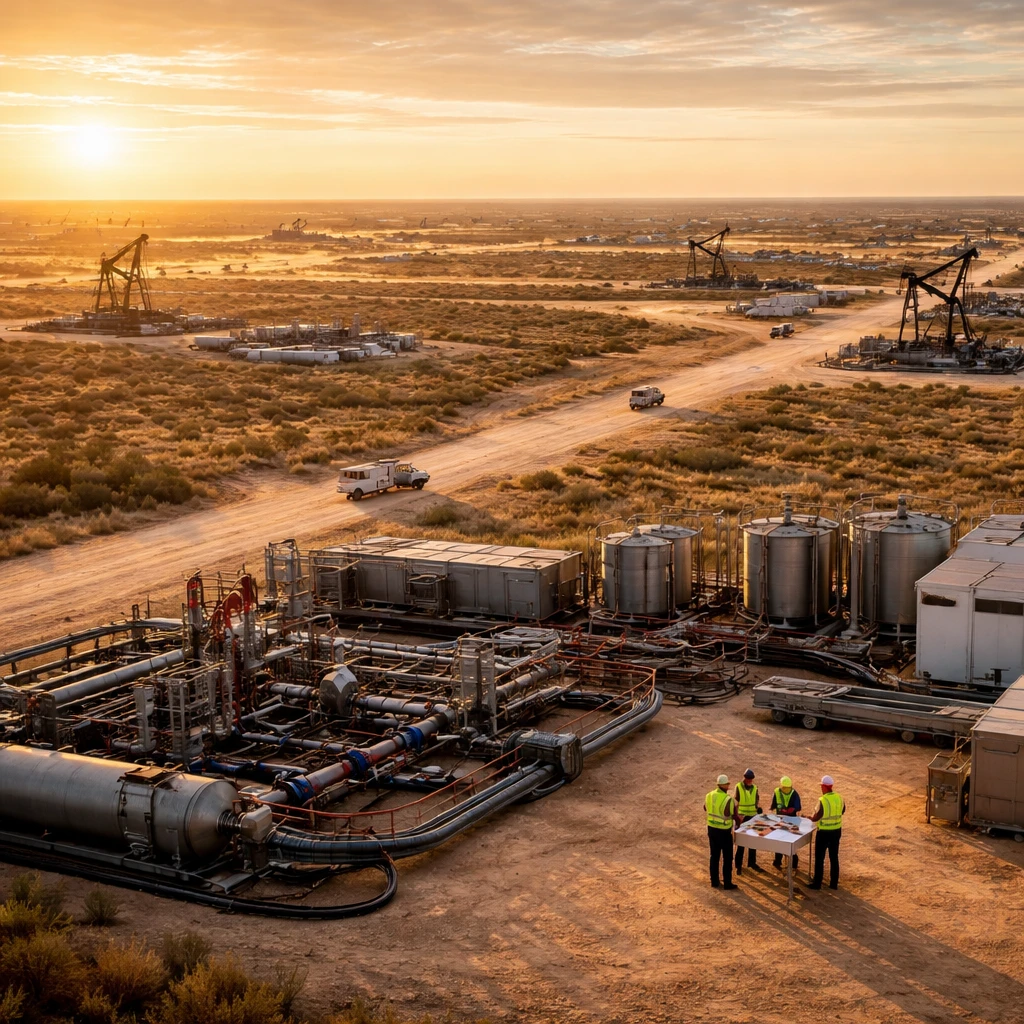
Riley Exploration Permian is an independent oil and natural gas company focused on acquisition, exploration, development and production in Texas and New Mexico, including horizontal development of the San Andres formation on the Northwest Shelf of the Permian Basin. The Permian remains the premium shale basin in the U.S. and operators with efficient drilling and low incremental costs tend to generate outsized free cash flow when oil prices are supportive. Riley's setup - modest net leverage, solid returns on capital and a meaningful dividend - positions it as a direct play on Permian mid-cycle cash generation that also pays investors today.
Fundamentals - relevant numbers
- Market capitalization: about $850 million.
- Price-to-earnings: ~5.25x (based on reported EPS of $7.46).
- Price-to-book: ~1.33x.
- Enterprise value: roughly $1.074 billion; EV/EBITDA ~4.58x.
- Free cash flow: $81.2 million, implying an approximate FCF yield near 9-10% against the market cap.
- Debt-to-equity: 0.39, modest leverage for an E&P peer.
- Dividend: $0.40 per quarter (declared 01/09/2026; payable 02/05/2026), which equates to an annual payout near $1.60 and a cash yield around 4.0% at current prices.
- Profitability: return on equity ~25.4% and return on assets ~13.8%—solid margins for the sector.
Put simply: the company converts commodity revenue into free cash at rates that support a meaningful dividend and leave room to reinvest or buy back stock. For an investor looking for income plus upside if Permian realizations stay healthy, that combination is attractive.
Valuation framing
On almost every standard multiple, REPX trades cheap. A P/E around 5x and EV/EBITDA below 5x are valuation levels normally associated with elevated risk or temporary earnings weakness. Riley's operating metrics tell a different story: strong cash generation ($81.2M FCF), modest leverage and positive ROE/ROA. The company also sits near its 52-week high ($40.00) after a post-2025 run, which argues that the market has begun to re-rate the name. If commodity prices and Permian differentials remain supportive, the current multiples look more like a buying opportunity than a value trap.
Compare qualitatively to peer dynamics: many U.S. E&P and integrated oil names have shifted to shareholder returns and capital discipline; Riley's dividend plus free cash flow profile fits that investor preference. The name is still a small-cap E&P with the attendant cyclicality, so the valuation premium investors are willing to pay will remain tied to commodity visibility and production guidance.
Technical and market structure notes
- Current price: $39.54; 52-week range: $22.52 - $40.00.
- RSI 72.8 suggests near-term overbought conditions; MACD is in bullish momentum but histogram is thin.
- Average daily volume (30-day): ~453,800 shares; float ~11.65 million shares. Recent short interest sits near 857,904 shares (~7.4% of float) with ~2 days to cover—meaning a meaningful short base exists but not an outsized one.
Catalysts to drive the trade higher
- Continued free cash flow conversion and cash returns - additional dividend increases or buybacks would support a re-rating.
- Higher WTI or improved Permian differentials would boost realized pricing and margins quickly given operational leverage.
- Operational improvements - higher per-well productivity or lower drilling/ completion costs would lift implied reserves economics and EBITDA.
- M&A optionality - as a cash-generative small-cap in the Permian, Riley is both a potential acquirer and an attractive consolidation target for larger U.S. E&P players.
Trade plan (actionable)
Thesis: Buy REPX to capture continued free cash flow conversion, dividend income and valuation multiple expansion as the market rewards reliable cash-generating Permian operators.
| Entry | Stop | Target | Horizon |
|---|---|---|---|
| $39.54 | $35.00 | $48.00 | Long term (180 trading days) |
Rationale: Entry at $39.54 captures the company near current trading levels where the dividend yields about 4% and multiples remain depressed relative to underlying cash generation. The stop at $35.00 protects capital if commodity weakness or company-specific operational setbacks appear; it sits below recent short-term support and limits downside to roughly 11.5% from entry. The target of $48.00 is based on a partial re-rating toward a mid-teens EV/EBITDA or modest multiple expansion from current levels while factoring in incremental earnings power from higher commodity realizations and continued cash returns. I view this as a long-term trade to be held for up to 180 trading days to allow operational cadence, quarterly results and macro moves to play out.
Position management and exit triggers
- Take profits incrementally: consider selling 40% at $44.00, 40% at $48.00 and keeping a 20% kicker if the business materially improves fundamentals (higher FCF or dividend increases).
- Move the stop to breakeven once the position gains 10-12% to protect against reversals given the stock's near-term overbought technicals.
- Reassess if the company reduces the dividend, materially increases leverage, or issues negative production guidance.
Risks & counterarguments
Below are the principal risks that could derail this trade and at least one clear counterargument to the bullish view.
- Commodity price volatility: Riley's earnings and cash flow are directly tied to oil and gas prices. A sustained drop in WTI or deteriorating Permian differentials would compress margins and likely lead to multiple contraction and dividend pressure.
- Liquidity and working capital constraints: Current and quick ratios are below 1.0, which signals tighter short-term liquidity. A sudden operational issue or capex spike could force financing that dilutes shareholders or raises costs.
- Dividend sustainability: Management has recently returned capital via quarterly dividends, but a sharp earnings drop or large one-time expense could force a cut, which would likely trigger a steep multiple decline.
- Operational risk: As a producer focused on horizontal development, drilling setbacks, downtime or lower-than-expected well performance could reduce free cash flow and investor confidence.
- Valuation complacency at the top: The stock trades near its 52-week high and the RSI is elevated, making short-term pullbacks more likely. Momentum could reverse quickly if macro headlines turn negative.
Counterargument: Cheap multiples can reflect real fragility. If the market is assigning low multiples because management has a history of inconsistent production, high reinvestment needs, or opaque reserve reporting, the current valuation may be justified. In that case, buying near the 52-week high would be premature.
What would change my mind
I would reconsider this trade if any of the following occurred: a) the company announces a material dividend reduction or a rights offering that dilutes equity, b) free cash flow collapses in the next two quarters below the current run-rate because of reservoir performance or price realization issues, c) leverage meaningfully increases (debt-to-equity rising well above 0.6) without a clear plan to monetize assets or return to positive cash generation, or d) oil prices drop and the company provides production guidance that implies a multi-quarter decline in cash flow.
Conclusion
REPX is a pragmatic long idea for investors comfortable with E&P cyclicality: the company offers healthy free cash flow, a dividend yield near 4%, and low-to-moderate leverage—characteristics that justify taking a long position with risk controls. Execution matters: enter at $39.54, use a $35.00 stop to limit downside, and target $48.00 over a 180 trading-day window. Monitor commodity prices, dividend policy and liquidity closely; these are the levers most likely to make or break the trade.