
Hook & thesis
Olin Corp. is quietly moving from earnings volatility toward clearer cash generation. The company is producing roughly $248 million in free cash flow while trading at a market cap near $3.33 billion. That combination - tangible cost savings and a sizable FCF base - suggests the market is underpricing the near-term margin improvement. I see a defined risk/reward to take a swing position that profits if the company converts efficiency programs into higher margins and steadier earnings.
This is a tactical long idea: enter at $29.25, protect at $26.50, and target $34.00. The plan is a mid-term swing: about 45 trading days. The stop is close enough to limit capital loss if margin programs slip, while the upside captures re-rating from multiple expansion and improved operational cash flow.
What Olin does and why investors should care
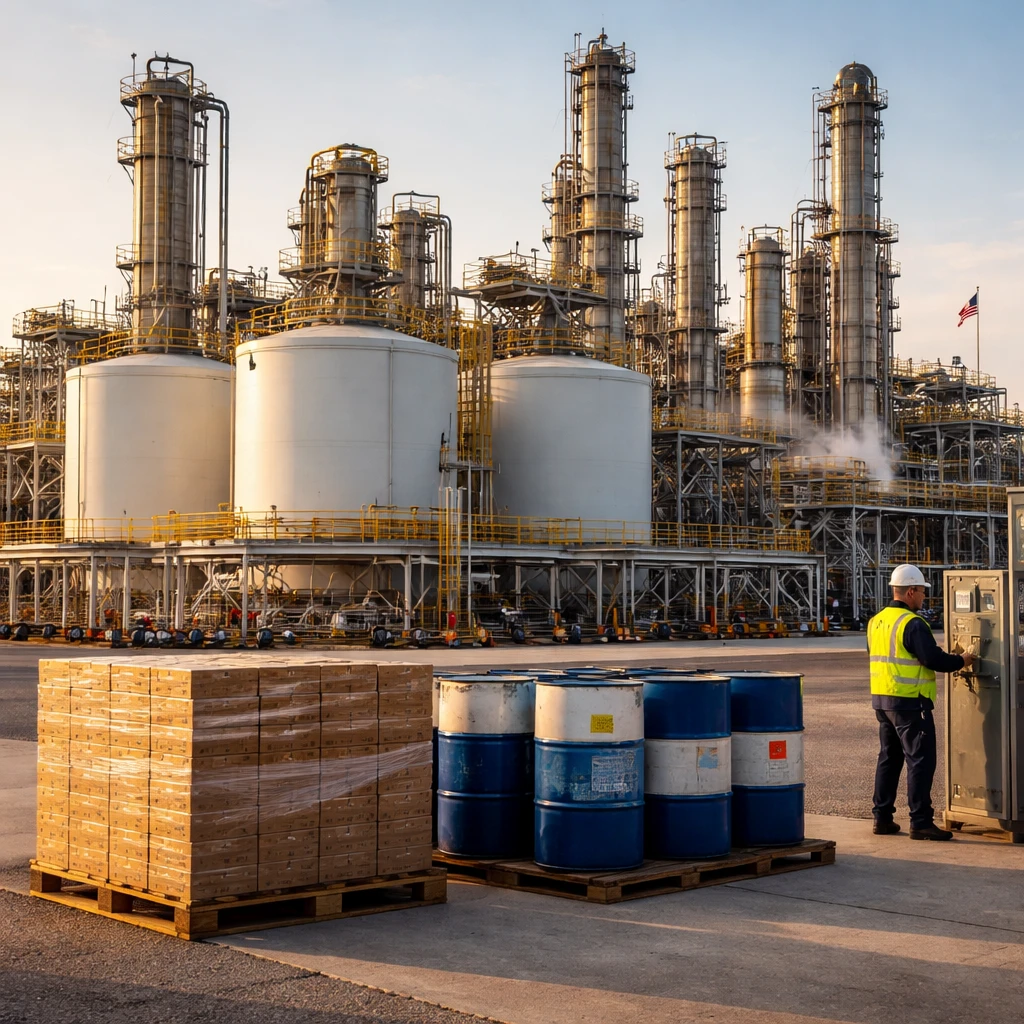
Olin operates three primary segments: Chlor Alkali Products and Vinyls, Epoxy, and Winchester ammunition. Together they expose the business to industrial demand (epoxy/resins), commodity chemicals pricing (chlor-alkali), and a defensive recurring revenue stream in ammunition. Investors should care because Olin combines cyclical upside with a durable FCF profile: enterprise value sits around $5.99 billion while free cash flow last reported is about $247.9 million, giving the company room to deleverage, repurchase stock, or sustain its dividend.
How the market should re-rate Olin
Two simple fundamentals can drive a re-rate. First, margin improvement from cost reductions and plant productivity lifts will translate into higher EBITDA and lower EV/EBITDA. Olin's EV/EBITDA is roughly 10.9x today - reasonable for a diversified chemicals player but cheap if margins normalize. Second, epoxy end-markets (adhesives, coatings, composites) show durable demand tailwinds from EVs, renewable energy, and infrastructure, supporting pricing and utilization. On the defensive side, Winchester ammunition remains a cash-generating franchise with steady demand fundamentals.
Data points that matter
- Market cap: ~$3.33 billion.
- Enterprise value: ~$5.99 billion.
- Free cash flow (most recent): $247.9 million.
- EV/EBITDA: 10.9x.
- Price-to-sales: 0.49x; price-to-cash-flow: 7.02x; price-to-free-cash-flow: 13.42x.
- Balance sheet: debt-to-equity ~1.54x; current ratio ~1.21, quick ratio ~0.73.
- Recent operational note: a public update showed revenue rose roughly 7% in Q2 2025, though profitability was pressured by input costs (publication dated 07/28/2025).
Valuation framing
At a market cap of about $3.33 billion and an enterprise value near $5.99 billion, Olin trades at modest multiples relative to historical commodity-chemical cycles. A 10.9x EV/EBITDA multiple already discounts some operational recovery; if cost initiatives and pricing push EBITDA meaningfully higher, multiple expansion toward low-teens would be reasonable and support upside to our $34 target. The company’s P/S of ~0.5x and P/CF ~7x point to value if FCF is sustainable. The balance sheet is levered (debt-to-equity 1.54x), so any sustained margin improvement improving coverage metrics would materially lower perceived risk and allow for a re-rating.
Technical backdrop
Momentum indicators are constructive. The 10-day SMA (~$28.41) and 9-day EMA (~$28.42) sit below the current price near $29.23, while the 50-day SMA is lower (~$25.12), signaling a positive trend. RSI is around 62, and MACD shows bullish momentum. Short interest is meaningful but not extreme: recent settlement shows ~15.16 million shares short (around mid-March), implying about 4 days to cover on average volume - a factor that can amplify moves on positive news.
Catalysts (what to watch)
- Public progress on cost-savings programs and any quantified margin guidance from management - explicit EBITDA uplift will drive multiples.
- Improvement in epoxy resin pricing/volumes tied to industrial demand and EV-related growth in adhesives/composites markets.
- Steady Winchester demand or contract wins that protect cash flows even if chemicals cycle down.
- Quarterly results that convert FCF into concrete balance-sheet improvements (debt paydown or buybacks) will re-rate shares.
- Macro energy costs - declines in natural gas/electricity would materially boost chlor-alkali margins.
Trade plan (actionable)
This is a swing trade targeting mid-term upside while controlling downside risk.
- Entry: $29.25.
- Stop loss: $26.50 - protects capital if margin initiatives stall or commodity pricing weakens.
- Target: $34.00 - reflects a combination of multiple re-rating and 1H EBITDA improvement being priced in over the next 45 trading days.
- Horizon: mid term (45 trading days). Rationale: the market often needs a couple of quarters' worth of confirmation on cost programs to re-rate cyclical chemicals names; 45 trading days gives time for incremental operational updates or a quarterly print to validate margin improvement.
Why the trade makes sense
The risk/reward is skewed: downside is capped by a defined stop near $26.50 while upside to $34 implies ~16% from entry. The company’s cash generation (FCF ~$247.9M) provides a tangible floor and optionality for deleveraging or shareholder returns if management prioritizes capital allocation. Momentum indicators support a near-term push higher, and the business mix provides both cyclical upside (chemicals/epoxy) and defensive steady cash flow (Winchester).
Risks and counterarguments
Below are the principal risks to this trade, and a brief counterargument to the bullish thesis.
- High leverage - debt-to-equity near 1.54x leaves limited room for margin compression. If margins deteriorate further, debt servicing will pressure cash flow and equity value.
- Earnings remain negative - trailing EPS sits negative; the company must convert operational improvements into consistent positive earnings to materially re-rate.
- Commodity and energy price risk - chlor-alkali margins are sensitive to feedstock and energy costs. A spike in natural gas or electric prices would erode the margin gains expected from cost-savings.
- Cyclicality and demand risk - end markets like construction and industrial coatings can soften, reducing epoxy volumes and pricing power.
- Regulatory and reputational risk tied to Winchester - political or regulatory shifts around ammunition could impact that segment's revenue and valuation multiple.
- Market sentiment / macro - broader risk-off conditions can compress cyclicals and keep the stock rangebound despite operational progress.
Counterargument: Margin improvements may already be partially priced in and could disappoint; management could prioritize share buybacks, or an energy-price shock could reverse early gains. If quarterly results show only marginal improvement in EBITDA or management misses guidance on cost savings, the stock could trade back toward the low-$20s quickly.
What would change my mind
- If management provides clear, measurable guidance showing sustained margins and outlines a credible plan to cut net leverage (e.g., material debt paydown or sustained buybacks funded by FCF), I would upgrade the target and extend the horizon.
- Conversely, a quarter showing recurring net losses, rising working capital needs, or an unexpected write-down would make me exit and reassess; that kind of print could push the stock below the stop and invalidate the trade.
- Also, a sustained spike in energy prices or a major regulatory action against ammunition sales would materially change the risk profile and force me to reduce position size or flip to a cautious view.
Conclusion
Olin is a pragmatic swing trade: modest valuation, visible free cash flow, and momentum set up a chance for a short-term re-rating if management executes on cost savings and markets remain supportive. The entry at $29.25 with a $26.50 stop preserves capital while letting the company prove out its margin story over the next 45 trading days. If you take this trade, size it relative to your risk tolerance and treat the stop as a capital-preservation tool, not a suggestion for averaging down.
Key metrics snapshot
| Metric | Value |
|---|---|
| Market cap | $3.33B |
| Enterprise value | $5.99B |
| Free cash flow | $247.9M |
| EV/EBITDA | 10.9x |
| Debt / Equity | 1.54x |
Trade summary
- Direction: Long.
- Entry: $29.25.
- Stop loss: $26.50.
- Target: $34.00.
- Horizon: mid term (45 trading days).
Keep position sizing prudent given leverage and cyclicality. Watch quarterly prints, management commentary on cost programs, and energy prices closely - any of these will dictate whether the trade runs or reverses.