
Hook & thesis
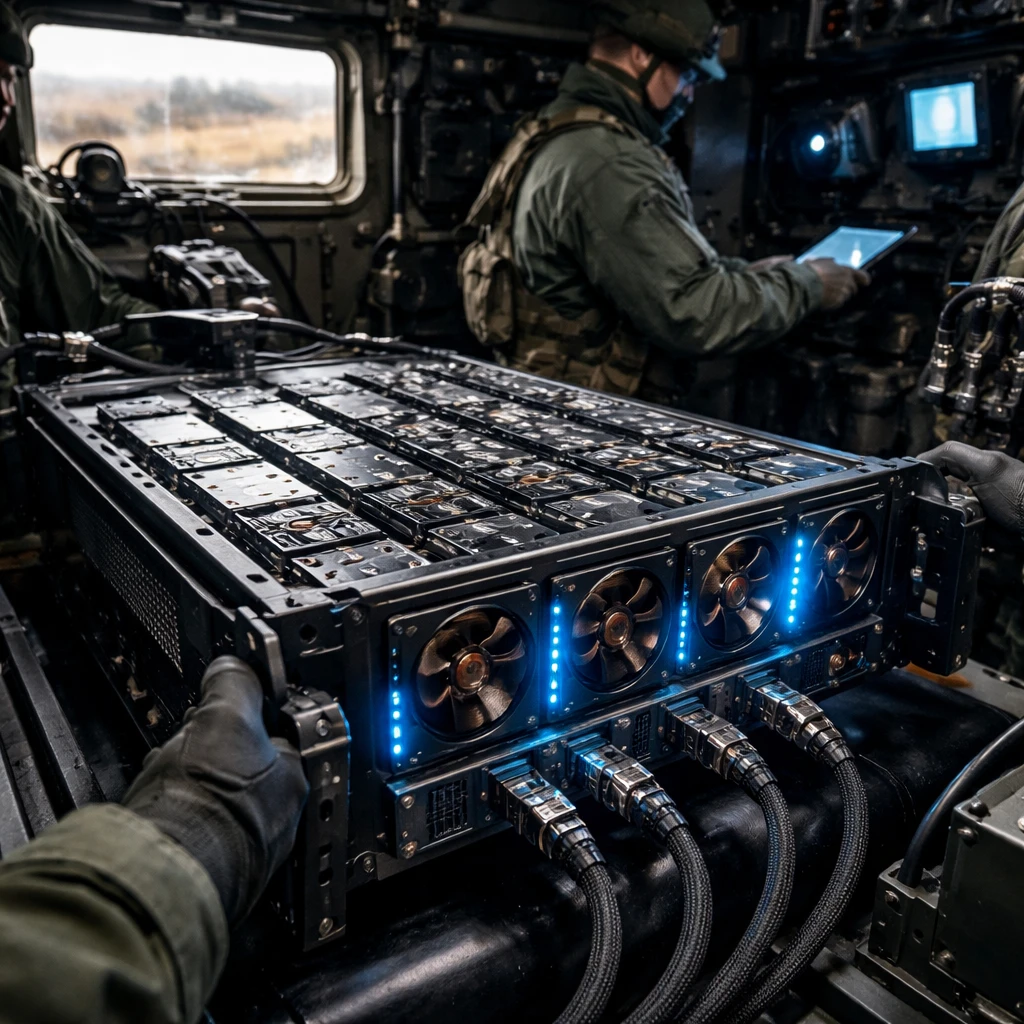
One Stop Systems (OSS) is small enough to be overlooked yet differentiated enough that a handful of wins can change the narrative. The company builds rugged, GPU-accelerated compute and storage systems aimed at edge-deployed AI and sensor processing - exactly the hardware profile mission integrators and defense primes need for modern combat vehicles and robotics.
Recent contract awards and platform wins provide concrete revenue visibility while the product portfolio - including high-density GPU expansion and rugged servers - creates what I call a "battlefield quasi-moat": specialized engineering, long procurement cycles, and integration complexity that slows competitor encroachment. That combination makes OSS an actionable mid-term swing trade for disciplined investors.
What OSS does and why the market should care
OSS designs and manufactures computing modules and systems targeting edge deployments: ruggedized servers, GPU expansion platforms, and specialized storage arrays. Customers include defense primes, commercial aerospace integrators, and industrial robotics firms. Edge compute for AI, sensor fusion, and real-time video processing is a growth pocket where ruggedization, thermal management, and integration expertise matter - and that favors suppliers with proven field pedigree.
Why this matters now: defense budgets and commercial aviation integrators are accelerating orders for GPU-accelerated edge compute that must survive shock, vibration, and constrained cooling environments. OSS's recent orders - a $1.2 million pre-production order from a major U.S. defense prime and a $1.5 million initial commercial cabin systems order (with an expected three-year pipeline of roughly $6 million) - illustrate buyers are moving from evaluation to procurement.
Key facts and recent performance
- Market cap: $193,815,962.
- Current price: $7.83 (market open $7.67, intraday high $7.835).
- Shares outstanding: 24,737,200; float: ~20.6M.
- Q2 2025 revenue: $14.1 million, up 6.9% year-over-year; OSS segment bookings YTD: $25.4 million.
- Reported metrics: EPS ~ $0.21; reported P/E ~ 34.9; P/S ~ 5.87; P/B ~ 4.08.
- Enterprise value: $157,817,259; free cash flow was negative at -$6.4 million in the most recent reporting.
- Product highlights: Ponto - a high-density GPU expansion platform supporting up to 16 full-size GPUs in 6U rack space - and rugged short-depth servers for military platforms.
Valuation framing
At a market cap near $194 million and EV around $158 million, OSS is not microcap junk but it's small enough that a handful of contract expansions can move multiples. The stock trades at roughly 34.9x reported EPS and near 5.9x sales - levels that assume continued margin expansion and revenue growth from current bookings.
Given the company's negative free cash flow and relatively small revenue base (quarterly revenue in the mid-teens millions), the current multiple embeds a fair amount of future execution. That said, the specialized nature of the product set and defense-related pipeline give OSS upside optionality: securing follow-on orders from primes can materially lift revenue visibility without a proportional increase in sales and marketing spend.
Technical and market structure notes
Price action shows recent compression: the 10-day SMA is $8.08, the 20-day SMA $9.03, and the 50-day SMA $9.15, while the current price sits at $7.83. Momentum indicators are soft - RSI ~40 and MACD is signaling bearish momentum - which argues for an entry closer to current levels or on a mild pullback rather than chasing higher. Short interest has been elevated at times (recent settlement figures show short interest around 1.99M shares), but days-to-cover remains low (~1.5), so squeezes are possible but unlikely to be explosive.
Catalysts to watch
- Defense program maturation - follow-on production orders from the defense prime tied to the $1.2M pre-production award.
- Commercial platform scaling - conversion of the $1.5M initial cabin systems order into a multiyear revenue stream (projected $6M over three years).
- Product ramp: commercial adoption of Ponto in datacenter and enterprise AI workloads.
- Quarterly results and bookings commentary that show sequential margin improvement or stronger backlog conversion.
Trade plan (actionable)
I recommend a tactical long with conservative sizing for a mid-term swing trade: entry at $7.83, stop loss at $6.50, target at $12.50. This is a swing trade designed to run up to mid-term (45 trading days) if catalysts and order flow validate the thesis.
Trade details:
- Entry Price: $7.83
- Stop Loss: $6.50 (protects capital if bookings stall or a defense bid falls through)
- Target Price: $12.50 (captures upside if follow-on awards and commercial conversions accelerate revenue and margins)
- Horizon: mid term (45 trading days) - allow time for contract news, quarterly commentary, or follow-on orders to surface and move valuation.
Why this time frame: OSS is driven by discrete contract wins and procurement cycles that tend to resolve over weeks to months. Mid-term gives enough runway for the market to react to order conversions or management commentary without exposing the position to long-range macro noise. If the company reports material contract awards and backlog conversion before 45 trading days, consider taking partial profits near the target or tightening the stop to breakeven.
Risks and counterarguments
- Execution risk: small companies live and die by order conversion. The company has several small initial awards; failure to secure production contracts would compress revenue and margins quickly.
- Cash flow stress: free cash flow was negative (-$6.4M). If OSS needs to fund growth or absorb long procurement cycles without sufficient cash, the company may need equity dilution or expensive financing.
- Concentration and customer risk: work with defense primes and a few integrators can create lumpy revenue. Loss of a prime-level program or longer-than-expected qualification cycles would hurt near-term results.
- Valuation multiple sensitivity: the stock trades at high teens-to-thirties multiple metrics on a small earnings base; a single quarter of missed guidance or margin pressure could trigger outsized downside.
- Competitive pressure: larger established server and GPU vendors could undercut pricing or bundle solutions with services, pressuring OSS on commercial datacenter opportunities.
Counterargument: skeptics will say OSS's small scale and negative free cash flow make it vulnerable and that defense awards are often slow to convert to meaningful revenue. That's valid. However, the combination of multiple product wins across defense and commercial aerospace, plus a specialized product like Ponto that addresses unique thermal and density constraints, gives OSS a clearer path to repeatable orders than many other small hardware vendors. The trade is predicated on visible follow-ons and booking commentary - not a blind multiple expansion bet.
What would change my mind
I would exit or flip to neutral if any of the following occurs before the target is reached:
- Management confirms a major contract cancellation or significant delay in production acceptance tests.
- Quarterly commentary shows materially weaker bookings or pipeline than previously disclosed (bookings falling below the previously disclosed $25.4M YTD OSS bookings trend).
- Company announces dilutive financing sized to cover persistent cash burn without a commensurate revenue/booking ramp.
Conclusion
OSS is a small, specialized supplier to defense and commercial integrators where ruggedized, GPU-dense edge compute is in demand. The combination of tangible initial orders, a product set with integration barriers, and a market that values mission-capable hardware makes OSS a compelling tactical long. That said, the trade is high-conviction on execution: success depends on converting demonstrator and pre-production awards into production contracts and steady bookings.
If you believe the defense and aerospace integrator pipelines will accelerate and that OSS can convert initial awards into multiyear programs, the mid-term swing with an entry at $7.83, stop at $6.50, and target at $12.50 offers asymmetric upside. Keep position sizes moderate given cash burn and execution risk, and tighten stops if bookings disappoint or the company's guidance weakens.
Trade plan recap: Enter $7.83, Stop $6.50, Target $12.50. Horizon: mid term (45 trading days).