
Hook & thesis
Kinder Morgan (KMI) is a practical way to play what looks like a genuine natural gas upcycle. Recent price action in the physical market - a rapid surge in natural gas futures above $5/MMBtu during the January cold wave - has already translated into materially higher utilization and near-term pricing power across the midstream complex. KMI owns core interstate and intrastate natural gas pipelines, storage, and related terminals that benefit both from elevated volumes and the need for resilience in U.S. energy logistics.
Fundamentally, Kinder Morgan combines predictable, fee-based cash flows with exposure to higher throughput and capacity-driven growth projects. With a market cap around $73.3 billion and enterprise value roughly $105.8 billion, KMI already trades at valuation multiples that imply the market is paying for a steady income stream; the present macro setup gives it a chance to deliver above-consensus free cash flow that could re-rate the stock.
What Kinder Morgan does and why the market should care
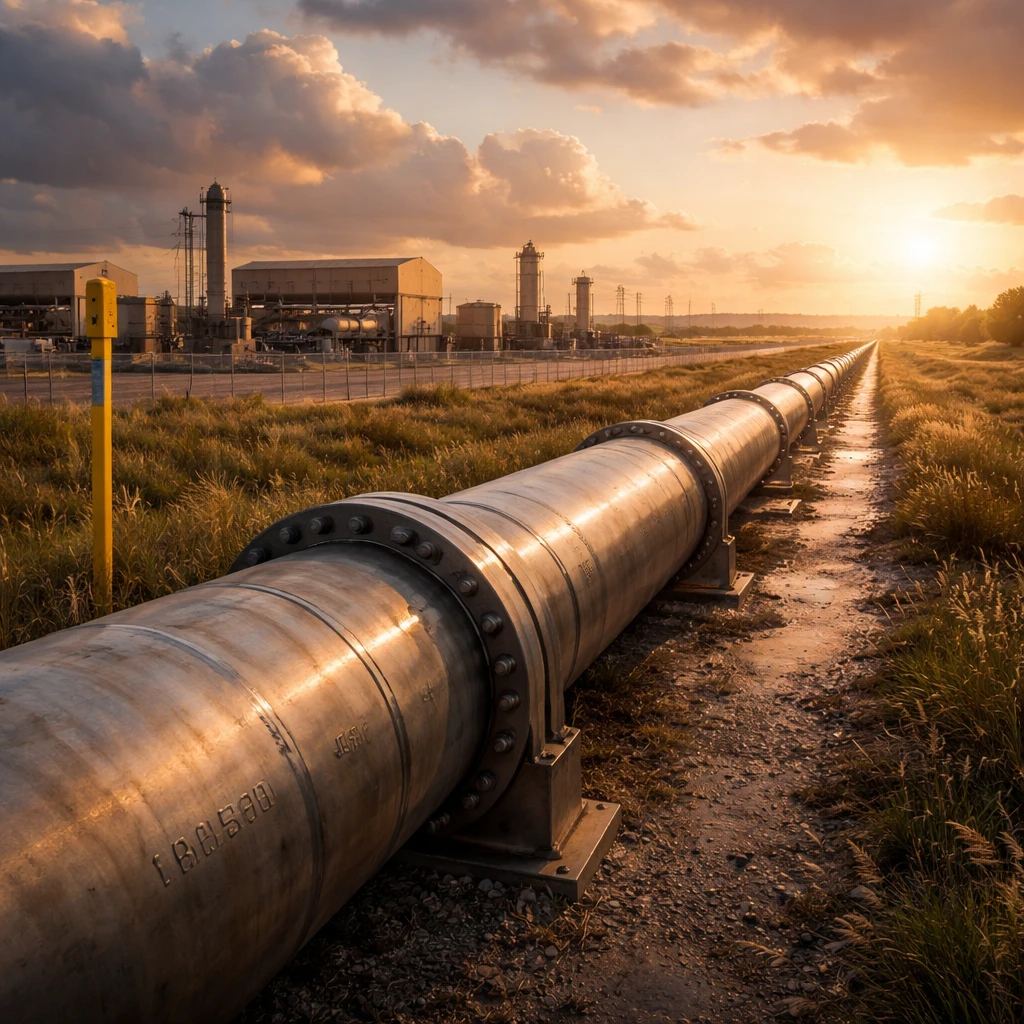
Kinder Morgan operates four main segments: Natural Gas Pipelines, Products Pipelines (refined product and crude), Terminals (liquids and bulk storage), and CO2 operations for enhanced oil recovery. The Natural Gas Pipelines segment is the core economic engine: long-haul interstate lines, regional intrastate networks and storage facilities that sit between production basins and demand centers including power generation and rapidly growing AI data center loads.
The market cares because pipelines provide fee-based revenue that is less exposed to commodity price swings than E&P companies, yet higher gas prices and stress events (like 01/23/2026 cold wave) drive incremental demand for transport and storage capacity. That combination - stable margins with upside to volumes - is why many investors view midstream names as defensive income plays that can still participate in commodity rallies.
Key financial snapshot
| Metric | Value |
|---|---|
| Market Cap | $73.26B |
| Enterprise Value | $105.83B |
| Free Cash Flow (TTM) | $2.891B |
| Dividend Yield | ~3.6% |
| P/E | ~24x |
| EV/EBITDA | ~14.8x |
| Debt / Equity | ~1.04x |
| 52-week range | $23.94 - $34.73 |
Support for the bullish case - numbers matter
Kinder Morgan generates significant free cash flow - about $2.89 billion in the latest frame - which underpins a ~3.6% yield and ongoing capital projects. Enterprise value sits at roughly $105.8 billion while the market values the equity at about $73.3 billion. These numbers indicate a capital-intensive business that nevertheless produces real cash that management can attribute to dividend growth, selective bolt-on projects, and balance-sheet management.
Operationally, KMI controls large portions of the U.S. gas transportation network and benefits from secular drivers: rising gas-fired power generation, LNG feedstock demand, and data center electrification. Several recent industry write-ups cite multi-billion-dollar backlogs for pipeline expansion (figures in public commentary reference $10B to as much as $20B in projects through 2030), which argues for persistent long-term volume growth, not a one-off uplift.
Valuation framing
At current prices near $32.93, KMI trades at ~24x earnings and ~14.8x EV/EBITDA. Those multiples sit above the cheapest pipeline peers but reflect the stability of fee-based cash flows and the scale of KMI's system. Historically, midstream companies often trade in the mid-teens EV/EBITDA when commodity cycles are muted; KMI’s higher multiple today is justified in part by its project backlog and dividend durability. If the natural gas supercycle gains traction and free cash flow rises materially from current $2.89B, a re-rating toward the high-teens EV/EBITDA (paired with improving EPS) is reasonable and would support upside to our targets.
Catalysts (near and medium term)
- Higher sustained natural gas prices and demand shocks (weather-driven or supply disruptions) that push throughput and storage utilization higher.
- Regulatory approvals and construction milestones on KMI’s expansion projects - each green light converts backlog into contracted cash flow.
- Dividend increases or capital return programs tied to improving free cash flow - KMI has nine consecutive years of dividend increases cited in recent coverage.
- Strength in demand from AI data centers and LNG export capacity that increase long-haul transport requirements.
- Quarterly results that beat on FCF and raise full-year free cash flow guidance, prompting a multiple expansion.
Trade plan (actionable)
We upgrade KMI to Buy with the following trade parameters:
- Entry: Buy at $33.00.
- Stop loss: $31.00.
- Target: $36.00.
- Horizon: mid term (45 trading days) - we expect the trade to play out over the next several weeks to months as natural gas price momentum, project milestones, or quarterly results provide directional catalysts.
Rationale: an entry at $33.00 places you slightly above the current price and inside the recent trading range, while a $31.00 stop keeps risk limited to roughly $2 per share if a market rotation or negative headline re-prices the sector. The $36.00 target assumes a modest re-rating and/or better-than-expected free cash flow over the near term - about a 9% upside from entry, which is attainable if EV/EBITDA moves modestly higher or if incremental throughput lifts quarterly earnings.
Technical and market positioning notes
Technically, KMI sits close to its short-term moving averages; the 10-day and 20-day SMAs are near $33.57 and $33.36 respectively, while the 50-day SMA is $32.35. Momentum indicators show neutral-to-slightly-bearish signals today (MACD histogram negative and RSI ~48). Short interest is moderate with days-to-cover hovering around 3.2 in recent settlements, suggesting limited forced-squeeze risk but active bearish positioning exists. Use the stop to manage that technical risk.
Risks and counterarguments
- Commodity reversals: If natural gas prices revert quickly, the near-term uplift to volumes and storage demand could evaporate. Pipelines are less commodity-exposed than producers, but throughput declines can still pressure earnings and project economics.
- Interest rates and financing costs: Kinder Morgan carries meaningful leverage (debt/equity ~1.04). Rising rates increase financing costs on new projects and can compress valuation multiples for yield-sensitive names.
- Project execution and permitting delays: Multi-billion-dollar expansions are not risk-free. Delays, cost overruns, or regulatory pushback would delay contracted cash flows and curtail any near-term re-rating.
- Regulatory/political risk: Midstream infrastructure faces permitting, eminent domain, and environmental scrutiny. Policy shifts that restrict pipeline buildouts or increase compliance costs would be a headwind.
- Valuation complacency: At ~24x P/E and EV/EBITDA near 14.8x, some of KMI's growth is already priced in. A slower-than-expected ramp in volumes or persistent macro risk could limit upside and make the dividend the primary return driver.
Counterargument to our thesis: The main counterargument is that the market is temporarily extrapolating a weather-driven price spike into a long-lasting supercycle. If higher gas prices prove transient and capital investment for new demand (LNG, data centers) stalls, KMI’s multiples could compress back toward the midstream average and returns would be muted. That said, KMI’s combination of contracted and regulated cash flows provides a buffer that reduces the downside compared with upstream names.
Conclusion and what would change our mind
We upgrade KMI to Buy and view it as an actionable way to play a potential natural gas supercycle while collecting a 3.6%+ yield. The balance sheet (enterprise value ~$105.8B; debt/equity ~1.04), steady free cash flow (~$2.89B) and a substantial project backlog give management optionality to invest and return capital. Our trade plan - entry $33.00, stop $31.00, target $36.00 over a mid-term 45 trading day window - balances upside capture with disciplined risk control.
We would change our view if any of the following occur: 1) KMI reports a meaningful downward revision to project economics or backlog conversion timelines; 2) natural gas prices collapse below structurally supportive levels without a clear catalyst for recovery; or 3) the company materially increases leverage without commensurate contracted cash flows. Conversely, a sustained strip of natural gas prices above $4.50-$5.00 and better-than-expected free cash flow conversion would strengthen our bullish stance and justify raising the target.
Key action points
- Initiate a long at $33.00 with a protective stop at $31.00.
- Monitor natural gas front-month futures and KMI operational updates for catalyst confirmation.
- Reassess position sizing around quarterly FCF print and any major project milestone announcements.
Trade idea timestamp: 04/06/2026 - Plan is for a mid-term (45 trading days) swing trade that takes advantage of both secular and cyclical drivers in U.S. natural gas markets.