
Hook / Thesis
InfuSystem (INFU) is a small-cap healthcare-services operator that has quietly rebuilt earnings power since its trough in 2025. The company combines a durable medical equipment rental business (ambulatory infusion pumps) with patient services and oncology support. That mix creates recurring cash flow from rentals and consumables plus higher-margin service revenues. At the current price near $9.40, the market is pricing a unimpressive growth story into a mid-20s P/E, but the underlying free cash flow and improving operating leverage argue for a re-rating if revenue growth and margins hold.
Our actionable trade idea: go long INFU with a clear entry, stop and target. We expect the stock to run materially higher through 2026 on continued earnings improvement, recurring rental revenue expansion and either a capital-return program or targeted M&A that captures synergies in oncology services.
What the company does and why the market should care
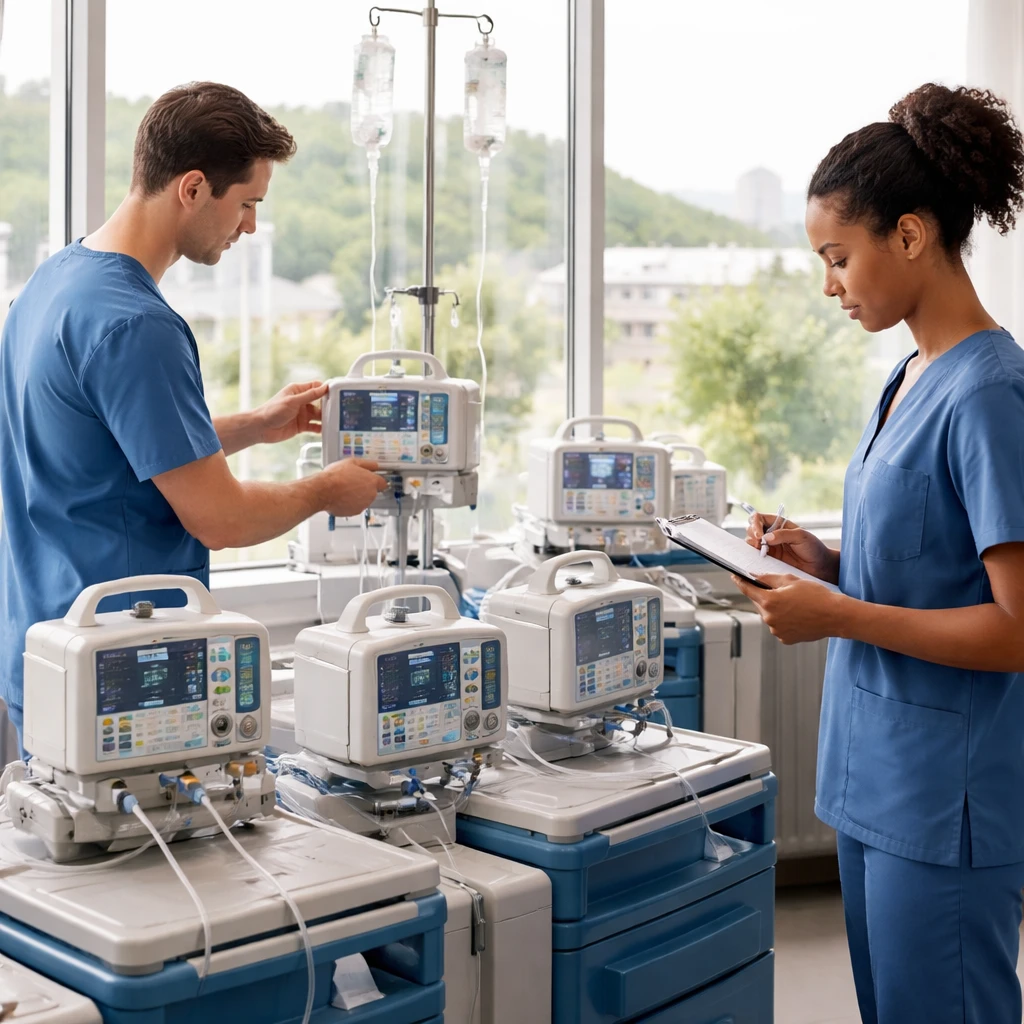
InfuSystem Holdings operates two segments: Patient Services and Device Solutions. The Patient Services segment covers durable medical equipment rentals, clinic-to-home logistics and oncology-related services. The Device Solutions segment sells and rents infusion pumps, provides consumables and offers biomedical recertification and maintenance. That combination is powerful in outpatient oncology and infusion therapy markets because it ties customers to recurring rental/consumable purchases and creates high-visibility service contracts that show up in recurring revenue.
The market should pay attention because InfuSystem is not a pure one-time medical device vendor. The rental model smooths revenue and makes future cash flow more predictable. Management has demonstrated the ability to move the profit needle: in Q2 2025 reported EPS jumped to $0.12 and revenue grew 6.8% to $36.0 million (reported 08/05/2025), evidence that Device Solutions and oncology services can carry margin expansion when volumes improve.
Hard numbers that support the thesis
- Market cap: roughly $190.0M; enterprise value: $206.1M.
- Reported earnings per share (most recent ratio snapshot): $0.33; trailing P/E ~28.6 and price-to-sales ~1.32.
- Free cash flow (latest reported): $15.722M, a meaningful figure for a $190M company and a lever management can use to pay down debt, fund device inventory, repurchase stock or pursue small M&A.
- Balance-sheet health: debt-to-equity ~0.34, current ratio ~1.8 and quick ratio ~1.53, indicating liquidity to support growth without aggressive financing.
- Valuation context: 52-week range is $4.66 (low) to $11.04 (high). The current price near $9.40 sits above the 50-day SMA (~$9.16) and about at the 10-day SMA (~$9.40), suggesting the market has already priced some recovery but not a full re-rating.
Valuation framing
At a $190M market cap and EV of $206M, InfuSystem is trading at ~1.32x price-to-sales and a P/E in the high-20s on trailing EPS of $0.33. That multiple is defensible if InfuSystem can sustain mid-single-digit top-line growth while leveraging rental and consumable margins. The free cash flow of $15.7M is the most interesting number: if FCF continues at that scale, management has real optionality to allocate capital toward buybacks or strategic tuck-ins that increase scale and operating leverage.
Put differently, a modest improvement in earnings to about $0.50 - $0.70 in the next 12-18 months (driven by margin expansion and steady revenue growth) would justify a mid-teens to low-20s P/E multiple and push the stock well past the $14 mark. Our target of $14 assumes a combination of EPS improvement and multiple expansion from today's levels.
Technical and market dynamics
The technical picture is neutral-to-favorable for a long entry: current price around $9.40 is above the 50-day SMA and close to the 10-day SMA. RSI sits near 51 — not extended — and MACD shows short-term bearish momentum but without extreme weakness. Short interest is manageable: most recent settlement shows roughly 216,234 shares short with days-to-cover under 2, limiting the risk of a disruptive short squeeze but also meaning shorts are present and paying attention.
Catalysts (2-5)
- Continued margin expansion from Device Solutions and oncology services as utilization and consumable sales improve.
- Quarterly results that sustain or exceed the Q2 2025 improvement (EPS and revenue growth); management beat or upward guidance would trigger re-rating.
- Use of free cash flow for share repurchases or targeted tuck-in acquisitions that increase scale in oncology services.
- Industry dynamics such as growing outpatient infusion demand and stable reimbursement that favor rental and service models.
Trade plan
This is a directional, conviction trade for investors who can accept mid-cap healthcare volatility. We expect the trade to play out over multiple months.
| Action | Price | Horizon |
|---|---|---|
| Entry | $9.35 | Long term (180 trading days) — allow time for operational improvement and capital allocation to play out. |
| Target | $14.00 | |
| Stop | $7.50 |
Rationale for horizon: improvements tied to device rental penetration, consumable sales and oncology services will take several quarters to show up in full-year numbers. Free cash flow deployment decisions (buybacks, debt paydown or M&A) also take time to materialize. Give management up to 180 trading days to execute and for the market to re-rate shares.
Risks and counterarguments
We lay out the main risks and an explicit counterargument to our bullish thesis.
- Reimbursement risk: outpatient and durable medical equipment reimbursement changes can materially affect demand and margins for rental and consumable products.
- Execution risk: management may struggle to scale Device Solutions or integrate any M&A, which would blunt margin expansion and free cash flow conversion.
- Competitive and pricing pressure: larger device vendors or integrated healthcare providers could undercut rental pricing or underbid service contracts, compressing margins.
- Valuation compression: the stock already trades at a P/E near 28.6; if growth disappoints even modestly, multiple contraction could send the stock well below our entry level.
- Counterargument: the market is rightly skeptical and may be assigning a premium multiple only if margins are sticky. If InfuSystem's EPS does not progress beyond $0.33 or free cash flow falls, the current valuation would look stretched and investors could rotate out quickly.
Other operational risks include inventory management for rentals, supply chain issues for device components and seasonal fluctuations in oncology procedure volumes. On the financial side, leverage is modest (debt-to-equity ~0.34), but a sudden need for working capital could force dilution or debt issuance, both of which would be negative for equity holders.
What would change our mind
We will reassess the thesis if any of the following occur:
- Quarterly results show recurring revenue contraction or a reversal in consumable sales trends.
- Free cash flow declines materially below the $15M level without a credible explanation or plan from management.
- Management announces dilutive capital raises or large, poorly executed acquisitions that destroy value.
Conclusion
InfuSystem is a pragmatic long candidate for investors who believe the company's rental-and-service model can translate into consistent free cash flow and incremental margin gains. At ~$9.40 and a market cap near $190M, the company is not expensive relative to the real optionality embedded in its cash generation. Our trade prescription is to enter near $9.35 with a $7.50 stop and a $14.00 target, and to run the position for up to 180 trading days while monitoring quarterly operational progress and capital allocation decisions.
Bottom line: if InfuSystem can convert its device rental annuity into consistent margin expansion and maintain FCF in the $15M range, shareholders should be rewarded. If that fails to happen, the valuation is vulnerable.