
Hook & thesis
Diebold Nixdorf (DBD) has the ingredients for a disciplined trade: improving cash generation, visible product momentum in retail automation, and technical momentum that has the tape starting to act like a recovery story. Expectations of index inclusion are creating a near-term demand dynamic that could accelerate multiple expansion and force short covering. I see a clear tactical entry here for investors willing to accept execution risk in exchange for outsized upside over the next several months.
My base thesis is simple: the company has moved from cash burn to positive free cash flow, the business mix is shifting toward recurring services and higher-margin retail products, and valuation metrics (EV/EBITDA ~9) are not extreme relative to a normalized hardware-plus-services business. That combination — improving fundamentals plus a liquidity/flow event — is what makes DBD an attractive long here.
What the company does and why it matters
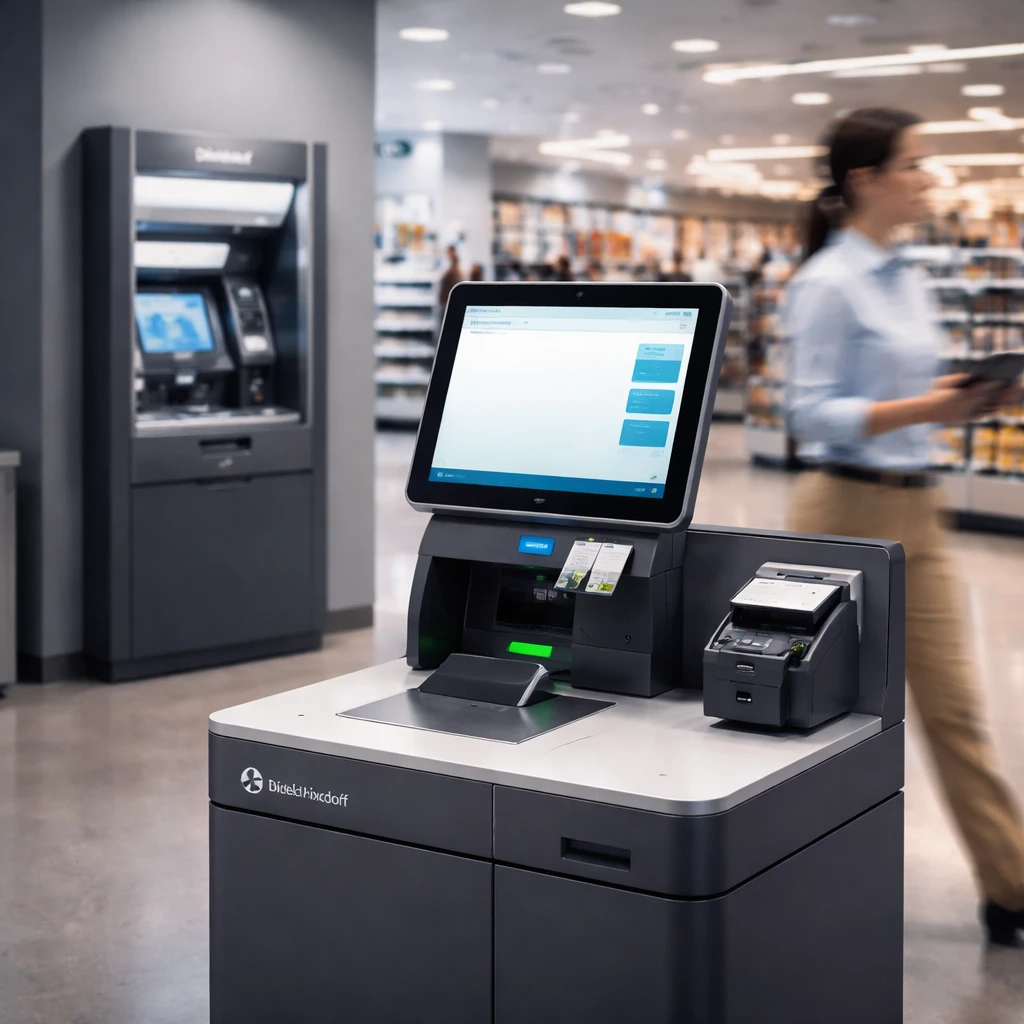
Diebold Nixdorf provides integrated software-led services, self-service delivery and security systems to banks, retailers, commercial and government customers. Its product set covers ATMs and ATM managed services, self-checkout kiosks, cash handling devices and associated software and servicing. The secular drivers matter: retail automation and contactless service adoption, ongoing ATM fleets needing remote monitoring and managed services, and the large installed base of banking hardware that requires lifecycle support.
Put simply, Diebold sits at the intersection of two durable markets: cash handling/ATM services and retail automation. Growth in self-checkout and kiosk demand (industry reports show strong CAGR for both segments) plays to Diebold’s hardware and software bundle — and the business model is trending toward more recurring service revenue and positive free cash flow.
Evidence from the numbers
- Liquidity and cash flow: Diebold reported positive free cash flow of roughly $239 million (most recent available figure), which materially improves the capital structure story versus prior years.
- Profitability: Trailing EPS is approximately $2.72, with a reported price/earnings around ~29x based on the recent price. Return on equity is modest at roughly 8.6%, showing the company is earning a return on capital as the turnaround progresses.
- Valuation: Enterprise value sits near $3.33 billion with EV/EBITDA about 9x. For a mixed hardware-and-services business moving toward recurring revenue, that multiple is reasonable and leaves room for re-rating if growth re-accelerates or margin expansion continues.
- Market action and liquidity: Shares trade with an average daily volume near 310k, float near 34.5 million shares and a 52-week range of roughly $36.43 to $85.99. Technical indicators show bullish momentum: RSI around 60, a rising MACD and moving averages that are converging higher.
- Recent operating datapoints: Q2 2025 revenue was reported at $915.2 million (08/06/2025) with the company maintaining full-year guidance at the time and showing growth in retail product sales — an important signal for margin recovery.
Valuation framing
At a market capitalization near $2.8 billion and enterprise value around $3.33 billion, DBD is trading at EV/EBITDA ~9x and a P/E in the high-20s. That positions the stock between low-growth industrial hardware multiples and higher multiple SaaS peers; the proper valuation hinge is how much of Diebold’s revenue mix transitions to higher-margin, recurring software and services over the next 12-24 months.
If recurring revenue grows and free cash flow stays solid, a rerating toward a mid-teens EV/EBITDA (assuming improved margin stability) would justify a material upside from current levels. Conversely, if hardware remains the dominant revenue driver with thin incremental margins, the current multiples may already price in reasonable outcomes. For a tactical trade, the EV/EBITDA 9x base gives us a margin of safety relative to outright speculative hardware plays.
Catalysts
- Index inclusion / rebalancing flows - Expectations of an index addition or rebalancing can create near-term buying pressure and squeeze short positions. Even expectations alone can tighten supply given a relatively modest float.
- Quarterly results and guidance - Upcoming quarterly results with sustained free cash flow and any upward guidance would be a clear catalyst for multiple expansion.
- Retail wins and product rollouts - Continued momentum in self-checkout kiosks and retail product sales (areas the company has flagged) should drive higher-margin revenue and lift investor confidence.
- Margin improvement / services growth - Evidence that service mix and software revenue are growing as a share of total revenue will be a multi-quarter rerating trigger.
Trade plan (actionable)
Recommendation: Establish a tactical long position at an entry of $80.00. This is a near-current-entry trade sized for investors comfortable with execution risk and sentence-style volatility.
| Entry | Target | Stop | Horizon |
|---|---|---|---|
| $80.00 | $95.00 | $72.00 | Long term (180 trading days) |
Rationale for horizon: Index inclusion and business mix shifts are multi-week to multi-month events. Expect the trade to run over several quarters as flows materialize, guidance is updated and margin recovery becomes visible. I prefer a long-term (180 trading days) window to give catalysts time to play out while managing risk with a clear $72 stop.
Position sizing and risk management
Given the stock’s average volume and float, avoid oversized positions that would be difficult to exit. Use the $72 stop and consider trimming into strength — for example, take 40% off the position near the first target and trail a stop on the remainder to capture additional upside should multiple expansion continue.
Risks and counterarguments
- Execution risk - Moving from hardware to a higher mix of services and software requires execution across sales, delivery and product integration. Missed targets or project delays would compress margins and disappoint investors.
- Macro and capex cycles - Banks and retailers can pull back capital expenditures in a macro slowdown, which would directly hurt sales of kiosks, ATMs and hardware.
- Short interest & volatility - The stock has visible short interest and elevated short-volume days. That creates two-sided risk: catalysts can spark squeezes, but negative news can accelerate downside moves through leveraged short positioning.
- Valuation sensitivity - At a P/E in the high-20s and EV/EBITDA ~9, a large portion of positive outcomes is priced in; any signal that revenue mix is not improving could quickly re-rate the stock lower.
- Liquidity and supply - Average daily volume (~310k) is decent, but the float is only ~34.5M shares. Large index-related flows could be transient, leaving price vulnerable once passive buying slows.
Counterargument: One could argue the turnaround is already reflected in the current price — the 52-week high near $86 and a P/E approaching 30 imply expectations of continued improvement. If Diebold fails to convert product momentum into durable service revenue growth, the stock could revert to a lower multiple quickly.
What would change my mind
I would be less constructive if the company misses free cash flow expectations, or if upcoming quarterly results show revenue declines in both retail product sales and services. A sustained cut in guidance or visible weakness in the ATM managed services book would also prompt exiting the trade. On the bullish side, faster-than-expected recurring revenue growth or a confirmed index inclusion with public timeline would make me more aggressive and push the target higher.
Conclusion
Diebold Nixdorf offers a pragmatic, event-driven trade: improving free cash flow and product momentum make the fundamental case, while expected index-related flows and bullish technicals provide a near-term catalyst. I recommend a tactical long at $80.00, with a stop at $72.00 and a target of $95.00 over a long-term horizon of 180 trading days. Keep position size conservative, monitor quarterly results closely, and be prepared to trim into strength or tighten stops if momentum weakens.
Relevant dates cited in this piece: Q2 revenue report 08/06/2025.