
Hook & thesis
ICU Medical is no longer an obscure supplier in the hospital supply chain; it is a cash-generative medtech platform that can drive margin expansion and begin to meaningfully return capital to shareholders. Recent quarterly beats, a free cash flow stream of roughly $92 million, and a conservative balance sheet give management optionality. That optionality - reinvesting in higher-margin products, paying down or refinancing debt, or initiating buybacks - is what makes ICUI attractive as a mid-term trade.
Price action has cooled from the $160 52-week high, offering a lower-risk entry near current levels. The set-up is straightforward: buy into evidence of margin conversion while keeping a tight stop for downside scenarios tied to supply-cost inflation or regulatory headlines.
What ICU Medical does and why the market should care
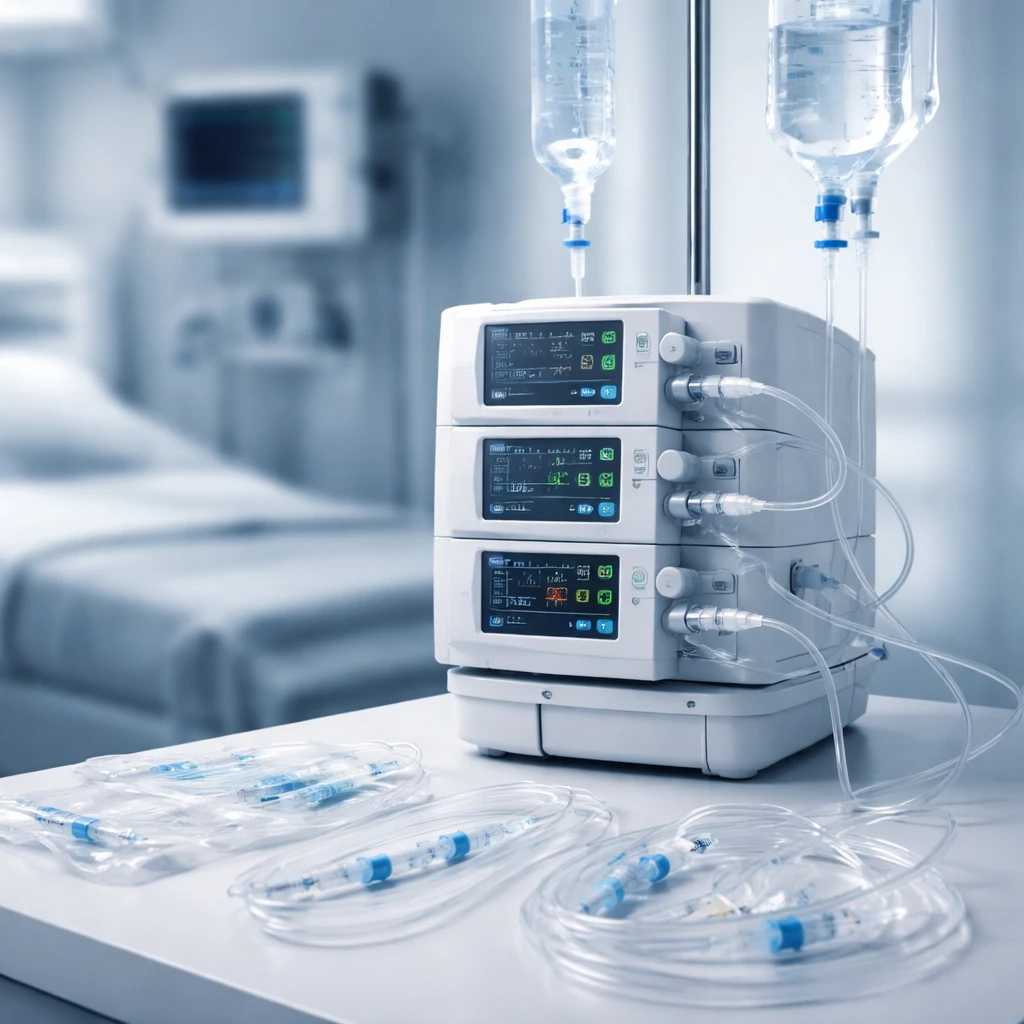
ICU Medical develops devices and consumables for infusion therapy and critical care: IV smart pumps and sets, closed system transfer devices for hazardous drugs, sterile IV solutions, and associated monitoring and safety software. These products are sticky - hospitals buy pump platforms and then consume proprietary disposables and solutions over years, creating recurring revenue and high gross-margin annuity-like streams.
The big fundamental driver is two-fold: 1) secular demand for infusion and critical care products as chronic disease prevalence and surgical volumes rise; and 2) differentiated pricing power on proprietary consumables and smart-pump ecosystems. Market research cited in recent industry write-ups points to multi-year growth in IV solutions and infusion pumps, which should help appliance utilization and mix.
Support for the thesis - the numbers
Key balance-sheet and valuation figures anchor the bullish case: market capitalization sits near $3.10 billion with an enterprise value around $4.12 billion. Management is generating free cash flow in the neighborhood of $91.8 million, and EV/EBITDA is roughly 13.3x. That combination - meaningful free cash generation and mid-teens EV/EBITDA - implies the business can afford selective reinvestment or shareholder returns without jeopardizing the balance sheet.
Liquidity and leverage metrics are reasonable: current ratio about 2.39 and debt-to-equity around 0.6, suggesting capacity to absorb working capital swings or fund buybacks without aggressive refinancing. The stock trades at $125.68 and has traded as low as $107 and as high as $160 over the past 52 weeks, so there is room for a mid-term recovery if margins keep improving.
Technical and investor positioning context
Short interest has moderated recently but remains meaningful (roughly 1.19 million shares on the latest settlement with days-to-cover around 4.17), so the street is paying attention. Technicals are constructive: the 10-day SMA sits near $124.55 and the 20-day SMA near $126.22, placing the current price in the immediate support/supply band. Momentum indicators show subdued but improving readings (RSI ~43.9; MACD histogram recently turned positive), which favors a tactical long rather than an aggressive breakout chase.
Valuation framing
On the surface the headline P/E is unhelpful (skewed by near-term EPS volatility and nonrecurring items), but other metrics offer a clearer read. EV/EBITDA at ~13.3x and EV/sales near 1.85x reflect a market willing to pay for a stable medtech business with recurring consumables. P/FCF around 34x is higher than what value investors prefer, but not extreme for profitable medtechs with durable cash flows and product annuities. Given the free cash flow profile, the market capitalization of ~$3.1 billion supports a narrative where modest margin expansion or a modest buyback program could be multiple-accretive over the coming quarters.
| Metric | Value |
|---|---|
| Current price | $125.68 |
| Market cap | $3.10B |
| Enterprise value | $4.12B |
| EV/EBITDA | 13.3x |
| Free cash flow (TTM) | $91.8M |
| P/FCF | 34.3x |
| Current ratio | 2.39 |
| Debt/Eq | 0.60 |
| 52-week range | $107.00 - $160.29 |
Catalysts
- Quarterly margin print showing continued operating leverage as higher-margin products and cost actions flow through the P&L.
- Management signaling or initiating a capital return program (share repurchases or an expanded buyback authorization), which would directly support EPS and FCF per-share metrics.
- Positive macro tailwind for IV solutions and infusion pumps from rising chronic care demand and surgical volumes, sustaining volume and ASP mix benefits.
- Resolution or benign conclusions to any outstanding regulatory/legal inquiries that have been a headline risk, removing an overhang on the shares.
Trade plan (actionable)
Direction: Long
Entry: $126.00
Target: $150.00
Stop loss: $115.00
Horizon: mid term (45 trading days) - the rationale is to give one to two quarterly datapoints and any near-term margin commentary time to manifest in results and guidance revisions. This horizon captures the next quarterly report cadence and allows catalysts—like a buyback initiation or a clearer margin trajectory—to show up without overexposing to longer-term macro risks.
Implementation notes: enter near $126.00 and size the position so that the $115 stop represents an acceptable dollar loss relative to portfolio risk tolerance. The $150 target strikes a balance between reward and realism: it sits below the 52-week high but reflects ~19% upside from entry, which is reasonable if management confirms margin leverage or announces a capital return plan.
Risks and counterarguments
- Input cost inflation: Petrochemical-derived raw material prices could increase IV bag and tubing costs. Recent industry commentary warns that petrochemical supply shocks could push costs higher within weeks, compressing margins before product price pass-through can occur.
- Regulatory / legal overhang: There have been investigations and legal notices involving the company. Any protracted or adverse regulatory outcome could hurt revenues, increase compliance costs, or create an earnings haircut.
- Execution risk on margin conversion: Improving gross margins in a medtech business is often incremental. If the company fails to convert higher-margin mix or if there are unexpected SG&A or R&D increases, the margin leverage thesis could stall.
- Valuation sensitivity: P/FCF near 34x and P/S ~1.41x mean the stock already prices in a fair amount of positive execution. Disappointing numbers could result in a sharp re-rating, especially given the historically wide EPS swings.
- Short-squeeze volatility: Meaningful short interest creates the potential for sharp intraday moves; this works both ways and can make stops harder to execute cleanly.
Counterargument: One credible counterpoint is that margin expansion is already priced in and management will choose to reinvest heavily into R&D and manufacturing capacity rather than return cash. If the company prioritizes growth capex over buybacks or dividends, the capital-return story could be delayed and the stock may grind lower even with solid topline numbers. That scenario would make the current valuation less attractive and could compress multiples until visible returns are delivered.
What would change my mind
I would reduce conviction if upcoming quarterly results show persistent margin pressure (gross margin compression >200 bps year-over-year) driven by higher input costs that management cannot offset with pricing. I would also change my view if free cash flow falls materially below the current run rate or if management explicitly rules out any near-term capital return program. Conversely, conviction would rise materially if the company announces a buyback authorization, raises guidance on margins, or posts another clean beat on EPS with explicit commentary on sustaining margin gains.
Conclusion - clear stance
ICU Medical is a tactical long for the mid term (45 trading days). The combination of recurring consumable revenue, a healthy free cash flow profile (~$91.8M), reasonable leverage (debt/equity ~0.6) and an EV/EBITDA of ~13.3x creates a favorable backdrop for margin-driven upside and a nascent capital-return story. The trade uses a defined entry at $126.00, a protective stop at $115.00, and a target of $150.00 to balance upside potential with realistic risk management. Stay nimble around earnings and headlines, and cut quickly if the margin story stalls or costs spike.