
Hook & thesis
Celestica is one of the cleanest, most direct ways to get exposure to the AI infrastructure buildout. The company sits at the intersection of contract manufacturing, systems integration and logistics for servers, storage and networking - the exact hardware that cloud and enterprise customers are buying to scale AI workloads. Recent partnership news with AMD on a rack-scale platform and the company's ability to generate free cash flow make Celestica a tactical long with defined risk controls.
We like Celestica because it combines operational capacity that scales with customer demand and a balance sheet that supports rapid ramping. The stock trades at $328.54 today after a strong run, but the fundamentals - $7.24 in earnings per share, a market cap near $37.8 billion and $458.3 million of free cash flow - justify a position for investors who want to play AI infrastructure outside of the pure-play chip names.
What Celestica does and why the market should care
Celestica is a global provider of supply chain solutions and electronics manufacturing services. It operates two primary segments: Advanced Technology Solutions (ATS) - which includes aerospace, defense, industrial, health tech and capital equipment - and Connectivity and Cloud Solutions (CCS) - which covers enterprise communications, telecommunications, servers and storage.
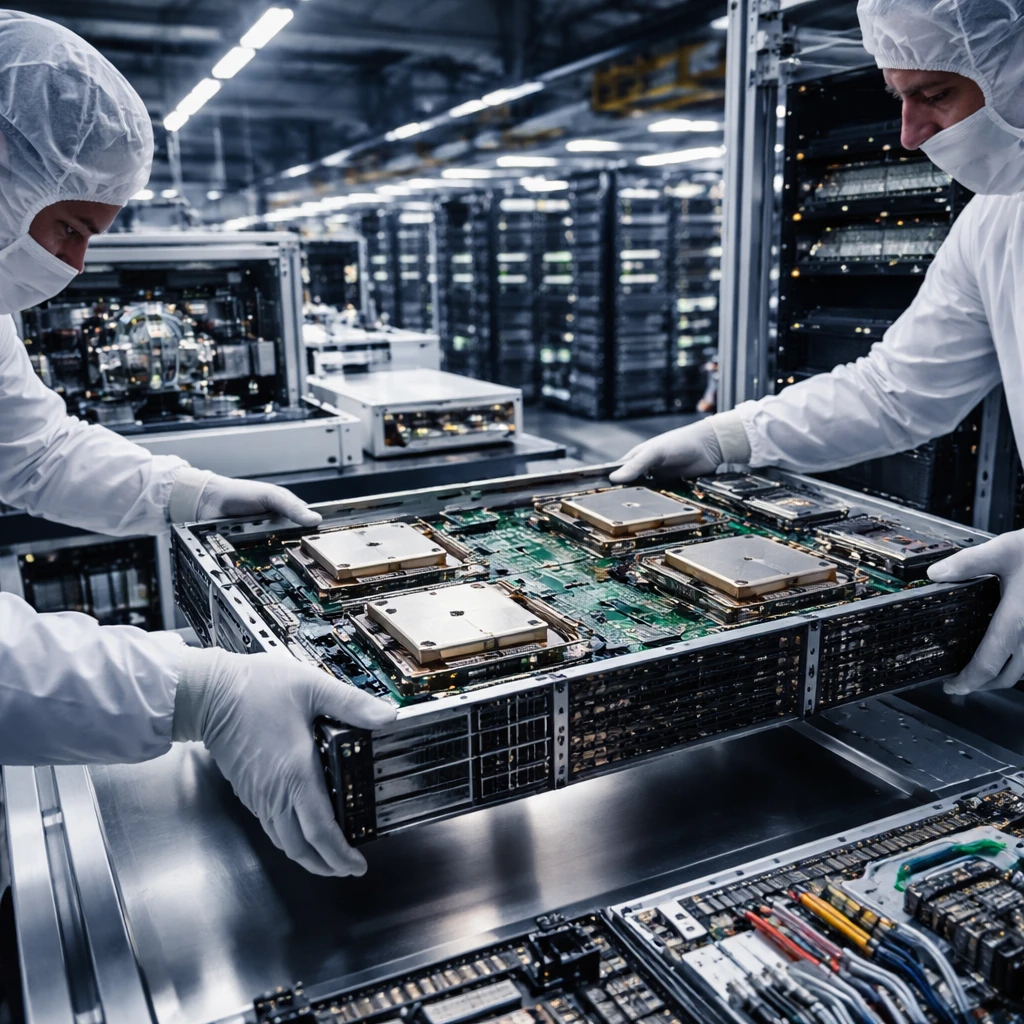
The important point for investors is the CCS business. The company is already manufacturing and integrating server and networking hardware that cloud providers and large enterprises need to deploy AI clusters. That is not a commodity assembler role: it requires engineering, thermal and mechanical design expertise, quality control at scale, and supply-chain coordination for specialized components (including high-bandwidth memory and custom interconnects). When hyperscalers commit capex to train and serve large models, someone has to turn chips and boards into racked, validated systems at scale - and Celestica is positioned to be that partner.
Recent proof points
- Strategic partnership with AMD to develop and manufacture networking switches for AMD's "Helios" rack-scale AI platform (announced 03/16/2026). This is a direct, revenue-bearing collaboration that maps to large-scale AI deployments.
- Strong profitability and cash generation: EPS of $7.24 and reported free cash flow of $458.3 million.
- Balance-sheet and leverage: debt-to-equity of 0.35 and an enterprise value of roughly $37.05 billion - manageable leverage for a company with recurring contract flows.
Valuation framing
Celestica's market capitalization stands at $37,771,586,720 and it trades at a P/E in the mid-40s (approx. 44.3). Price-to-sales is roughly 2.98 and EV/EBITDA is about 29.7. Those multiples look rich versus a generic industrial manufacturer, but they reflect a company with high incremental margins on systems assembly, strong ROE (about 37.6%) and meaningful free cash flow.
Context matters: Celestica is not being priced like a low-margin EMS player; the market appears to be valuing the company for growth and margin expansion tied to AI-related systems. At $328.54 the stock is below its 52-week high of $363.40 (11/05/2025) and far above the 52-week low of $68.83 (04/09/2025), which highlights the re-rating the business has undergone as investors assign more value to AI-exposed supply-chain assets.
Put simply, you are paying for growth and optionality. If Celestica wins a material share of cloud or enterprise rack builds for AI, multiples could compress positively as EBITDA and FCF scale. If AI demand disappoints, the current multiple leaves downside risk.
Catalysts
- Ramp of the AMD Helios rack-scale platform with Celestica as a manufacturing partner - initial deployments and commercialization milestones should translate into visible revenue in quarterly results (catalyst timeline: 1-4 quarters following announcements).
- New contract announcements with other cloud or enterprise customers expanding CCS revenue.
- Quarterly beats on revenue and margin as higher-margin AI system assembly scales; watch FCF conversion and gross-margin expansion in earnings reports.
- Resolution or clarification on investigator activity tied to customer assembly shifts - a favorable outcome would remove a material overhang (news item noted on 02/17/2026).
- Industry-level drivers: accelerated datacenter capex for inference and training workloads, and better availability of HBM and other specialized components, which would ease supply constraints.
Trade plan (actionable)
Trade direction: Long. Risk level: Medium.
Entry price: $328.54 (current market price). Target price: $375.00. Stop loss: $295.00.
Horizon: long term (180 trading days). Rationale: the partnership ramps and meaningful contract wins in manufacturing and systems integration take multiple quarters to convert to revenue and visible margin improvement. Allowing ~180 trading days (roughly six months) gives time for order flow, production scaling and at least two quarterly results that could show the impact of AI-related projects on revenue and FCF.
Position sizing: keep any single position to a size consistent with a medium-risk allocation in a diversified portfolio (we recommend no more than 3-5% of total capital for a single trade idea unless you have a higher risk appetite).
Supporting technical and market signals
- Daily momentum is constructive: MACD shows bullish momentum with a positive histogram and the RSI sits near 63.8, indicating strength without extreme overbought readings.
- Volume profile is healthy: two-week average daily volume is roughly 1.84 million shares, and recent daily volume supports liquidity for entrance and exit at reasonable spreads.
- Short interest and short-volume data show occasional elevated short activity, but days-to-cover remains low (~2 days in recent settlements), so the stock is not heavily over-shorted relative to average volume.
Risks and counterarguments
Below are the primary risks that could invalidate this thesis, plus a counterargument worth considering:
- Customer-concentration and execution shifts. Reports that large customers may move assembly in-house or to other suppliers can remove a material revenue stream. An investor action point: monitor any customer win/loss commentary in quarterly calls and press releases. (Negative news on this front surfaced and prompted market reaction on 02/17/2026.)
- Legal and reputational overhang. The existence of an investor investigation into securities claims tied to customer assembly shifts can create volatility and deter new contract announcements until matters are resolved.
- Supply-chain constraints for key components. AI systems require specialized memory and interconnect components; shortages (or sticky pricing) for HBM or custom silicon could reduce margins or delay shipments. AMD commentary around HBM supply in the industry highlights this systemic risk.
- Valuation sensitivity. At ~44x reported EPS and EV/EBITDA near 29.7, Celestica is priced for growth. Any slowdown in AI capex would likely compress multiples rapidly and produce negative returns.
- Macro/capex cycles. Datacenter capex is lumpy and sensitive to macroeconomic conditions. A broad enterprise/cloud capex pullback would hit order books and revenue visibility.
- Counterargument: the market may already have priced in a best-case AI ramp into Celestica, so upside could be limited if growth is significant but less than expectations. That said, Celestica's free cash flow ($458.3M) and strong return on equity (~37.6%) give it the financial flexibility to invest in capacity and to compete on execution - which makes it better capitalized to win than smaller EMS peers.
What would change my mind
I would reduce conviction or flip to neutral/short if any of the following occur:
- Concrete evidence that multiple hyperscalers are shifting large-volume AI rack assembly away from Celestica to a competitor or in-house (material revenue loss).
- Quarterly results that show declining gross margins and negative FCF conversion, suggesting the company cannot scale AI systems profitably.
- Adverse legal rulings or settlements stemming from the investor investigation that materially damage management credibility or result in financial penalties.
Conclusion
Celestica is a tactical, high-conviction long for investors seeking exposure to the AI infrastructure buildout without concentrating in chipmakers or hyperscalers. The AMD Helios partnership is a concrete, near-term revenue pathway, and the company’s cash generation and returns support a growth-at-a-reasonable-price argument despite a premium multiple. Our trade plan - entry at $328.54, stop at $295.00, and a target of $375.00 over a 180-trading-day horizon - balances upside from AI-related ramps with a pragmatic risk control that recognizes valuation and execution risks.
Monitor customer announcements, quarterly margin trajectories and the legal overhang. If Celestica converts partnership announcements into visible revenue and margin expansion, the shares should re-rate materially higher; if execution or customer shifts occur, the stop loss limits downside while the thesis is reevaluated.
Quick reference - Trade parameters
| Direction | Entry | Stop | Target | Horizon |
|---|---|---|---|---|
| Long | $328.54 | $295.00 | $375.00 | long term (180 trading days) |
For traders: use the stop and reassess into newsflow; for investors: consider a staged build if you want a longer-term hold after the company provides evidence of durable AI-related order flow.