
Hook & thesis
Cal-Maine Foods (CALM) looks like a classic cash-generative predator in an out-of-favor commodity market: low multiple, visible free cash flow, and a small, strategic acquisition that meaningfully increases capacity. The company's recent purchase of Creighton Brothers for $128.5 million - including capacity for 3.2 million laying hens and an egg products processing plant in Indiana - strengthens vertical sourcing for its growing prepared foods business. Given Cal-Maine's valuation metrics (P/E ~5.3, EV/EBITDA ~3.4), I believe the market has not fully priced the acquisition's earnings and margin upside into the share price.
This note lays out a position trade: a long on CALM with entry at $77.07, a stop loss at $70.00, and a target at $95.00. I expect the trade to play out over roughly 120 trading days (position - 120 trading days) to allow for operational integration, seasonal price movement in eggs, and at least one dividend payment to flow through investors' returns.
Business and why the market should care
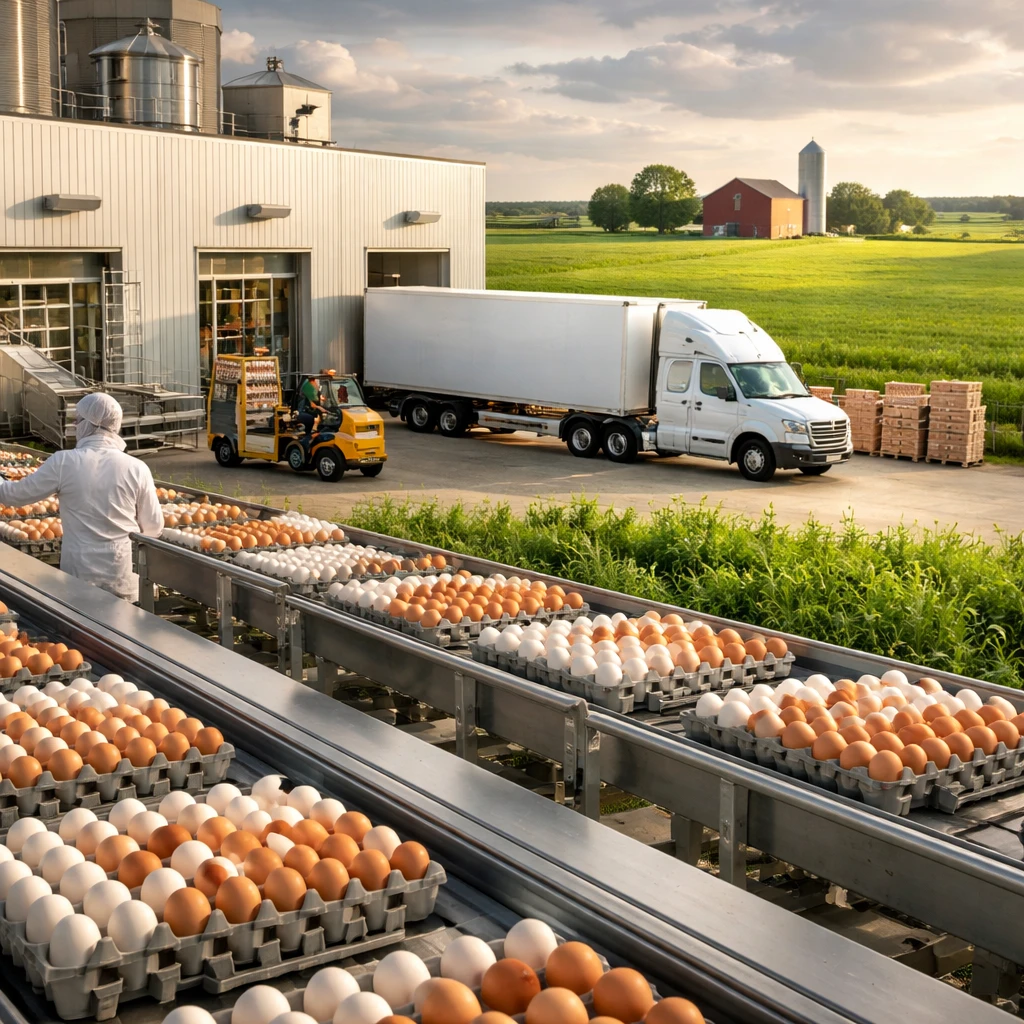
Cal-Maine is the largest shell egg producer in the U.S., operating farms, processing plants, hatcheries and feed mills. Customers include national and regional grocery chains, club stores, foodservice distributors and egg-product manufacturers. The company reported Q3 fiscal 2026 net sales of $667.0 million (down 53% year-over-year) and diluted EPS of $1.06 (down 89.8%) as egg prices normalized after a prior supply shock. Even with those declines, Cal-Maine remains cash-generative: reported free cash flow of $720.36 million and an enterprise value of roughly $3.26 billion.
Investors should care for three connected reasons:
- Scale and cash flow - Cal-Maine trades at a low multiple: price-to-earnings ~5.25 and price-to-book ~1.35. Its EV/EBITDA is about 3.42 and EV/Sales ~0.94. Those multiples are consistent with an industry-commodity discount but leave room for upside if earnings recover or improve via higher-margin lines like prepared foods.
- Acquisition-driven margin optionality - The Creighton deal (announced 03/02/2026) cost $128.5M in cash and adds 3.2M laying hens and an egg-products facility in Indiana. Management says this strengthens internal sourcing for prepared foods, a line that grew 441.2% in the quarter. Specialty eggs already represent 50.5% of shell egg sales, so expanding capacity and processing can lift realized margins on higher-value SKUs.
- Dividend and yield support - Cal-Maine declared a quarterly dividend of $0.36 per share; the stock yields roughly 10.5-10.8% depending on the data point you use. That yield puts a floor under downside for income-focused investors, especially with the next ex-dividend date on 04/29/2026 and payable date 05/14/2026.
Supporting numbers from recent results and the balance sheet
- Q3 FY2026 net sales: $667.0 million, down 53.0% YoY.
- Q3 FY2026 diluted EPS: $1.06, down 89.8% YoY.
- Free cash flow (latest reported): $720.36 million.
- Market capitalization: ~ $3.65 billion; enterprise value: ~ $3.26 billion.
- Valuation multiples: P/E ~5.25, EV/EBITDA ~3.42, P/B ~1.35, EV/Sales ~0.94.
- Acquisition cost: $128.5 million in cash; adds capacity for 3.2 million hens and processing capability in Indiana (announced 03/02/2026).
- Dividend: $0.36 per share quarterly; ex-dividend date 04/29/2026; payable date 05/14/2026.
- Technicals/market structure: current price $77.07, 52-week high $126.40, 52-week low $71.92, RSI ~39.7 (slightly oversold), and shares outstanding ~47.38 million.
Valuation framing
Cal-Maine's valuation reads cheap relative to the business's cash-generative profile. A P/E near 5.3 and EV/EBITDA near 3.4 typically imply either persistent commodity headwinds, structural earnings decline, or balance-sheet/operational risk. None of those are obviously present here: the company has limited reported debt (debt-to-equity shows 0), reported strong free cash flow, and used cash on hand to fund the Creighton deal rather than taking on leverage.
The acquisition logic is straightforward: internalize more of the supply chain for prepared foods (a high-growth, high-margin segment for Cal-Maine) and expand specialty egg capacity. If management can preserve or expand margins on specialty and prepared SKUs, earnings per share and free cash flow should recover faster than the broader shell-egg commodity cycle. Given current multiples, only a modest EPS recovery is needed to generate meaningful upside for shareholders.
Catalysts
- Operational integration of Creighton assets and visible cost or margin improvements (expected over the next several quarters).
- Seasonal egg price improvements or renewed supply constraints (eggs are sensitive to supply shocks and HPAI developments), which would lift commodity realization.
- Dividend capture around ex-dividend date 04/29/2026 and payable 05/14/2026, which can attract income buyers and reduce near-term selling pressure.
- Progress on prepared foods growth showing sustainable margin expansion (prepared foods grew 441.2% in the quarter - proof of concept that scale can multiply earnings).
- Any public commentary from management quantifying expected synergies or incremental EBITDA from the Creighton purchase during subsequent earnings calls.
Trade plan (actionable)
- Trade direction: Long CALM.
- Entry price: $77.07.
- Stop loss: $70.00 (if price breaks below this, it’s a sign the market is repricing downside risk; cut size).
- Target price: $95.00.
- Position size: size this as a position trade consistent with your portfolio risk tolerance; the thesis hinges on integration and commodity cycles, so avoid overleveraging.
- Horizon: position (120 trading days). I choose 120 trading days because integration benefits and seasonality in egg pricing typically need multiple quarters to translate into EPS and free-cash-flow expansion. Expect to reassess after ~60 trading days at interim updates or after the next earnings call.
Why these levels? The entry is the current tradable price so you get immediate exposure to potential catalysts. The stop at $70 keeps downside capped to roughly 9% from entry and sits just below the 52-week low ($71.92) - a break below that zone suggests broader market re-evaluation. The $95 target is a realistic re-rating from a P/E ~5.3 to an exit P/E in the ~7.0-8.0 range on a recovering earnings base and visible integration gains - it represents roughly 23% upside from entry, plus dividends while you hold.
Risks and counterarguments
- Commodity-price risk - Egg prices remain volatile. If prices continue to normalize or decline further, top-line pressure and margin compression could persist and delay earnings recovery.
- Avian flu (HPAI) risk - Renewed outbreaks could force flock culls or supply disruptions that harm production and margins in unpredictable directions.
- Integration execution risk - Creighton brings scale and capacity, but integration missteps, higher-than-expected capex, or operational disruptions could dilute expected benefits.
- Dividend sustainability - The yield is attractive (~10.5-10.8%), but if earnings remain depressed management may be forced to reduce payouts to preserve capital.
- Investor sentiment and technicals - Short interest is elevated (short interest ~5.19M recently with days-to-cover near 6.8), and the stock has been trading below near-term moving averages; this can amplify downside during market stress.
Counterargument: The market may already be pricing in the acquisition’s risks and the commodity-cycle sluggishness. A deep and prolonged decline in egg realizations or a surprise capex burden tied to integrating Creighton could keep earnings depressed, meaning the low multiples are warranted. Additionally, specialty and prepared foods are growing off a smaller base; even very high percentage growth does not instantly move company-wide margins.
What would change my mind
I would reassess or exit the trade if one or more of the following occurs:
- Management publicly revises synergy expectations materially lower or discloses unexpected integration costs tied to the Creighton assets.
- Company guidance points to another prolonged period of depressed egg realizations (several consecutive quarters of negative pricing surprises).
- Material balance-sheet deterioration or a decision to meaningfully cut the dividend to shore up liquidity.
Conclusion
Cal-Maine is a cash-rich, low-multiple commodity producer that just added strategically relevant capacity with the Creighton acquisition. Valuation metrics look cheap versus a business that still generates strong free cash flow and is shifting revenue mix toward higher-margin prepared foods and specialty eggs. That combination - low multiples plus a clear, near-term catalyst - creates an asymmetric risk-reward for a position trade over the next ~120 trading days. The entry at $77.07, stop at $70.00 and target at $95.00 give defined risk and a path to meaningful upside if integration and pricing dynamics play out in the company’s favor. Keep position sizing sensible and monitor the next earnings update for confirmation of integration benefits.