
Hook / Thesis
Broadcom is not the loudest name in AI, but it may be the most consequential plumbing company undergirding the next wave of inference infrastructure. While headlines favor GPUs and general-purpose stacks, Broadcom has quietly captured custom accelerator contracts with hyperscalers and built a diversified revenue mix that turns high-margin silicon wins into meaningful free cash flow.
That combination - sticky hyperscaler design wins, enormous free cash flow and a net-debt position that management can deploy - creates a near-term trade opportunity. If AI capex reaccelerates into mid-2026 and Broadcom executes on ramp plans, the stock can re-rate materially from the current ~$314.56 price. This idea frames an actionable long with entry, stop and targets and explains the fundamental rationale and key risks.
What Broadcom does and why the market should care
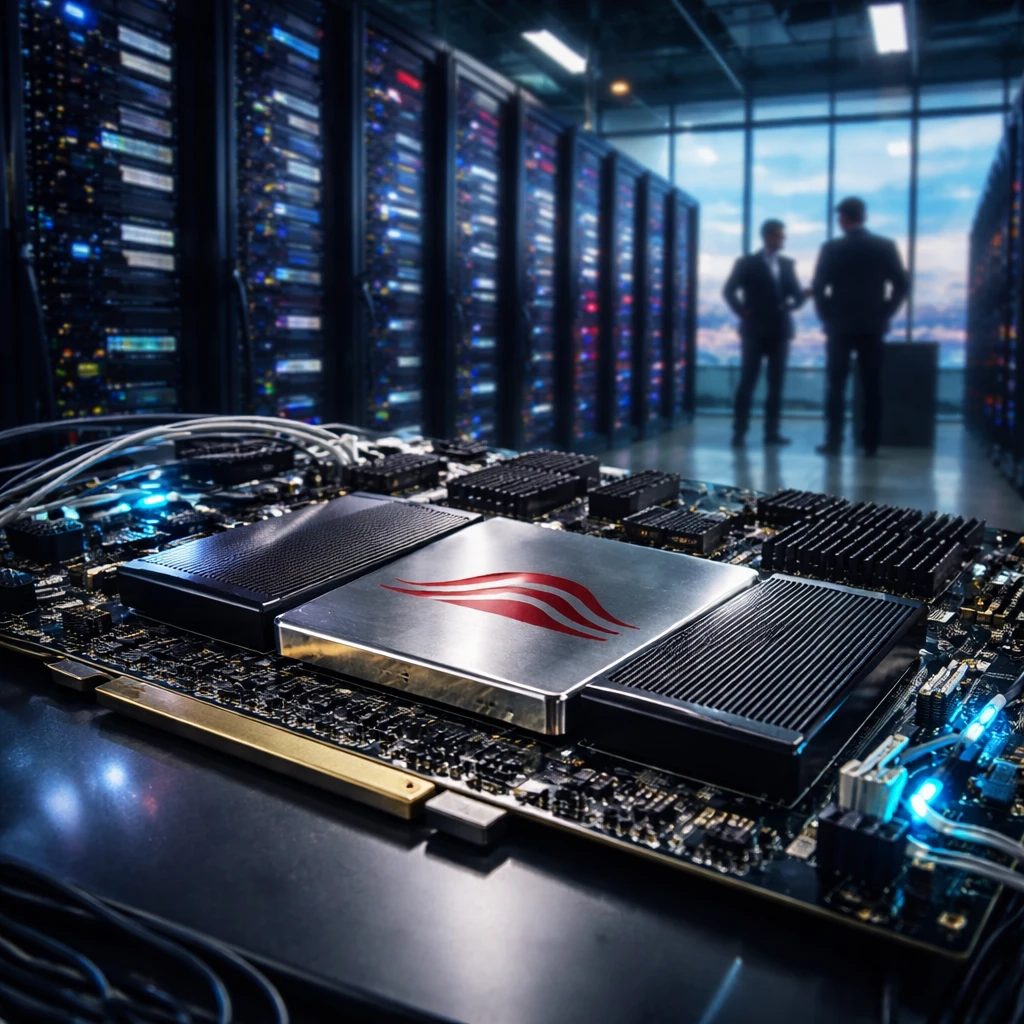
Broadcom operates across two large pillars: Semiconductor Solutions (custom and commodity chips) and Infrastructure Software (mainframe, security and storage networking). The real story for this trade is the Semiconductor Solutions side: custom AI accelerators that hyperscalers are commissioning to drive inference cost-efficiency.
Why does that matter? AI inference is a scale business. Once a hyperscaler commits to a custom accelerator, the revenue profile is sticky and scales quickly across data centers. Broadcom's approach is not to fight on a general-purpose playing field but to partner on tailored silicon - a model that delivers attractive margins and predictable multiyear revenue streams.
Key financials and market context
Use the numbers: Broadcom carries a market capitalization near $1.49 trillion and an enterprise value around $1.54 trillion. Recent reported free cash flow sits at about $28.9 billion - an enormous cash engine that funds buybacks, dividends and strategic R&D.
Profitability metrics are strong: return on equity is roughly 31%, return on assets ~14.7%, and the company maintains a debt-to-equity of ~0.83 - not asset-light leverage but manageable for a large-cap tech compounder. The company also pays a modest dividend (roughly 0.8% yield) while prioritizing capital returns.
Valuation framing
At around $314.56 the stock trades at a trailing P/E near the high 50s / low 60s (market snapshots show values ~59-61x). Price-to-sales and EV-to-sales multiples are elevated (P/S >21, EV/S roughly 22.6). On face, Broadcom sits at premium multiples that reflect high profitability and structural exposure to AI infrastructure.
Two points on valuation: first, multiples look expensive versus broad-market averages but not unreasonable versus mission-critical data-center infrastructure peers that trade on revenue durability and high cash conversion. Second, free cash flow of ~$29B supports buybacks and multiple support; when cash generation is this large relative to market cap, valuation should be viewed in the context of cash yield and capital allocation optionality rather than just P/E.
Technical and market structure notes
Price action has consolidated: 10-day SMA sits near $311, 50-day SMA closer to $325 and RSI about 47 - neither stretched nor oversold. Momentum readings show some short-term bearish MACD histogram (slight negative), but short interest in the most recent settlement is modest (~52.5 million shares), which represents just over 1% of float and only ~1.66 days to cover. That structure means short squeezes are possible but not the primary catalyst.
Concrete trade plan (actionable)
Trade direction: Long
Entry price: $314.56
Stop loss: $285.00
Target 1: $360.00
Target 2 (stretch): $420.00
Horizon: long term (180 trading days) - plan to hold into the 2H 2026 AI capex cycle and earnings ramps tied to hyperscaler rollouts.
Why these levels? Entry reflects the current print and allows room for short-term noise. The stop at $285 protects capital if Broadcom misses hyperscaler ramps or if macro volatility reintroduces a broad-tech risk-off leg; $285 is also comfortably below the 10-day and recent consolidation lows, giving the trade a buffer. The first target at $360 is a conservative re-rating off continued execution and represents ~14.5% upside. The $420 stretch target is near the prior 52-week high ($414.61) and assumes a sustained reacceleration of AI inference demand plus multiple expansion.
Catalysts that can drive the move
- Hyperscaler deployments and public confirmations of custom Broadcom accelerator ramps - contract announcements or customer commentary could materially re-rate expectations.
- Quarterly results or guidance beats where semiconductor revenue and gross margins expand due to higher-mix custom AI chips.
- Renewed AI capex cycle in data centers in 2H 2026, moving spend from prototype to production-scale procurement.
- Strategic M&A or increased buyback cadence funded from free cash flow - any visible upgrade to capital return policy would support the multiple.
Balanced risk framework
This trade is bullish, but risks are real and measurable.
- AI spend timing risk - Hyperscaler procurement cycles can slip. If AI spending delays or shifts to alternative architectures (e.g., cloud-only offloads or software optimizations that reduce hardware demand), Broadcom's custom chip ramps could be postponed.
- Competition and design risk - Nvidia, AMD and other silicon vendors are aggressively optimizing inference stacks. Broadcom's win rate depends on execution quality and differentiated efficiency; lost RFPs would reduce upside.
- Valuation compression - The stock's premium multiples leave less room for disappointment. Macroeconomic shocks or broad multiple contraction in tech would pressure the price even if revenue trends remain solid.
- Customer concentration - Hyperscaler wins are high-value but concentrated. If one major partner slows or shifts to a competitor, the revenue and margin impact could be magnified.
- Supply chain / execution - Large-scale silicon production and yield issues can delay shipments; given the scale of hyperscaler contracts, production hiccups would be damaging.
Counterargument
One plausible counterargument is that Broadcom is a defensive, diversified cash engine already priced for perfection: high P/E, high EV/S and a run of good execution. If AI revenue growth is real but not large enough to justify elevated multiples, returns will be muted and investors may prefer higher-growth names. In that scenario, Broadcom still returns cash, but price appreciation lags. That is why the stop and two-tier targets are essential - the trade captures an asymmetric reward if AI ramps faster than consensus and limits downside if the market re-rates the stock.
What would change my mind
I would materially downgrade this trade if any of the following occur: (1) clear public evidence that hyperscalers are pulling back custom AI accelerator programs or shifting to different vendors at scale, (2) a quarter with meaningful misses in semiconductor revenue or gross margin that point to design or yield issues, or (3) a broad tech-market de-risk that compresses multiples by 20%+ without relief from buybacks or improved guidance.
Key metrics snapshot
| Metric | Value |
|---|---|
| Current price | $314.56 |
| Market cap | $1.49T |
| Enterprise value | $1.54T |
| Free cash flow | $28.9B |
| Trailing P/E | ~60x |
| EV / Sales | ~22.6x |
| ROE | ~31% |
| Debt / Equity | ~0.83 |
| 52-week range | $138.10 - $414.61 |
Final take
Broadcom is a pragmatic way to play AI infrastructure exposure without buying the headline-grabbing GPU names. The company combines durable hyperscaler partnerships, a sizeable free cash flow base and a balance sheet capable of sustaining growth and returns. That makes a long entry at ~$314.56 a reasonable, actionable trade if you accept the thesis that custom accelerators will be a meaningful slice of AI inference spend in 2026.
Trade with discipline: enter around $314.56, use a $285 stop to protect capital, and look for $360 as the first realistic re-rating target and $420 as a stretch if the AI cycle accelerates. If hyperscaler commentary, quarterly results and production ramps align over the next several quarters, this trade has an asymmetric upside profile that justifies the risk.