
Hook and thesis
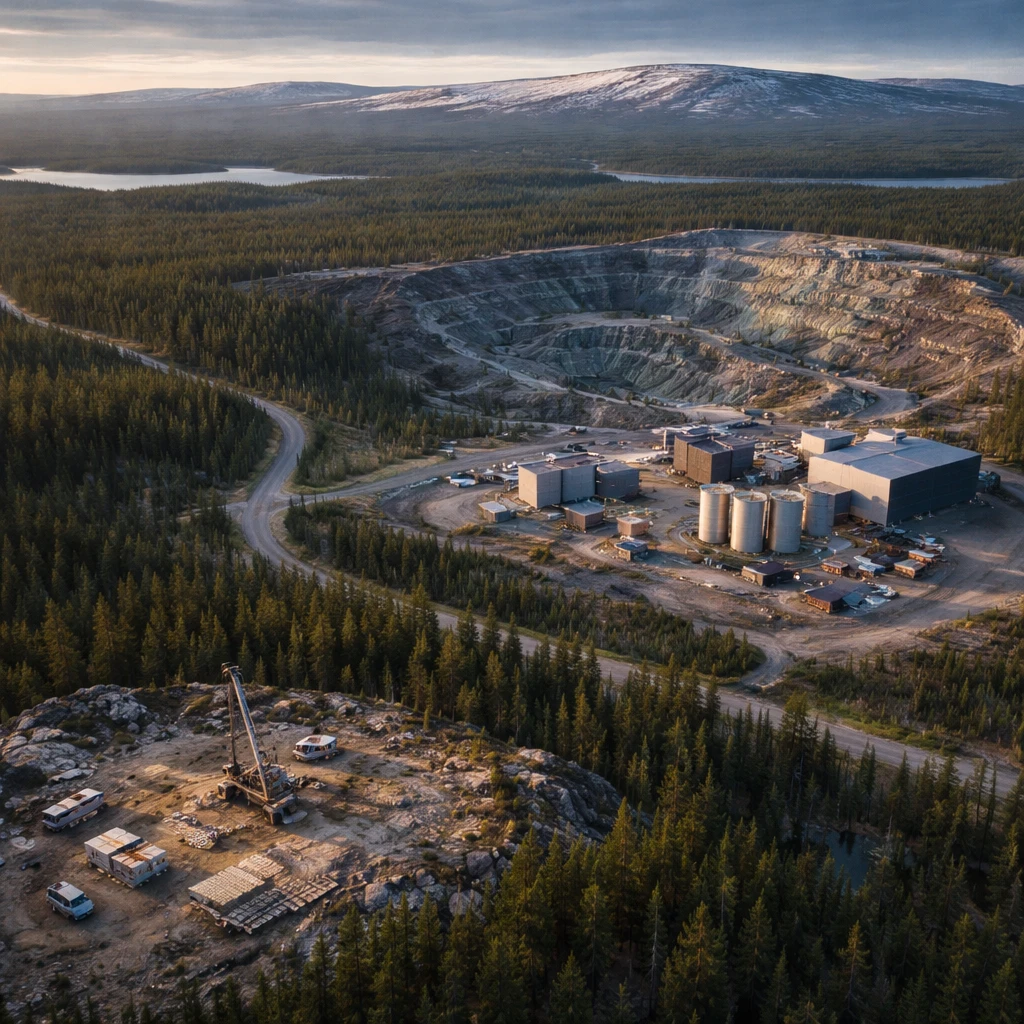
Agnico Eagle is at a turning point. The company just assembled a contiguous 2,492 square-kilometer district in Finland's Central Lapland Greenstone Belt via a string of acquisitions announced on 04/20/2026, and separately agreed to buy B2Gold's 70% interest in the Fingold joint venture for US$325 million. These moves are not financial engineering intended to juice near-term headline metrics. They materially alter the reserve, resource and production runway available to Agnico - creating a credible path to higher, lower-cost output and $365 million of cited synergies on district consolidation.
Put simply: this is a miner buying future ounces and the optionality of recurring free cash flow. That matters more than raw bullion direction for a company of Agnico's scale. My trade thesis: buy AEM for project-driven rerating with the trade plan below.
Why the market should care
Agnico is not a single-mine operator. It runs diversified assets across Northern and Southern businesses plus exploration. The recent deals expand its footprint around the Kittile4 mine and adjacent Ikkari and Aurion assets, consolidating fragmented ownership and creating obvious operational synergies. Management has publicly quantified potential synergy benefits of roughly $365 million and set a strategic intent to lift annual production toward 500,000 ounces within a decade from the consolidated Finnish district (04/20/2026 announcement).
Operational scale matters in mining: higher-scale, contiguous assets reduce per-ounce sustaining and expansion costs, improve access to higher-margin ore, and shorten mine-life tail risks through seamless satellite development. For investors, that translates into a more deterministic production profile and less reliance on volatile spot gold to create value.
The business in numbers
Key snapshot metrics underpin the case:
- Market cap: $105.74 billion.
- P/E ratio: 24.35; P/B: 4.37.
- Dividend per share: $0.45 quarterly, yielding ~0.76%.
- Shares outstanding: 500,989,470; float ~499.47 million.
- 52-week high / low: $255.24 / $103.38.
- Average daily volume (30d): ~2.41 million shares; recent two-week average ~1.84 million.
Technically, the stock is not overbought. The 10-day simple moving average is $216.50, 20-day SMA is $207.65 and 50-day SMA is $214.98. The 14-day RSI sits near neutral at 49.94 and MACD is showing bullish momentum with a positive histogram. Short interest has been low on a days-to-cover basis recently (~1.5 on 03/31/2026), which suggests fewer structural sellers to cap a rally.
Valuation framing
At a $105.7 billion market cap and a P/E of 24.3, Agnico is priced like a high-quality, scaled gold producer rather than a pure exploration story. That premium is warranted in part: a diversified portfolio, a history of steady cash generation and a dividend. Still, the market appears to be assigning only modest value to the newly consolidated Finnish district and the near-term production uplift from Fingold and Aurion-type deals.
Two valuation points to keep in mind:
- Relative to its own 52-week range, AEM trades well under the March 2026 peak of $255.24. If the market re-rates to re-capture even a portion of that premium on better-than-expected project updates, the upside is material.
- At current multiples, a modest improvement in annual attributable production or margin expansion could swing free cash flow materially given Agnico's scale. That in turn would justify a multiple expansion even if gold prices remain range-bound.
Catalysts
- Closing of the Aurion Resources acquisition - announced 04/20/2026 and expected to close early Q3 2026 - which increases the exploration and development optionality in Finland.
- Expected close of the Fingold purchase from B2Gold for US$325 million (announcement 04/20/2026) and the associated Nunavut collaboration agreement; operational synergies and knowledge transfer can accelerate development timelines.
- First resource and feasibility upgrades from the consolidated Finnish district - drill results and a consolidated technical report could trigger a re-rate toward a production growth narrative.
- Company guidance updates or a production outlook lift tied to district integration; even a modest move toward the 500,000 oz ambition over a multi-year window would re-price the company materially.
Trade plan (actionable)
Position: Long AEM.
Entry: $211.06.
Stop loss: $195.00.
Target: $260.00.
Horizon: long term (180 trading days) - the thesis depends on integration and resource/feasibility updates that play out over months, not days. Expect the trade to last up to 180 trading days to capture deal closings, initial synergy reporting and resource conversion. Short-term price action will be noisy given gold's macro sensitivity; the stop is sized to tolerate volatility while protecting capital if project economics or macro conditions deteriorate materially.
Position sizing and risk management
Given the stock's liquidity (30-day average ~2.41 million shares) and the trade's medium risk profile, limit initial allocation to a size where a drop to the stop results in a loss you can tolerate (e.g., 1-3% of portfolio capital). Reassess position after each major catalyst: if management reports stronger-than-expected synergies or resource conversions, consider adding; if key deals fail to close or capex overruns appear, reduce exposure.
Risks and counterarguments
- Gold price risk: the most obvious counterargument is that Agnico's share price is still materially correlated to gold. A sustained sell-off in gold would compress margins and cash flow and could erase rerating gains even if projects ultimately succeed. Recent market behavior saw gold and silver pull back sharply earlier in the year, illustrating sensitivity (03/23/2026 coverage noted sizable price drops from January peaks).
- Integration and execution risk: acquisitions create complexity. Consolidation in Finland requires blending geological models, harmonizing permitting strategies, and aligning development timelines. Execution missteps or discovery of lower-than-expected continuity could delay production ramps and increase costs.
- Permitting and geopolitical risk: while Finland is a low sovereign risk jurisdiction, permitting timelines and indigenous/community relations can extend project timelines. Similarly, projects in Nunavut face unique logistic, environmental and regulatory hurdles.
- Capital intensity and inflation: delivering new production requires upfront capital. Rising inputs, labour or energy costs could inflate capital expenditures and reduce the present value of project cash flows. If capex overruns exceed about 20% on a large project, the investment thesis weakens materially.
- Dilution risk: although management has not signalled immediate equity raises, aggressive expansion could prompt future financings that dilute current shareholders if debt capacity proves insufficient or markets turn unfriendly.
Counterargument to my thesis: Investors could reasonably argue the market is right to price AEM conservatively because the company is still exposed to gold price volatility and because certainty around converting exploration assets into low-cost production is inherently delayed. If gold stays weak and the company needs to slow investment, the re-rating may never arrive.
My response: The recent purchases are accretive on an asset basis and give management the flexibility to prioritize high-return satellites around existing mills. The quantified synergy target of $365 million is not trivial and could meaningfully improve per-ounce economics, which matters for cash flow regardless of short-term gold gyrations. The trade therefore leans on operational optionality rather than a pure macro bet.
What would change my mind
I will downgrade or exit this trade if any of the following occur:
- Deal collapses or faces regulatory blocking conditions that materially reduce acreage or synergies.
- Management publishes updated guidance showing material grade deterioration or a >20% capex overrun on a major development project.
- Gold prices enter a prolonged structural bear market with price action below key economic thresholds for multiple quarters, leading to sustained negative free cash flow for the company.
Conclusion
Agnico Eagle's recent acquisitions move the company from a high-quality gold producer to an operator with a clearer growth runway driven by contiguous district consolidation and low-risk satellite development. The market currently gives Agnico premium valuation multiples, and I view that premium as justifiable if management executes on synergies and converts resources into production. For traders willing to accept project and commodity risk, a long position at $211.06 with a $195 stop and a $260 target over 180 trading days offers a favorable risk-reward to capture the re-rating from project-driven growth.