
Hook & thesis
Aehr Test Systems is not an AI chip designer; it is a maker of the test and burn-in machinery that sits upstream of the chips running generative AI. That makes it a classic infrastructure play: when data-center suppliers scale silicon photonics, memory, and AI processors, the machines that validate and burn-in wafers become a gating factor. Recent customer wins suggest Aehr could be the quiet bottleneck in the AI supply chain—and that gaping bottlenecks can convert into outsized revenue bursts.
The trade: buy AEHR at $62.00 with a stop at $48.00 and a target of $85.00, horizon mid term (45 trading days). The idea is to capture order conversion and shipment cadence that management has flagged and the market has started to price in. This is a high-risk, high-reward tactical swing: the stock is richly valued on forward expectations but the underlying orders and short days-to-cover create a favorable asymmetric setup if bookings and delivery milestones hold.
What Aehr does and why the market should care
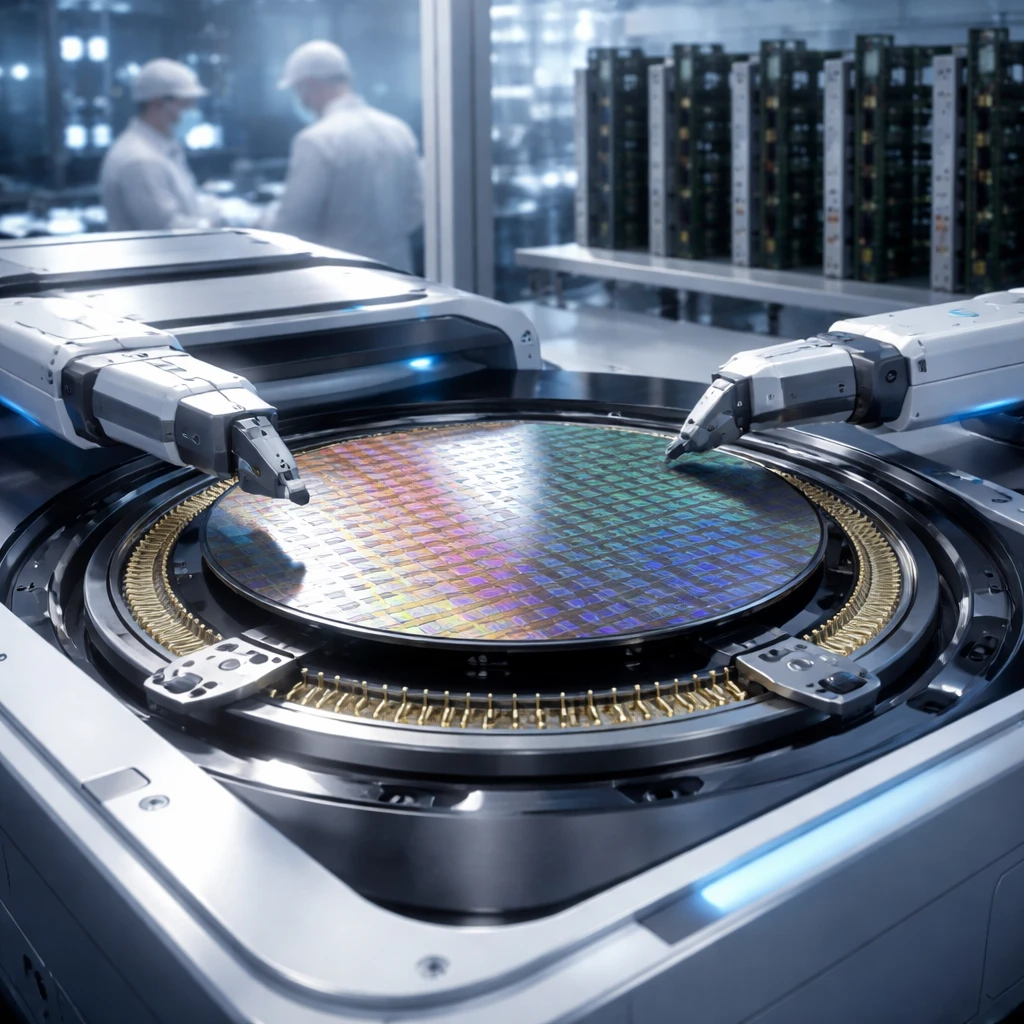
Aehr Test Systems designs and manufactures wafer-contact parallel test and burn-in systems (FOX-XP, FOX-NP, FOX-CP, WaferPak, DiePak and automation accessories). These systems are used by semiconductor manufacturers to stress and verify chips at wafer scale ahead of packaging and deployment. In the context of AI data centers, Aehr's products are relevant for three vectors:
- AI processors - lead customers have placed orders for wafer-level burn-in to validate high-performance inference and training dies.
- Silicon photonics - Aehr announced its first silicon photonics customer order on 03/31/2026, a strategically important niche as photonic transceivers scale inside hyperscale networking gear.
- Memory (NAND/DRAM) - burn-in and parallel wafer test are essential for high-volume memory producers; Aehr has cited potential memory supplier partnerships in recent commentary.
Numbers that matter
Market pricing has already moved: the stock traded as high as $66.28 today and sits near $61.73, up massively from a 52-week low of $6.58. Snapshot metrics show a market capitalization around $1.89B and an enterprise value near $1.51B. Valuation multiples are stretched on backward earnings: price-to-sales sits at roughly 29x, price-to-book about 11.8x, and trailing EPS are negative (reported EPS -$0.23 in recent results). The company reported a meaningful revenue trough earlier in the year, with one quarter showing revenue of $9.9M and a 27% year-over-year decline, but management has disclosed new AI-related orders and projected a material pickup in bookings and shipments for the next quarters.
On the supply/demand side, shorts have been active but coverage days have compressed to roughly 2.2 days to cover as of 03/13/2026, and recent short-volume data show heavy short activity on high-volume days—conditions that can exacerbate rallies on positive headlines and earnings beats.
Valuation framing
At roughly $1.9B market cap and an enterprise value near $1.51B, the market is pricing Aehr as a growth company rather than a cyclical test-equipment vendor. That pricing reflects expectations for multi-quarter acceleration in bookings and revenue tied to AI data-center expansion and silicon photonics ramp. From a qualitative perspective, paying ~29x sales requires either a large increase in absolute revenue over the next 12-24 months or durable margin expansion; the recent past shows declining revenue and negative profitability, so the premium is entirely forward-looking.
The sensible framework: treat current price as contingent on execution. If the company converts announced orders to revenue at the cadence management has suggested (shipments scheduled across fiscal Q4 and the next two quarters with bookings in the tens of millions), multiples can compress as sales grow. If orders slip or prove smaller, the premium will reverse quickly—this is not a long-duration, low-volatility multiple.
Catalysts (what to watch)
- Order conversion and shipment notices tied to the March 31 silicon photonics order and the March 2 $14M AI chip supplier order - look for shipping confirmations and revenue recognition across the next two quarters.
- Quarterly results and guidance - management signaled stronger bookings ($60-80M bookings referenced in commentary) and projected revenue lift; an earnings beat with concrete shipment schedules would validate today's valuation.
- Additional major customer disclosures - new public customer names or expanded purchase orders from large memory or networking suppliers would de-risk the thesis.
- Sector momentum - strong demand signals from other test-equipment peers and data-center capex commentary that supports a secular increase in wafer-level burn-in for AI chips.
Trade plan
Plan: Long AEHR at $62.00. Target $85.00. Stop $48.00. Risk level: high.
Horizon: mid term (45 trading days). The rationale for 45 trading days: the trade is intended to capture order-to-ship conversion and the market's reaction around discrete shipment and booking milestones, which often materialize over several fiscal weeks. Short term (10 trading days) the position could be volatile with momentum squeezes; long term (180 trading days) would require a separate valuation thesis tied to sustained revenue growth and margin improvement beyond one or two quarters.
Position sizing guidance: keep exposure small relative to portfolio size (single-digit percent of risk capital) given execution risk and elevated valuation. Move stop to breakeven once half the position reaches $75 to protect against a mean-reversion pullback.
Why this setup is asymmetric (and why it's risky)
The asymmetry comes from three factors: narrow product market fit (few suppliers make wafer-level burn-in systems suited for silicon photonics), rapid re-rating potential if a major customer ramps, and compressed short interest days-to-cover which can amplify upside on positive confirmations. Those same factors cut the other way: order concentration, execution risk, and stretched multiples create downside risk if shipments slip or orders are one-off.
Risks and counterarguments
- Execution risk: The stock is already pricing in material bookings and shipments. If the company misses on timing or volume, the multiple can unwind quickly and violently.
- Order concentration: Several news items cite large orders from a handful of customers. If one of those customers delays or reduces demand, revenue will be disproportionately affected.
- Valuation sensitivity: Price-to-sales near 29x and price-to-book near 11.8x leave little room for disappointment. A single-quarter miss would likely trigger a large drawdown.
- Macro / sector risk: AI capex is cyclical at the margin. A broader data-center pause or a step-down in AI server builds would hit demand for test equipment.
- Competition & technology risk: Larger equipment vendors could adapt or undercut, and alternative test flows could emerge that reduce the need for Aehr's specific wafer-contact burn-in in certain applications.
Counterargument: It is reasonable to argue that Aehr's rally is already a short squeeze and narrative play rather than a fundamentals upgrade. Shorts could cover, creating a further pop that is detached from long-term fundamentals, and once that squeezes out, price could revert to pre-rally levels if bookings do not continuously materialize. That is a credible scenario and the primary reason this is a tactical swing, not a buy-and-hold recommendation.
What would change my mind
I will become materially more bullish if the company reports: (1) clear, named-customer wins that move beyond anonymous press releases; (2) a multi-quarter booked backlog that converts into recognized revenue with shipment confirmations; (3) improvement in gross margins as systems scale and utilization rises; or (4) a pattern of repeat orders from hyperscalers or major memory suppliers. Conversely, a missed quarter, withdrawal of previously announced orders, or downward revision to shipment timing would flip the trade to a cut-and-run scenario.
Key metrics snapshot
| Metric | Value |
|---|---|
| Current price | $61.73 |
| 52-week range | $6.58 - $66.28 |
| Market cap | $1.89B |
| Enterprise value | $1.51B |
| Price / Sales | ~29x |
| Price / Book | ~11.8x |
| Recent quarterly revenue (example) | $9.9M (quarter showing a 27% decline YoY) |
Conclusion - clear stance
AEHR is a tactical, execution-dependent long. The setup offers an asymmetric reward if management converts the announced AI and silicon photonics orders into shipments over the coming weeks and quarters. Buy at $62.00, target $85.00, stop $48.00, horizon mid term (45 trading days). Keep position sizing conservative and move stops to protect profits on early outperformance. If the company misses conversion timelines or guidance, respect the stop and reassess on fresh, verifiable order data.
News timeline references
03/02/2026 - $14M order announced from an AI chip supplier.
03/31/2026 - First silicon photonics customer order disclosed; order scheduled to ship in fiscal Q4 2026.
04/06/2026 - Stock rallied ahead of fiscal Q3 earnings and amid macro headlines; management flagged growing AI-related bookings.
Trade with a plan: entry $62, target $85, stop $48, mid-term (45 trading days). Monitor shipment confirmations, named-customer disclosures, and quarter-to-quarter revenue recognition closely.