
SpaceX is positioning itself to operate what Deepwater Asset Management's Gene Munster describes as the industry's first sovereign AI platform by assembling end-to-end control of hardware, software, data and distribution, according to Munster.
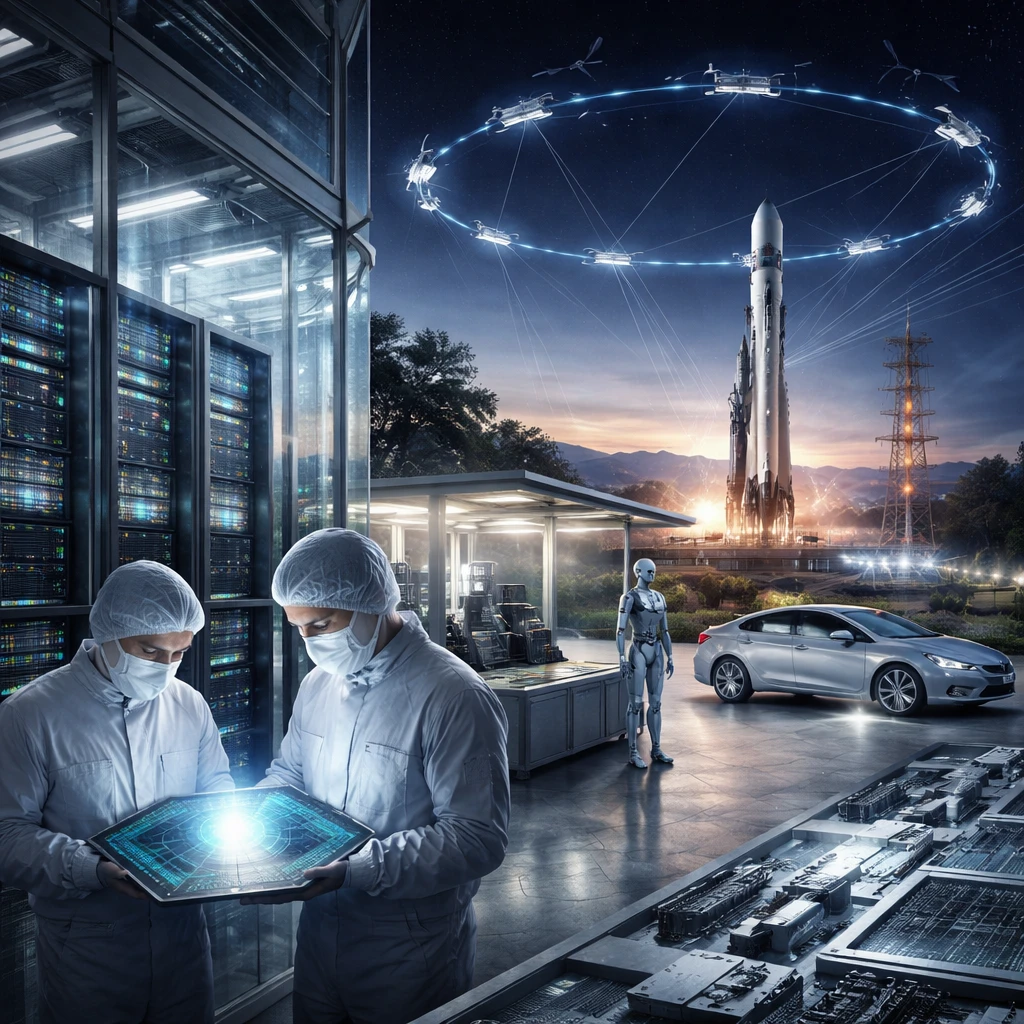
Munster identifies four concrete infrastructure elements that together make up this sovereign stack. First, he points to SpaceX's launch advantage enabled by proven rocket reusability. Second, he highlights Starlink as a global communications network under SpaceX's control. Third, he cites Grok as a frontier AI model trained on proprietary data from X. Fourth, Munster notes the Terafab initiative as an internal, in-house chip manufacturing capability.
Combined, these four pillars form what Munster characterizes as a closed-loop intelligence system that spans raw silicon through satellite-based delivery. That configuration, he argues, removes the need for external suppliers or platforms such as TSMC, AWS or traditional internet service providers, since each layer is owned and operated within the SpaceX ecosystem.
From a commercial perspective, Munster frames the sovereign stack as a mechanism for margin capture across multiple stages of AI production. By controlling chips, models, and distribution, SpaceX could retain value that otherwise would flow to outside fabricators, cloud providers or network operators. Munster draws an analogy to Apple in the sense of integrated hardware and software, saying the structure allows SpaceX to internalize value across the stack.
Munster contrasts SpaceX's configuration with other major AI participants. He says OpenAI, Meta, Amazon and Microsoft do not possess full vertical integration. Google, Munster contends, is the closest comparator but still shows gaps - notably continued reliance on external fabrication and the absence of launch vehicles.
Munster also identifies Grok's design philosophy as central to the sovereign case. He describes Grok's commitment to truth-seeking with minimal creator-imposed restrictions as the intellectual foundation for the thesis. In Munster's view, a model optimized for maximal truth-seeking will likely perform best across many tasks over time, with nature as the ultimate arbiter of outcomes.
Another dimension Munster highlights is the potential physical AI connection through Tesla. He outlines a scenario where Optimus robots and Tesla vehicles could run Grok, receive connectivity via Starlink, and execute queries processed on SpaceX-manufactured silicon. Taken together, Munster asserts that SpaceX stands alone in building a fully sovereign AI system with its own chips, models, data, internet and rockets, placing it in a competitive position in an AI-first future that other companies cannot replicate in the same way.
Summary
Gene Munster says SpaceX has assembled chip fabrication, model training on proprietary X data, a global Starlink network and launch capabilities to create a vertically integrated, sovereign AI platform that could operate without dependence on external cloud, silicon or network providers.
Key points
- SpaceX controls four infrastructure elements - reusable launch, Starlink, Grok trained on proprietary X data, and Terafab chip manufacturing - which together form a closed AI production loop.
- Munster argues this vertical integration enables capture of margins across chips, models and intelligent output, likening the approach to Apple's integrated hardware-software model.
- Other major AI companies lack the same level of vertical integration, with Google identified as the closest rival but still relying on external fabrication and lacking launch vehicles.
Risks and uncertainties
- Other AI players' lack of full vertical integration is a competitive limitation identified by Munster; this is a market risk for those companies across cloud, AI and semiconductor sectors.
- The sovereign thesis rests in part on Grok's truth-seeking design being the optimal path for long-term model performance - an outcome Munster describes as likely but not guaranteed, creating uncertainty for model effectiveness.
- SpaceX's reliance on proprietary X data for Grok's training is a foundational element of the case, so the model's performance and applicability hinge on that dataset's quality and relevance.