
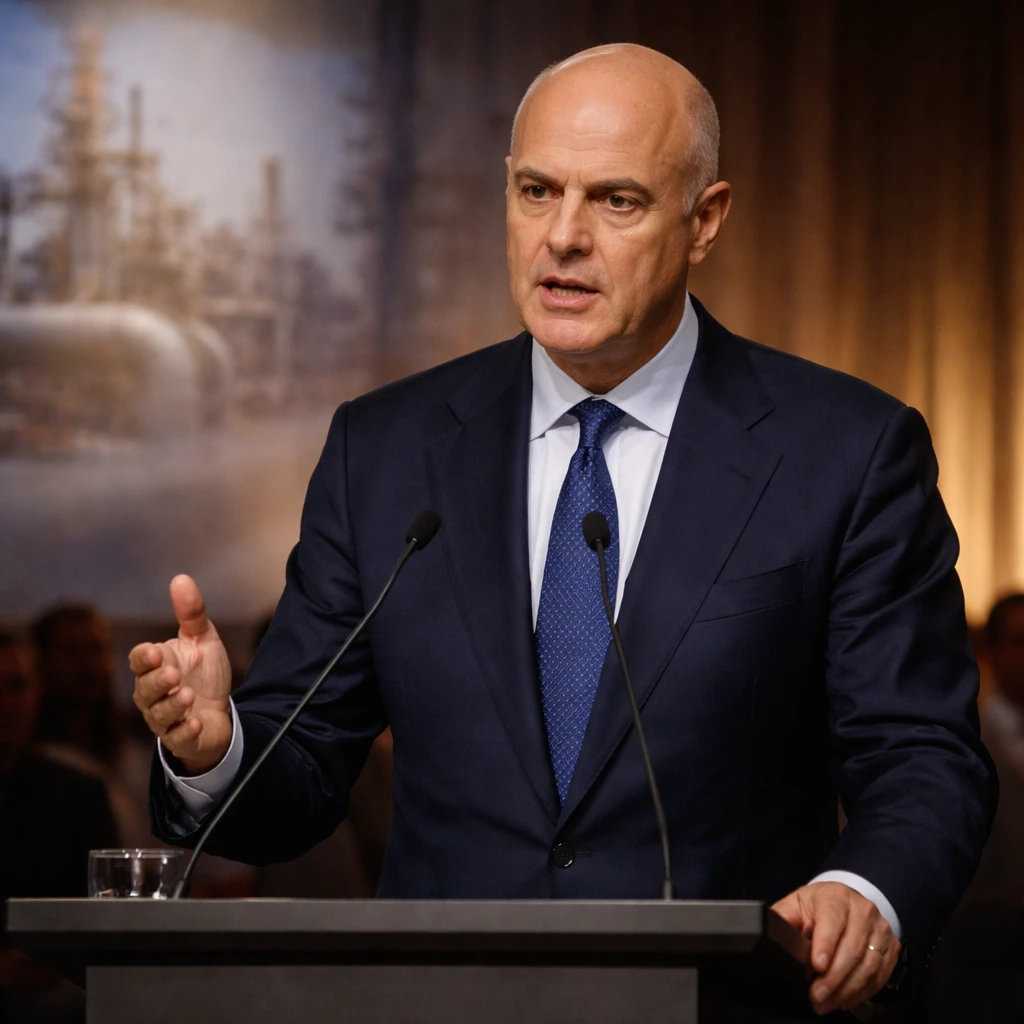
Claudio Descalzi, the chief executive of Italian energy firm Eni, called on the European Union to revisit its plan to progressively ban imports of Russian gas starting in 2027. Speaking at an event organized by the co-ruling League party on Sunday, Descalzi was quoted by Italian news agencies expressing concern over how the bloc would replace a significant tranche of Russian supply.
Descalzi specifically said it was unclear how the EU could make up for 20 billion cubic meters of gas that currently comes from Russia. He warned that this volume provides important flexibility to the output of power stations, implying potential impacts on electricity generation if those supplies are removed without clear substitutes.
The comments come against the backdrop of EU restrictions on Russian liquefied natural gas. Under the bloc's schedule, imports of Russian LNG on short-term contracts are set to be banned from April 25, while imports under long-term contracts would be phased out from January 1, 2027.
In addition to concerns about physical gas volumes and power station flexibility, Descalzi highlighted geopolitical developments when assessing threats to energy supplies. He said the conflict in Iran is "the most important event of the last 40 years" in terms of disruption to energy flows, a characterization he made during the same address.
Context and comments
Descalzi's remarks were conveyed by Italian news agencies after his appearance at the party event. He framed the EU timeline for banning Russian gas imports as requiring further consideration, given the specific figure of 20 billion cubic meters and the role that gas plays in balancing power station output.
Key points
- Eni CEO Claudio Descalzi urged the EU to reassess plans to phase out Russian gas imports beginning in 2027.
- Descalzi noted uncertainty about replacing 20 billion cubic meters of Russian gas, emphasizing its role in providing flexibility for power station output.
- EU bans on Russian LNG are scheduled for short-term contracts from April 25 and for long-term contracts from January 1, 2027.
Risks and uncertainties
- Replacement of 20 billion cubic meters of Russian gas is unclear - this poses risks for the power generation sector that relies on gas for flexible output.
- Phased bans on Russian LNG, with dates set for April 25 and January 1, 2027, create transition uncertainty for energy markets and utilities.
- Geopolitical instability, exemplified by Descalzi's description of the Iran conflict, is cited as a major potential disruptor to energy supplies.
Note: This article reports the comments attributed to Claudio Descalzi and the EU timetable for LNG restrictions as quoted by Italian news agencies. It does not add or infer facts beyond those presented in those reports.