
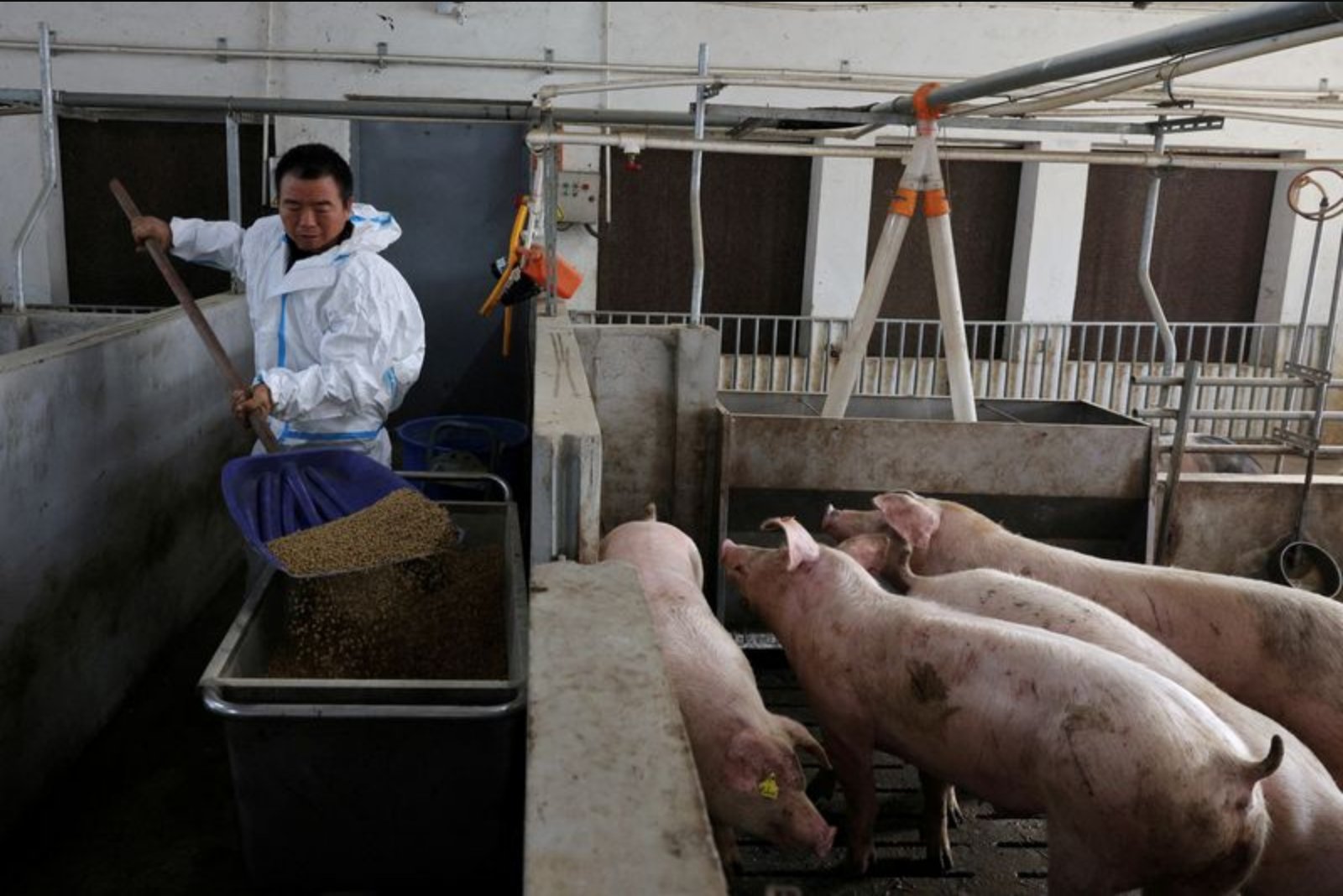
Summary: Across Taizhou's floodplains and beyond, pig producers are trialing fermented feeds made from cheaper, locally sourced materials to cut heavy dependence on imported soymeal. The drive is both a grassroots cost response to volatile soybean prices and part of a broader government campaign to boost food self-reliance. Large agribusinesses and dairy groups are reducing soymeal in rations through fermentation and synthetic amino acids, while foreign and domestic investment is building capacity. Adoption is rising but faces barriers including feed spoilage, animal performance concerns and inconsistent standards, and the long-term effects on meat quality remain unsettled.
On the farm: fermentation at scale
At the perimeter of a pig operation on the low, unbroken floodplain outside Taizhou, two square, four-metre pools hold a pungent ochre liquid that is central to one farmer's attempt to halve his soybean use. The pools contain a fermented mash - comparable to yogurt - made from locally available, lower-cost inputs such as brans, pumpkin vines and wine lees. Fermentation breaks down proteins and makes nutrients easier for pigs to digest, reducing the need for higher-grade proteins from soymeal, roughly 80% of which China imports.
For the farm owner, 47-year-old Gao Qinshan, the change is financially driven. Feed accounts for about 70% of pig rearing costs, and soybean prices have become volatile amid a trade stand-off with Washington and pressures from the war in the Middle East. "Soybean prices have become so unstable," Gao said, noting that combined with an industry already weighed down by oversupply and weak consumer demand, pig farming has slipped into unprofitability. "Everyone is thinking about how to cut costs."
Policy priorities: food security and soymeal reduction
Behind the farm-level cost calculus lies a deliberate policy trajectory: Beijing has prioritized long-term food security and greater self-reliance for agricultural inputs. The government sharply accelerated measures to expand non-soy protein sources for livestock in March of last year - a move that coincided with increasing trade tensions early into President Donald Trump's second term. As soybeans took on greater significance in trade bargaining, fermented feed rose to policy prominence.
Interviews with dozens of livestock and feed producers, state researchers and industry experts indicate Beijing is moving more rapidly than previously appreciated to deploy new technologies and promote fermented feed. Analysts say that in agricultural policy terms, "the biggest national policy goal right now is soymeal reduction," reflecting the trade-driven motivation to change feed inputs. "Fermentation is essential," said Fu Zhenzhen, a feed analyst at Beijing Orient Agribusiness Consultants.
Scale and potential impact on soybean imports
China is the world's largest buyer of soybeans, importing $52.7 billion of the oilseed in 2024, with $12 billion sourced from the U.S., figures from the World Bank show. Chinese customs data indicate inbound shipments reached a record 111.8 million metric tons last year, a 6.5% increase from 2024. Fermented feed accounted for about 8% of industrial feed in China, up from 3% in 2022, and industry forecasts expect adoption to reach roughly 15% by 2030.
That shift in feed composition could translate into measurable reductions in soybean imports. Industry calculations suggest fermented feed could help cut imports by up to 6.3% from last year’s levels, though figures are dependent on adoption rates and feed formulations.
Industry players and supply chain measures
Major agricultural firms are already adjusting feed recipes and production lines. Muyuan Foods, the world’s largest pig farmer, has lowered soymeal content in its feed from 10% six years ago to about 7.3% today by supplementing with synthetic amino acids derived from fermented corn starch, according to Zhang Meng, director of the company’s feed division. New Hope Liuhe has developed soymeal-free poultry feeds by fermenting duckweed and other low-cost protein sources, industry insiders said. State-linked dairy producers Yili and Mengniu, working with the National Center of Technology Innovation for Dairy, have reduced soymeal in cattle feed by approximately 20%.
China has also drawn foreign investment into the fermentation sector. The Dutch trading house Louis Dreyfus has plans to build a fermented feed production line in Tianjin, reflecting growing commercial interest in the technology. Consultants estimate the domestic fermented feed market reached about $6 billion last year, approaching Europe's more mature $7 billion market, while the U.S. market remains smaller, in part because soybeans and corn are readily available there.
Analysts also point to faster adoption rates for certain species: for poultry, an estimated 25% adoption of fermented feed in China already exceeds Europe’s approximate 20% rate.
Practical barriers and animal-level concerns
Despite policy backing and corporate initiatives, barriers to widespread adoption remain. Fermentation systems often require significant changes to existing feeding infrastructure and farm routines. On the ground, some producers report early setbacks: fermented feed can grow mould and spoil if not managed correctly, causing waste and prompting some farmers to abandon trials.
Technical questions about animal performance persist. Some analysts caution that pigs fed on ad hoc fermented mixes may mature more slowly and exhibit weaker disease resilience. The industry faces the challenge of standardising fermentation processes so that nutritional profiles are consistent and animal health is not compromised. As one agriculture consultant in Beijing observed, the sector risks prioritising cost reduction at the expense of animal health and meat flavour. "There is so much demand from consumers for better quality meat, but the industry is just focused on reducing costs and doing what the government wants," said Ian Lahiffe. "There are a lot of benefits to feeding soybeans. They need to think about how to avoid sacrificing animal health and meat flavour."
Market context: prices, profitability and incentives
Current market conditions help explain why farmers and companies are receptive to the fermentation model. Pork prices remain at 16-year lows, making cost-reduction measures attractive. Beijing has provided incentives across the supply chain to encourage adoption - from feed producers to livestock operations - reflecting a top-down effort to secure progress. Still, the lack of a unified technical standard for fermented feeds complicates rollout and raises risks that benefits at the national level may not be realised evenly on individual farms.
Outlook and unanswered questions
Fermented feed is gaining momentum as both an economic response to high soybean prices and a policy lever for reducing import dependency. Large agribusinesses are actively reformulating rations, and investment is flowing into production capacity. Yet the long-term consequences for animal growth rates, disease resilience and meat flavour are not settled, and adoption will depend on farmers overcoming practical challenges such as spoilage and the need to modify feeding systems.
Whether fermentation can deliver both the cost savings producers seek and the quality consumers expect remains an open question. The sector's current trajectory suggests significant structural change, but that change will be shaped by technical standardisation, farm-level uptake and continued industry innovation.
Key points
- Fermented feed adoption is rising in China as a cost-driven and policy-supported strategy to reduce soymeal use, which has implications for soybean import volumes and the commodities market.
- Major agribusinesses and dairy groups have materially cut soymeal in rations through fermentation and synthetic amino acid supplementation, indicating supply-chain level shifts in feed formulation.
- Practical hurdles - including spoilage, lack of standardised fermentation methods and potential impacts on animal growth and meat quality - could slow or unevenly distribute adoption across rural farms.
Risks and uncertainties
- Operational risk: Fermented feed can spoil or grow mould if handling and fermentation processes are not properly managed, potentially causing financial losses for farmers and complicating wider adoption - a risk to the livestock and feed manufacturing sectors.
- Animal health and product quality risk: Some analysts report slower maturation and susceptibility to disease for pigs fed informal fermented mixtures, and there are concerns about negative effects on meat flavour, which could affect consumer demand and pork market dynamics.
- Implementation and standardisation risk: The absence of a single, standard approach to fermentation across farms and feed producers raises uncertainty about the consistency of nutritional outcomes and the ability to scale benefits across the industry.
Promotional note appearing within original coverage: "Should you be buying 2319 right now? ProPicks AI evaluates 2319 alongside thousands of other companies every month using 100+ financial metrics..." (Content preserved from the original report.)