
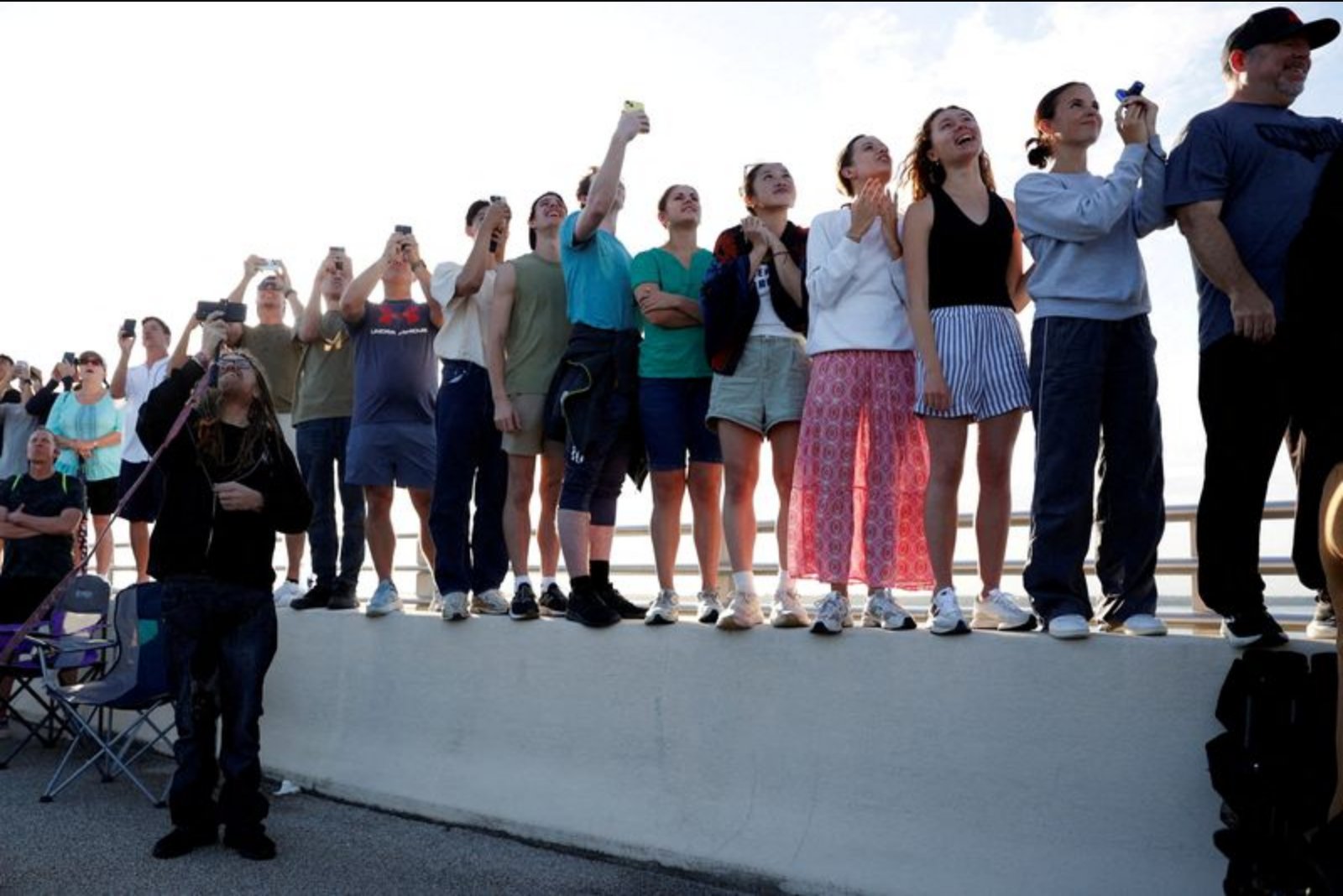
NASA’s Artemis II mission has provoked a broad swell of public interest across the United States, drawing attention from people across the political spectrum who have gathered to watch, learn and celebrate a 10-day crewed voyage to the moon. The mission - the first human trip to lunar vicinity in over half a century - has become a focal point for events ranging from launch watch parties to expanded classroom curricula and a noticeable increase in space-themed retail sales.
Having launched on April 1, the Orion capsule rode aloft on the Space Launch System rocket from Cape Canaveral, Florida, and the four astronauts traveled to the far side of the moon. The mission, which is intended as a critical dress rehearsal for a planned attempt later this decade to land astronauts on the lunar surface for the first time since Apollo 17 in late 1972, is scheduled to conclude on Friday with a splashdown of the Artemis II crew in the Pacific Ocean off California.
Public attention around the crew’s return is expected to match the interest seen at liftoff. Observatories and planetaria have reported surges in attendance tied to the mission, while retailers and independent creators have responded with a wave of Artemis-branded products.
Visible signs of national fascination
Chicago’s Adler Planetarium reported hundreds of visitors gathering to watch the launch and learn more about Artemis. Gaza Gyuk, senior astronomer at the institution, said that the mission’s imagery and goals resonated across age groups. "Everyone can be excited about humans extending their capabilities, learning new things, and doing so in a positive, peaceful way," he said, adding that new photographs of Earth taken from space - showing oceans and land masses without human-imposed boundaries - have reinforced a sense of shared humanity for many viewers.
Polling conducted during the Artemis II mission captured widespread public enthusiasm. About 69% of Americans said they get excited about space exploration, roughly 80% expressed a favorable view of NASA, and 69% said it was important to return astronauts to the moon. These responses included large majorities across both major political parties, suggesting a rare area of bipartisan support.
Educational and inspirational ripple effects
Across school systems, teachers have integrated Artemis into lesson plans and hands-on activities. At the STEM Lab public school in Northglenn, Colorado, engineering teacher Erin Brabant decorated corridors with posters of the SLS rocket, astronauts and a mission timeline, and assigned students to construct models of lunar landers. Brabant observed that Artemis commands attention in classrooms: "When we talk about Artemis, it’s like every kid stops what they’re doing. Their little side conversations stop, and they have questions," she said.
Educators and parents noted the mission’s potential to broaden inspiration, particularly because of the crew’s composition. The presence of pilot Victor Glover - identified as the first Black astronaut to travel to the moon - and mission specialist Christina Koch - described as the first woman ever sent to the moon - has been highlighted as motivating for students from historically underrepresented groups. In Pilot Mountain, North Carolina, a Girl Scout troop watched the launch live; the girls, some as young as five, were captivated and linked the mission to their own projects for Women’s History Month, in part because Koch is a former Girl Scout.
Social and cultural resonance
Observers said the mission offers a counterpoint to narratives that fact-based science is under siege or that modern technologies should primarily inspire distrust. Gyuk pointed to images of Earth without visible political borders as a visual prompt that "we’re all in this together," and organizers of community gatherings reported diverse turnout. In the Philadelphia suburb of Elkins Park, astronomy enthusiast Hector Ybe drew roughly 225 attendees to a launch party that included families and older residents who recalled the first moon landing in 1969. "For two hours, everybody forgot what was happening outside in the world, everybody was talking about space," he said.
Market and retail effects
Commercial activity tied to Artemis has appeared across multiple retail channels. NASA offered officially licensed merchandise such as baseball hats, mission pins, a women’s bomber jacket and playing cards. Independent vendors and e-commerce sellers offered a range of mission-themed items: keychains, posters, canvas art and custom accessories inspired by the Orion capsule. One apparel maker produced Artemis II socks featuring the SLS rocket; other small-scale creators listed 3D-printed, made-to-order earrings modeled on the gumdrop-shaped capsule.
The retail response has included both established outlets carrying official gear and independent artisans leveraging online marketplaces to reach collectors and enthusiasts. These purchases were visible at community viewing events and among attendees at planetarium sessions.
What remains uncertain
Analysts and observers have noted that Artemis has captured attention during a period of political polarization and an unpopular overseas military conflict, circumstances that may be part of the mission’s appeal as a unifying distraction. How enduring the public’s enthusiasm will be beyond the mission’s immediate media cycle is unclear. Similarly, while educators point to the mission’s potential to inspire students toward science and engineering, the long-term impact on career pipelines will depend on sustained visibility and access to educational resources.
As the Artemis II crew approaches splashdown, the mission’s immediate cultural and commercial effects are plainly visible. Whether those effects translate into persistent increases in public engagement with space science, expanded education pathways, or enduring market demand for mission-themed goods will be revealed over time.