
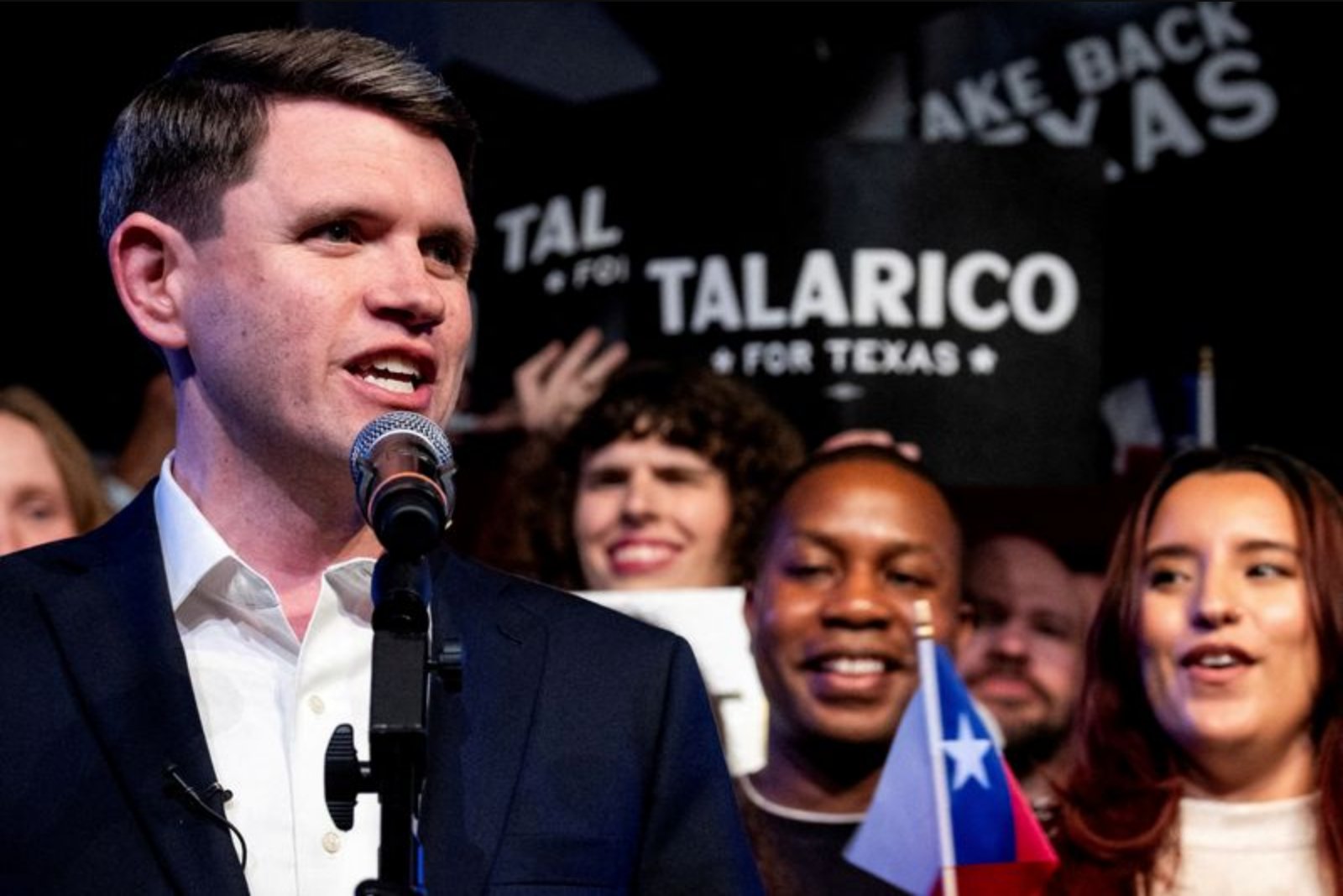
Texas Democratic nominee James Talarico won his party's Senate primary last month with strong backing from white, college-educated voters and Latino constituencies. Yet his ability to carry the state in November now turns on whether he can broaden that coalition to include a larger share of Black voters who coalesced behind his primary rival, U.S. Representative Jasmine Crockett.
Talarico, a 36-year-old white Presbyterian seminarian who has publicly emphasized his Christian faith, defeated Crockett, a Black congresswoman whose pointed criticism of former President Donald Trump and Republicans elevated her profile within the party. The margin in votes in the primary was close: Talarico received about 1.21 million votes to Crockett's roughly 1.07 million.
Despite those statewide totals, a Reuters analysis of county-level returns showed Crockett prevailed decisively in the 15 Texas counties where at least one in five voting-age residents identify as Black, winning 57% to Talarico's 42% in those areas. That split underscores the specific challenge Talarico faces in translating his primary victory into a competitive general election performance across the state.
Electability questions and community reaction
Some Crockett supporters said they were hurt by messaging from parts of Talarico's camp that emphasized electability - the idea that a white state representative could fare better in a general election than a Black congresswoman. For several voters and Black elected officials, the suggestion that race or gender made Crockett less viable struck them as rooted in racism and sexism.
"A lot of people took offense to that. Me personally included," said state Representative Lauren Ashley Simmons, whose Houston district includes several historically Black neighborhoods. Simmons, who had supported Crockett, said the Talarico campaign must do more than outreach in the halls of power. "They have to do the work to invest resources in reaching Black voters and making them feel centered and a part of this campaign," she said.
Texas has not elected a Democrat to statewide office since 1994. Political strategists and local leaders say that makes winning even a modest swing among Crockett's voters vital for Talarico. "He cannot win this state without the support of Black Texans," said Dallas Jones, a Texas Democratic strategist, who added that Talarico does not need an overwhelming surge of Black support but cannot afford a significant drop in turnout among that group.
Campaign outreach and pledges to engage
Talarico's campaign told reporters it is increasing on-the-ground efforts in counties with sizable Black populations, including Harris and Dallas counties, while also visiting smaller, rural Black communities such as Sand Branch. Campaign activities cited include volunteering to help deliver clean water and making appearances at intimate community gatherings.
In a statement provided to news outlets, Talarico said: "It’s on me to ensure Black Texans feel welcomed in, represented by, and proud of this campaign. That’s why we’re out doing the work right now to build the coalition we need to win in November: showing up everywhere to listen and to learn."
Activists who backed Crockett and community leaders say such engagement must address tangible concerns in Black communities, including unemployment, housing affordability and rising healthcare costs. "When it comes to Talarico, they are talking about what is he going to do to help those Black women who lost their federal jobs regain employment?" said Brianna Brown, executive director of the Texas Organizing Project, a nonpartisan group that endorsed Crockett. "They’re talking about good-paying jobs - we’re still at a $7.25 minimum wage in Texas."
Pearline Harper, a 72-year-old Crockett voter from Dallas, described frustrations with the healthcare system. She blamed Republican control of the White House and both chambers of Congress for increasing costs, and said she wants a return to a system in which doctors made care decisions for patients rather than insurers. "I just want it to go back to when doctors were taking care of patients because they were sick, not because ... insurance companies tell them what they can do," she said.
Faith outreach and local endorsements
Talarico has also pursued religious leaders as a means of connecting with Black Christian voters. Pastor Richie Butler, who hosted a roundtable for Talarico in north Texas and initially supported Crockett, said church leaders have responded positively to the nominee's approach. "There’s been feedback from pastors that he’s genuine and humble," Butler said. He plans to organize voter engagement events to help drive turnout among Black voters in his community and will vote for Talarico in the general election.
Harris County Commissioner Rodney Ellis, another Crockett backer who later endorsed Talarico, said he shifted his position after Talarico reached out by text seeking support. Ellis said he advised the nominee to focus on engaging voters in Harris County who do not reliably turn out, and to foster enthusiasm among Crockett supporters in East Texas so they will cast ballots in November. "There’s a difference between someone endorsing you and being for you," Ellis said, adding that Talarico needs to find a way to include Crockett in outreach efforts.
Challenges ahead and national implications
Political observers caution that Talarico's task is far from complete. The Republican side will determine its November opponent in a May 26 runoff between U.S. Senator John Cornyn and Attorney General Ken Paxton, and analysts presently favor the eventual Republican nominee in the general election in Texas. Former President Donald Trump has not endorsed either Republican candidate.
Though Texas is not the central focus of national Democrats' strategy to flip control of the U.S. Senate, a Democratic upset there would create additional pathways to winning the chamber in November. Even a close race could force Republicans to shift campaign dollars away from other battleground states to defend a costly Senate contest in Texas - potentially altering resource allocation across a number of key races. A spokesman for Senate Democrats' campaign arm said candidates should not take any votes for granted.
Political analysts emphasize that Talarico should not presume he will capture most of the Black vote. "James Talarico is the underdog. He can’t make the assumption that he’s destined to get somewhere around 90% of the Black vote," said Andra Gillespie, an associate professor at Emory University.
Simmons, the state representative who supported Crockett, acknowledged that Talarico’s team has done early outreach to Black elected officials and community leaders. But she said she told the campaign candidly that rebuilding trust will take work. "Y’all have a lot of work to do to get support and trust and rebuild some bonds in the Black community," she said, adding that it is not enough for political allies who have served with him to simply urge communities to vote along party lines. "It can’t be assumed that we’re just going to support whoever’s on the ticket."
What remains unresolved
The central facts in this race are clear: Talarico won the Democratic primary with narrow margins, Crockett held stronger support in counties with larger Black populations, and both voter outreach and turnout among Black Texans will be decisive factors for the Democratic nominee's prospects in November. How successfully Talarico's campaign can translate its stated outreach into sustained support and higher turnout among Crockett's backers will shape the dynamics of the general election, as well as how national parties allocate resources in the closing months of the campaign.