
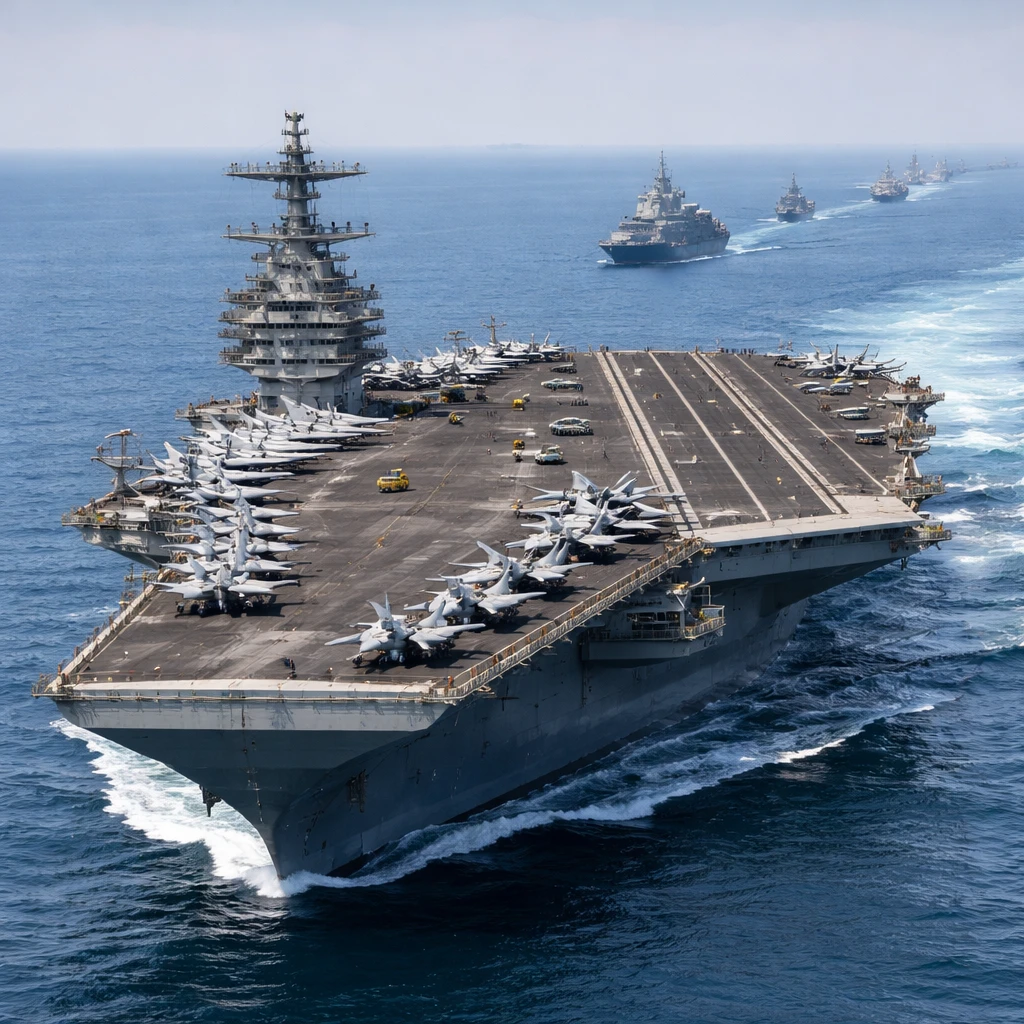
The Pentagon has announced the deployment of the USS Gerald R. Ford to the Middle East, marking a second aircraft carrier move in recent months as tensions with Iran remain elevated. Media reports on Friday indicated the Gerald R. Ford - the Navy's largest and most advanced carrier - will add to American naval strength already in the region.
According to the reports, the Gerald R. Ford will join the USS Abraham Lincoln and nine other U.S. warships operating in the Middle East. The deployment was highlighted by U.S. political leaders in the context of ongoing negotiations with Iran, and follows a period of heightened U.S. pressure on Tehran's nuclear activities.
Officials and commentators have tied the deployment to statements and policy positions advanced by U.S. President Donald Trump, who has repeatedly argued for stronger measures to limit Iran's nuclear program. The carrier movement comes as the two countries have engaged in limited diplomacy; the U.S. and Iran did hold talks in Oman last week, but those discussions were described as largely inconclusive.
Recent military action also frames the backdrop for the new deployment. The United States carried out air strikes on three of Iran's principal nuclear facilities in mid-2025, an episode that has figured prominently in public criticism of Tehran's plans for nuclear enrichment. Reports of the Gerald R. Ford's movement to the Middle East were released just days after President Trump met with Israeli Prime Minister Benjamin Netanyahu to discuss Iran.
The Pentagon's decision to position a second aircraft carrier in the region underscores the persistence of strategic tensions and the interplay between diplomacy and military posture. The Gerald R. Ford's arrival will expand the U.S. naval footprint alongside the Abraham Lincoln strike group and other vessels already operating in the theater.
Context and implications
- The deployment increases U.S. carrier presence in the Middle East at a time of strained U.S.-Iran relations.
- Recent diplomacy between Washington and Tehran has not resolved core differences, according to reports characterizing talks in Oman as largely inconclusive.
- Prior U.S. military strikes on Iranian nuclear sites in mid-2025 provide part of the immediate context for the current naval movements.