
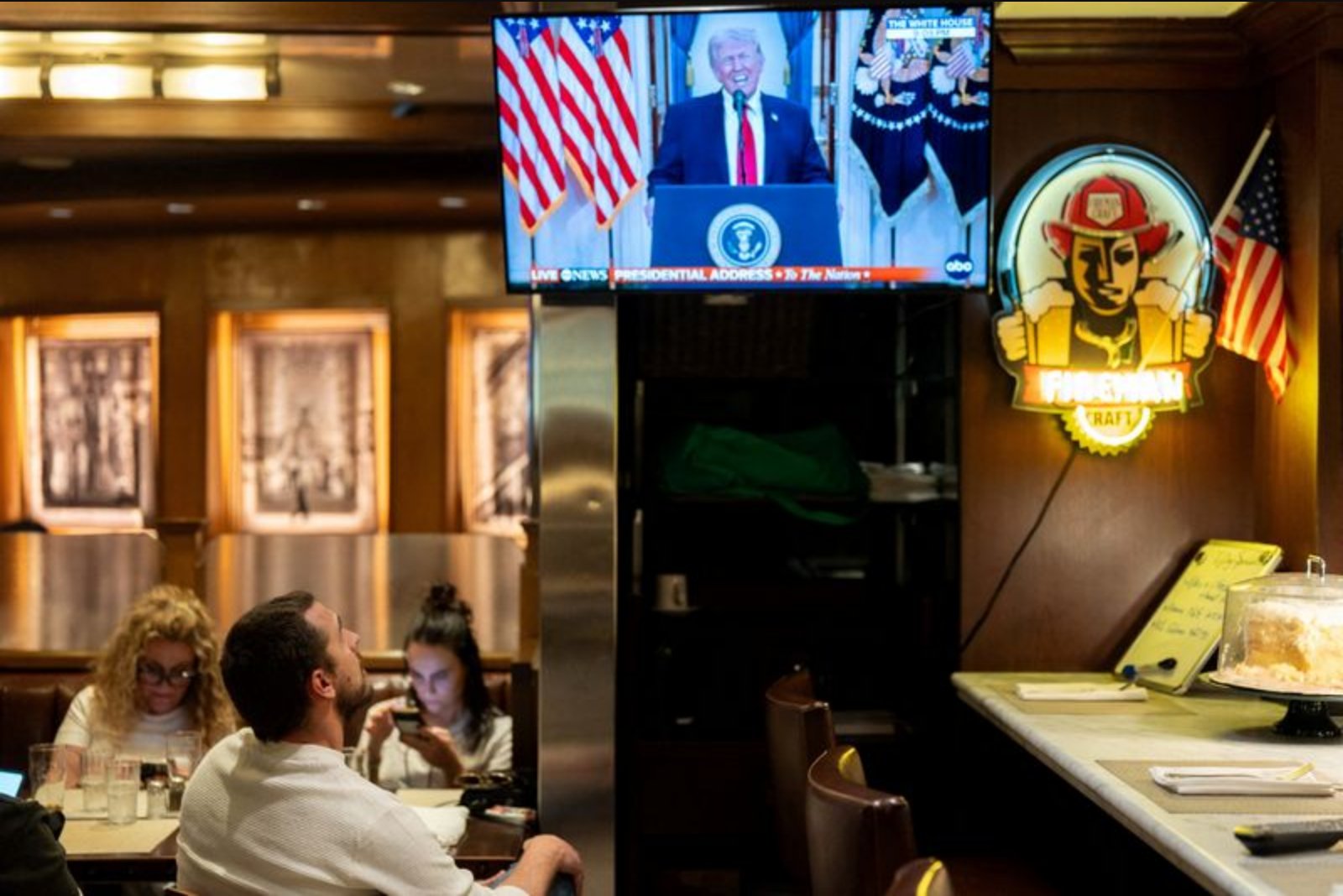
President Donald Trump unveiled a fiscal 2027 budget request that dramatically reallocates federal resources toward defense while cutting a broad swath of domestic programs. The submission calls for a 10% reduction in non-defense spending and a $500 billion increase in the military budget, lifting planned defense expenditures to roughly $1.5 trillion from about $1 trillion in 2026.
The White House framed the defense increases as necessary amid continued U.S. military engagement in the Middle East. The package includes a proposed 5% to 7% pay raise for military personnel, measures that come as thousands of service members remain deployed.
Officials described the proposed defense spending as approaching the "historic increases just prior to World War II," language the administration used to underline the scale of the escalation. The request will need congressional sign-off, setting the stage for likely partisan fights over spending priorities and potential impacts to the federal budget deficit.
Defense priorities and funding specifics
The administration's defense ask contains a mix of near-term and long-term investments. Among the sizable increases are funding for a controversial missile defense program dubbed the Golden Dome, resources to expand critical mineral supplies for defense industry needs, and $65.8 billion directed toward building 34 new combat and support ships.
Shipbuilding allocations include initial funding for a so-called Trump-class battleship and for additional submarines. The Pentagon previously requested an additional $200 billion to cover costs associated with the Iran war, though the White House has not formally transmitted that supplemental ask to Congress.
White House budget director Russell Vought characterized the proposal as a course correction on fiscal policy, writing that "Fiscal futility is ending" and asserting the nation's fiscal direction has "turned to face in the right direction."
Domestic spending cuts and program eliminations
To offset the sizable defense increase, the administration proposed steep reductions across several federal departments and programs. The plan calls for a 19% cut to the U.S. Department of Agriculture, a 12.5% reduction for the U.S. Department of Health, and a 52% cut to the Environmental Protection Agency.
NASA would face a 23% reduction in requested funding, including a $3.6 billion cut to the agency's science unit that the White House says would result in the cancellation of roughly 40 programs. The budget would also eliminate nearly 30 Justice Department programs the administration labels "weaponized," and propose cutting $315 million from the National Endowment for Democracy.
At the same time, the plan asks for a 13% increase for the Justice Department's capacity to "bring violent criminals to justice," along with sustained funding for homeland security and immigration enforcement at $2.2 billion, which the administration says will support U.S. Immigration and Customs Enforcement operations, 41,500 detention beds, and 30,000 family unit beds.
Pet projects and targeted spending
The submission includes funding for several initiatives aligned with the president's priorities. It provides $152 million for the proposal to return the former Alcatraz prison island to active duty, $481 million to expand hiring of air traffic controllers to address concerns about staffing in airport towers, and a $10 billion mandatory fund to establish a "Presidential Capital Stewardship Program" within the National Park Service to support targeted construction and beautification projects in and around Washington, D.C.
Political context and likely reception
The timing of the budget request situates it amid an international security backdrop and ahead of the 2026 midterm elections, when Republicans aim to preserve narrow majorities in the House and Senate. The White House presented the plan as aligned with the administration's broader policy priorities and argued that savings could be realized by "reducing or eliminating woke, weaponized, and wasteful programs, and by returning state and local responsibilities to their respective governments."
Democratic leaders, however, reacted sharply. Senate Budget Committee Democrat Jeff Merkley called the proposal "dead on arrival," criticizing the plan for emphasizing military spending while cutting programs such as housing, healthcare, education, roads, scientific research, and environmental protection.
Budget watchdog groups also voiced skepticism. Maya MacGuineas, president of the Committee for a Responsible Federal Budget, said the submission is "light on details and heavy on borrowing," and that it "relies on an entire decade of rosy economic assumptions for the vast majority of its improvements in the nation’s finances."
In a social media post, the president asserted that anti-fraud efforts could "balance our American Budget," a claim budget analysts greeted with skepticism. The White House documents express confidence that savings and program eliminations will help offset the new defense commitments.
Budgetary context and constraints
The request arrives amid a widening federal deficit. The nonpartisan Congressional Budget Office forecasts a $1.853 trillion shortfall in the fiscal year that ends on September 30, larger than the prior year's $1.775 trillion. The nation's debt total cited in the budget documents stood at $39.016 trillion.
Much of the political debate over federal spending centers on discretionary spending, the roughly one quarter of the budget that Congress directly controls. The administration's proposal does not engage with proposed changes to mandatory spending programs such as Social Security and Medicare, the most expensive components of federal outlays, where political consensus on cuts is generally elusive.
If enacted as proposed, total federal departmental spending would reach $2.2 trillion in 2027 compared with roughly $1.8 trillion in the current fiscal year, according to the White House submission.
Defense spending to reshape procurement and supply priorities
The administration's emphasis on defense will likely have direct implications for areas of procurement and domestic industrial capacity. The inclusion of funding to expand critical mineral supplies for the defense industry signals an intent to bolster inputs used in weapons systems, electronics, and other military platforms. The substantial shipbuilding request and investments in submarines and a new battleship design point toward multiyear commitments in naval procurement.
How Congress responds will determine the final shape of those procurement plans and whether supplemental requests, such as the Pentagon's earlier $200 billion to cover Iran war costs, are approved.
Next steps and areas of uncertainty
The president's budget proposal is a policy statement and a negotiation opening. Appropriations committees in Congress traditionally parse and reshape White House requests, and lawmakers often retain priorities that differ from the administration's. The proposal's ultimate fiscal impact is uncertain given the absence of detailed deficit projections from the administration in this package and competing views from budget analysts.
Lawmakers will weigh the administration's defense increases against proposed cuts to domestic programs and the political consequences of altering popular entitlement programs, a tension that has driven past budget standoffs — including a government shutdown that became the longest in U.S. history.
Reporting on federal budgets involves evolving details and negotiation. The administration's request sets the terms of the debate; the final outcome will be shaped on Capitol Hill.