
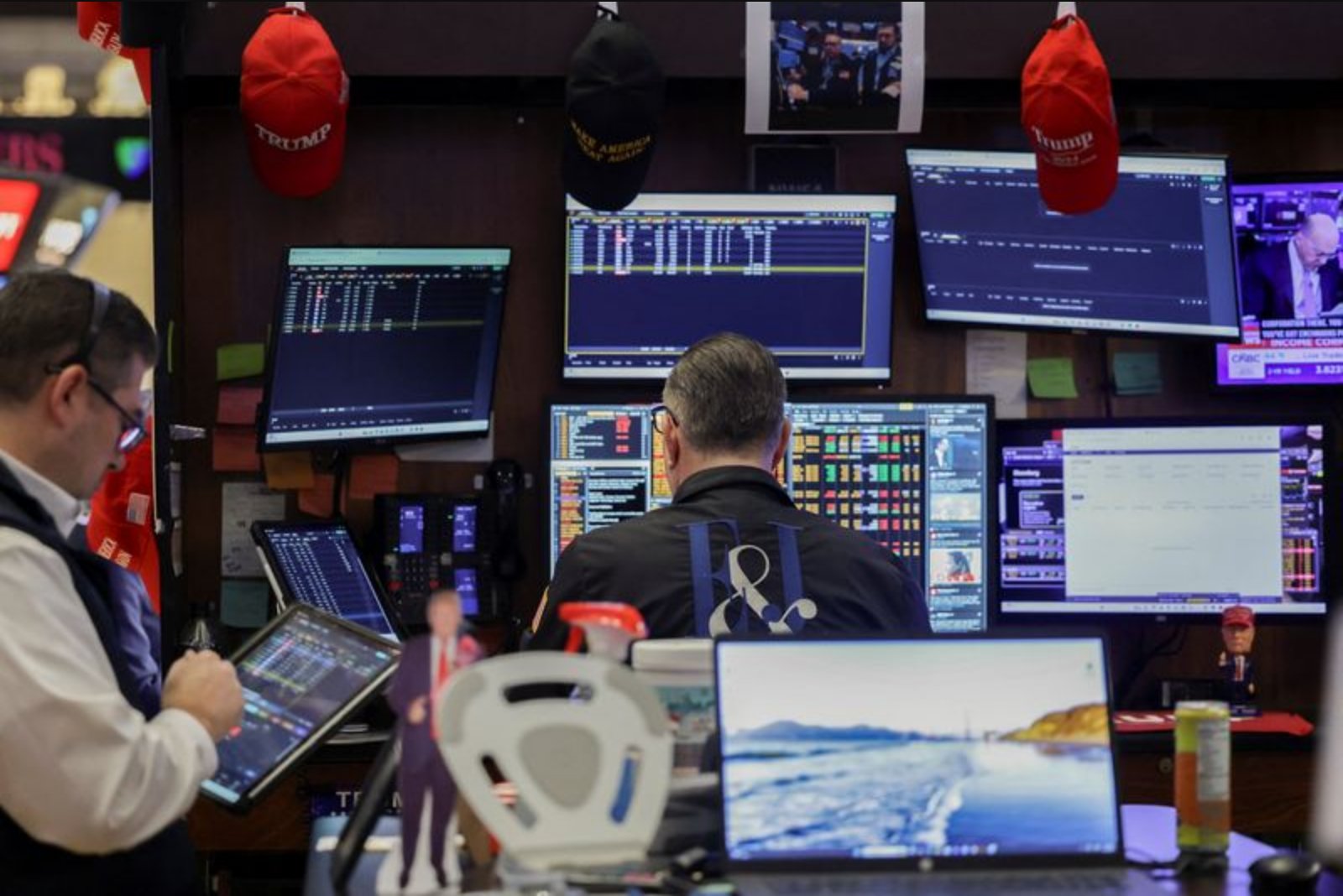
Global financial markets moved into a heightened state of uncertainty as a deadline imposed by U.S. President Donald Trump for Iran to reopen the Strait of Hormuz drew near. Investors are attempting to price a narrow set of possible outcomes - from a ceasefire to a rapid military escalation - and assess how each path would affect oil, exchange rates and risk assets.
Iran displayed no sign that it would abide by the ultimatum to restore navigation through the Strait of Hormuz by the end of Tuesday, and reports surfaced that Iran had severed direct diplomatic contacts with the United States. The White House set the deadline at 8 p.m. Washington time - equivalent to midnight GMT and 3:30 a.m. in Tehran - for Tehran to end its blockade of Gulf oil shipments, a standoff that has roiled commodity and financial markets in recent weeks.
"Markets are dealing with a somewhat binary situation as they try to position themselves ahead of a deadline which will either see a sudden resolution or a swift escalation," said David Morrison, senior market analyst at Trade Nation. On Tuesday the benchmark S&P 500 fell almost 1 percent, while the dollar and gold retreated slightly and oil inched upward.
Military escalation
One of the most damaging potential outcomes for markets would be a significant intensification of the conflict leading to sustained disruptions in oil supply. Citigroup has estimated in a recent note that a prolonged conflict and severe delivery interruptions could push Brent crude toward roughly $130 per barrel. Under that scenario, equity markets would likely move lower with the greatest pressure on interest rate-sensitive and cyclical sectors as investors price in a marked economic slowdown alongside rising inflation.
Within equities, airlines - including carriers like American Airlines - and other travel-related businesses such as cruise operators would be particularly exposed to higher fuel costs and weaker demand. By contrast, firms that combine defense exposure with security technology - the article cited Palantir and CrowdStrike as examples of AI-defense hybrids - might outperform if the conflict persists and volatility spikes, according to Pete Mulmat of IG North America.
The U.S. dollar has been a primary beneficiary of safe-haven flows triggered by the confrontation. "If expectations shift to high-for-longer oil prices, USD could strengthen further, as this may magnify the inflation and output pressures faced by energy importers," said Steve Englander, FX strategist at Standard Chartered. A stronger dollar could, in turn, put downward pressure on the Japanese yen and raise the prospect of intervention by the Bank of Japan. UniCredit analysts noted that the BOJ would be likely to step in if USD-JPY climbed quickly above 160, moving toward July 2024 highs near 162. At the time cited, the yen was trading at 159.82.
Ceasefire and de-escalation
A negotiated resolution or abrupt de-escalation would flip market dynamics. The S&P 500 has recovered roughly 4 percent since a seven-month low in late March, on hopes that diplomatic progress might be possible. J.P. Morgan analysts laid out the market implications of a ceasefire scenario, forecasting that bond yields would fall, oil and energy prices would decline substantially, the U.S. dollar would weaken, credit spreads would tighten and equities would rally.
In that environment, sectors that rallied on fears of prolonged conflict - such as defense contractors, fertilizer producers and energy firms facing higher input costs - could surrender some of their gains. Meanwhile, oil-sensitive and battered travel names, including airlines and cruise operators, could recover as fuel costs fall and demand expectations stabilize. A move toward de-escalation would also reopen the possibility that markets could start to price in interest rate reductions that had been put on hold by the inflationary pressures from a spike in energy costs.
Extension of the deadline
If the deadline is extended, investors might initially respond with a risk-on tilt as expectations build that an agreement is being negotiated. However, market commentary suggests a degree of skepticism about such a development. "Realistically, though, another TACO moment for Trump is more likely than Iran backing down and this is probably what’s preventing markets from going into meltdown," said Raffi Boyadjian, lead market analyst at Trading Point, referring to the Wall Street quip "Trump Always Chickens Out."
Under an extension scenario, equities could trade in a narrow range as participants remain cautious amid unresolved shipping risks and uncertain energy supply. J.P. Morgan analysts said they prefer a market-neutral approach while the situation in the Strait of Hormuz is unresolved.
Commodity and safe-haven dynamics
Analysts expect Brent crude to remain supported around the then-current range near $110 per barrel as long as supply disruptions persist while the Strait of Hormuz is closed. Gold may continue to find support from hedging demand amid prolonged uncertainty, even though gold prices had fallen 12 percent since the conflict began, pressured by a stronger dollar.
Investment tools and stock ideas
The article noted a sponsored evaluation tool that ranks stocks. ProPicks AI reportedly evaluates Carnival Corporation (CCL) and thousands of other companies each month using more than 100 financial metrics. The product claims to use AI to identify stock ideas based on fundamentals, momentum and valuation, and the article cited past winners such as Super Micro Computer (+185%) and AppLovin (+157%). The tool is presented as a way to identify whether CCL appears in any strategy or if alternative opportunities exist in the same sector.
As the deadline approached, market participants remained focused on which of the three broad outcomes - escalation, settlement, or a delay - would materialize. Each path carries distinct implications for commodities, interest rates, currencies and sector performance, and traders continued to adjust positions as new information arrived.