
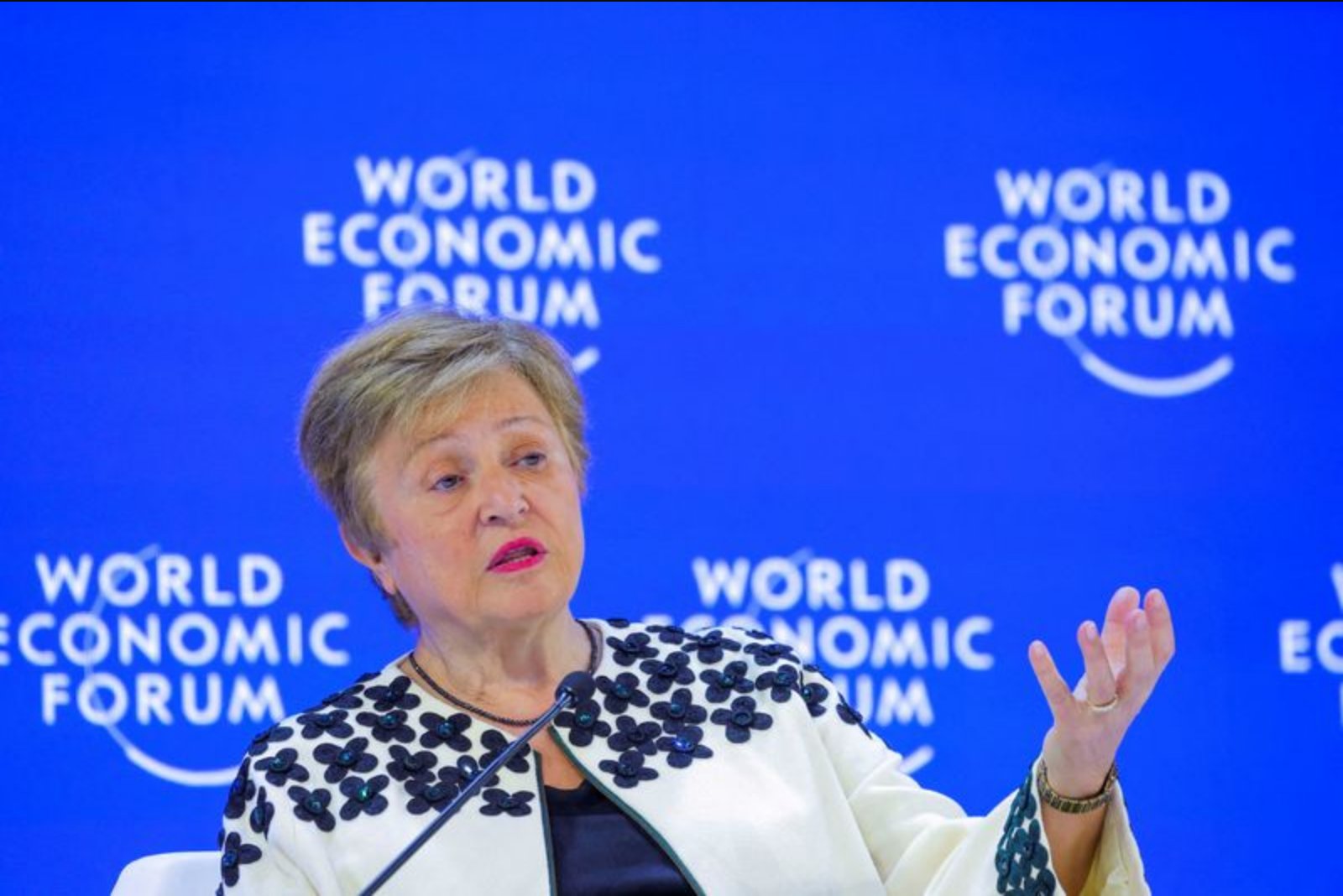
International Monetary Fund Managing Director Kristalina Georgieva said on Thursday that spillovers from the war in the Middle East are likely to push near-term requests for IMF financial assistance to between $20 billion and $50 billion.
Delivering prepared remarks ahead of next week’s IMF and World Bank meetings in Washington, Georgieva described the conflict - now paused - as a test for the global economy. She pointed to a 13% reduction in the daily flow of world oil and a 20% cut in liquefied natural gas supplies as precipitating a supply shock that has sent energy prices sharply higher and is disrupting global supply chains.
"Even in a best case, there will be no neat and clean return to the status quo ante," Georgieva said, stressing that the shock’s effects would persist even if fighting were to subside. She drew attention to the closure of Qatar’s Ras Laffan complex, which produces 93% of the Gulf’s LNG, noting it has been shut since March 2 and could take three to five years to return to full capacity.
Georgieva warned that uncertainty over maritime transits and the recovery of regional air traffic adds to the difficulty of predicting how quickly energy and transport networks will normalize. "The fact is, we don’t truly know what the future holds for transits through the Strait of Hormuz, or for that matter, for the recovery of regional air traffic," she said.
The Managing Director said the conflict, which began on February 28, will have lingering ripple effects. She cited potential oil refinery shutdowns and shortages of refined products that are already disrupting transportation, tourism and trade. The damage to infrastructure and disruptions to supply chains, she said, would slow growth even under optimistic assumptions.
Georgieva said the IMF has revised down its global growth forecast as a result of the crisis - a view consistent with earlier comments she made to Reuters - and that a range of scenarios will be published in next week’s World Economic Outlook. Those scenarios will span outcomes from a relatively swift normalization to ones in which oil and gas prices remain elevated for a prolonged period.
Even the most hopeful of the scenarios, Georgieva added, entails a reduction in growth owing to infrastructure damage, strained supply chains, losses in confidence and other scarring effects. She cited the IMF’s January projections, which had put global growth at 3.3% in 2026 and 3.2% in 2027, as reference points ahead of the downgrade.
Georgieva quantified the immediate fiscal pressure on the Fund, saying additional countries were expected to seek IMF support and that near-term demand could rise to $20 billion-$50 billion. She did not identify specific nations. An IMF official noted that this expected wave of requests would be on top of roughly $140 billion in programs that were in place before the war.
Historical lending activity was cited to provide context for recent program approvals: between May 2024 and March 2025, the IMF approved more than $36 billion in new lending, according to a study referenced by Georgieva.
Georgieva also highlighted human-security and commodity impacts. She said another 45 million people would face food insecurity as a result of the conflict, raising the total number of people facing hunger to over 360 million. On the industrial side, she pointed to continued supply-chain disruptions tied to critical inputs such as sulphur, helium used in chip manufacturing, and naphtha for plastics production.
In terms of inflation and financial conditions, Georgieva warned the energy shock had already pushed up short-term inflation expectations, even though longer-run expectations remained anchored. She described a tightening in financial conditions that had so far taken place in an orderly fashion and noted that some easing in those conditions was now observable.
Policy guidance from the IMF chief focused on collective action and caution. Georgieva urged countries not to resort to export controls, price controls or other unilateral measures that could exacerbate global imbalances. "I appeal to all countries to reject go-it-alone actions," she said, adding the admonition: "Don’t pour gasoline on the fire."
She advised that while watching and waiting has merit, central banks should "step in firmly with rate hikes" if inflation expectations threatened to lose their anchor and ignite an inflationary spiral. Georgieva noted many countries were implementing conservation steps such as restrictions on private vehicle use and expanded remote work to manage energy demand.
Georgieva said most countries had avoided untargeted tax cuts or broad energy subsidies, and the IMF was coordinating with members to ensure emergency measures remained temporary. She warned that introducing deficit-financed stimulus now would raise the burden on monetary policy, push up benchmark yields and increase the cost of debt.
On public finances more broadly, she urged governments to rebuild fiscal buffers that have eroded over years of under-saving. Georgieva observed that global public debt was already high relative to two decades ago and noted projections showing public debt rising to nearly 100% of global GDP by 2029, a level the IMF characterized as the highest since 1948.
Context for next week’s meetings
Georgieva said next week’s gatherings of thousands of finance officials at the IMF and World Bank will concentrate on how to manage the economic shock caused by the war and how the Fund can assist its members in need. She reiterated that the IMF has the resources to scale up balance-of-payments support under existing programs to meet expected demand.
While she stopped short of naming countries that might seek aid, Georgieva highlighted that additional requests were anticipated and that the Fund stood ready to respond.