
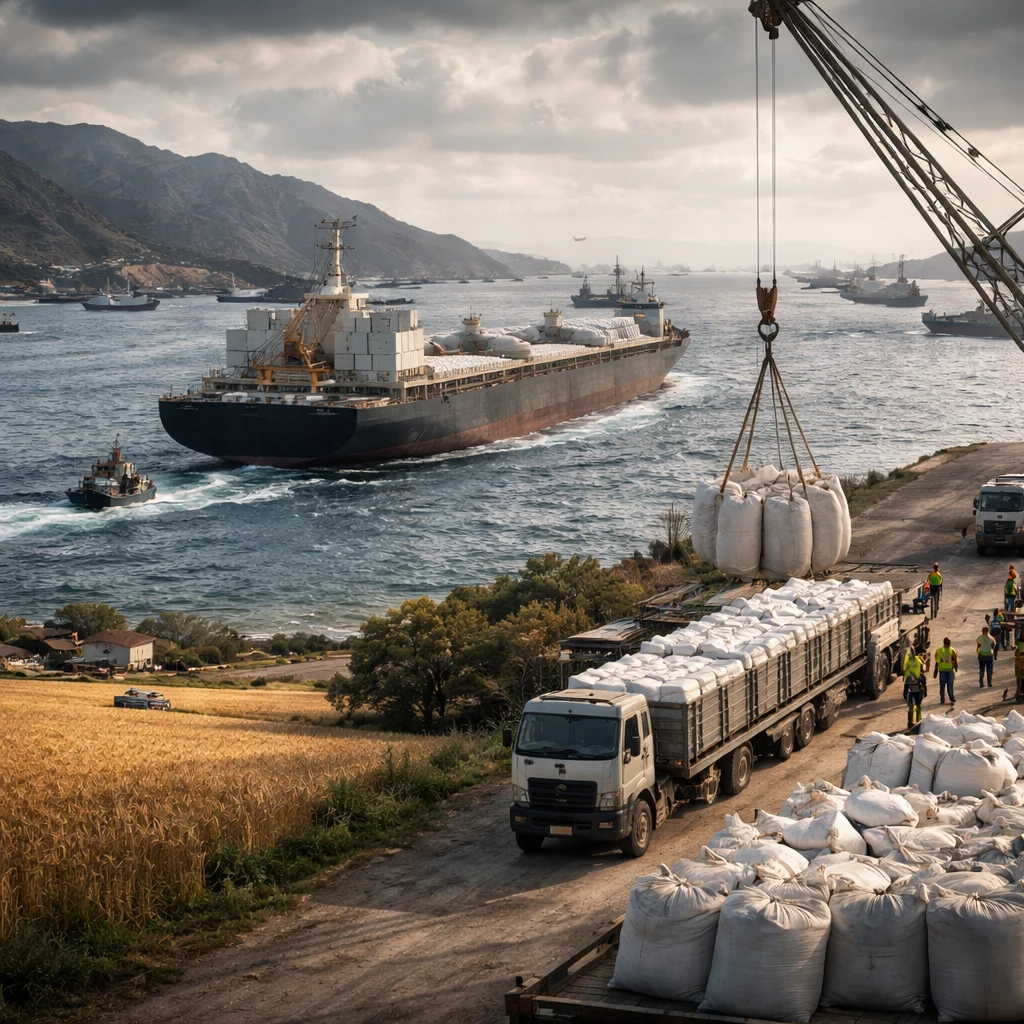
The Australian government has set up a senior-level working group with the fertilizer industry aimed at protecting urea supplies as instability in the Middle East threatens to unsettle a key agricultural input. Agriculture Minister Julie Collins told markets that roughly 60% of Australia’s urea imports, the nitrogen fertilizer critical to crop production, normally pass through the Strait of Hormuz - a route that remains heavily constrained despite the April 8 ceasefire.
Minister Collins sought to reassure markets that Australia currently has adequate reserves "on the water," but she warned the outlook further ahead is fragile. The government has placed the country at Level 2 of its four-tier National Fuel Security Plan, meaning supplies are still moving but the system is experiencing significant pressure.
The vulnerability stems in part from a near-term domestic production shortfall. Australia’s first major local urea facility, the A$6.5 billion ($4.6 billion) Perdaman plant in Western Australia, is not due to begin production until mid-2027. That gap between current needs and the arrival of a major domestic source is central to Canberra’s decision to coordinate closely with the fertilizer sector.
Treasury estimates point to immediate consumer impacts: grocery prices could rise by 3% to 4% "almost immediately" as elevated fuel and fertilizer costs flow through the supply chain. Australia is among the world’s leading exporters of wheat, beef and dairy; constrained access to affordable nitrogen fertilizer could influence how farmers set planting plans for the next season and erode Australia’s competitive position in global soft commodity markets.
Infrastructure Minister Catherine King said the government is preparing for a "long tail" of economic effects arising from the Iran conflict. As part of that response, Canberra launched an A$20 million "Every Little Bit Helps" public awareness campaign to encourage fuel conservation. Officials have also signalled they may postpone planned changes to the national road user charge, saying the present economic volatility is the "wrong time" to introduce that policy shift.
Beyond near-term measures, the administration is accelerating policy priorities intended to reduce future vulnerability. That includes faster moves toward electrification and boosting domestic production of sustainable aviation fuel and low-carbon liquid fuels. Nevertheless, the immediate state of the Australian economy remains linked to the outcome of "Safe Opening" negotiations in Islamabad, officials say.
Government and policy makers are watching the Strait of Hormuz closely. As long as that passage is a bottleneck for imports, Canberra faces the prospect of "stagflationary" pressure - the combination of rising costs and the potential for supply-driven cooling in agricultural output - a primary concern for the Reserve Bank of Australia and the Treasury.
Summary: Canberra has formed a high-level working group with the fertilizer industry to secure urea imports after disruptions affecting the Strait of Hormuz. While current supplies "on the water" are sufficient, dependence on seaborne routes for roughly 60% of imports and a domestic production gap until mid-2027 raise the risk of immediate grocery price rises of 3% to 4% and broader economic strain. The government is pursuing short-term conservation measures, may delay road charge changes, and is accelerating a shift toward low-carbon fuels and electrification.