
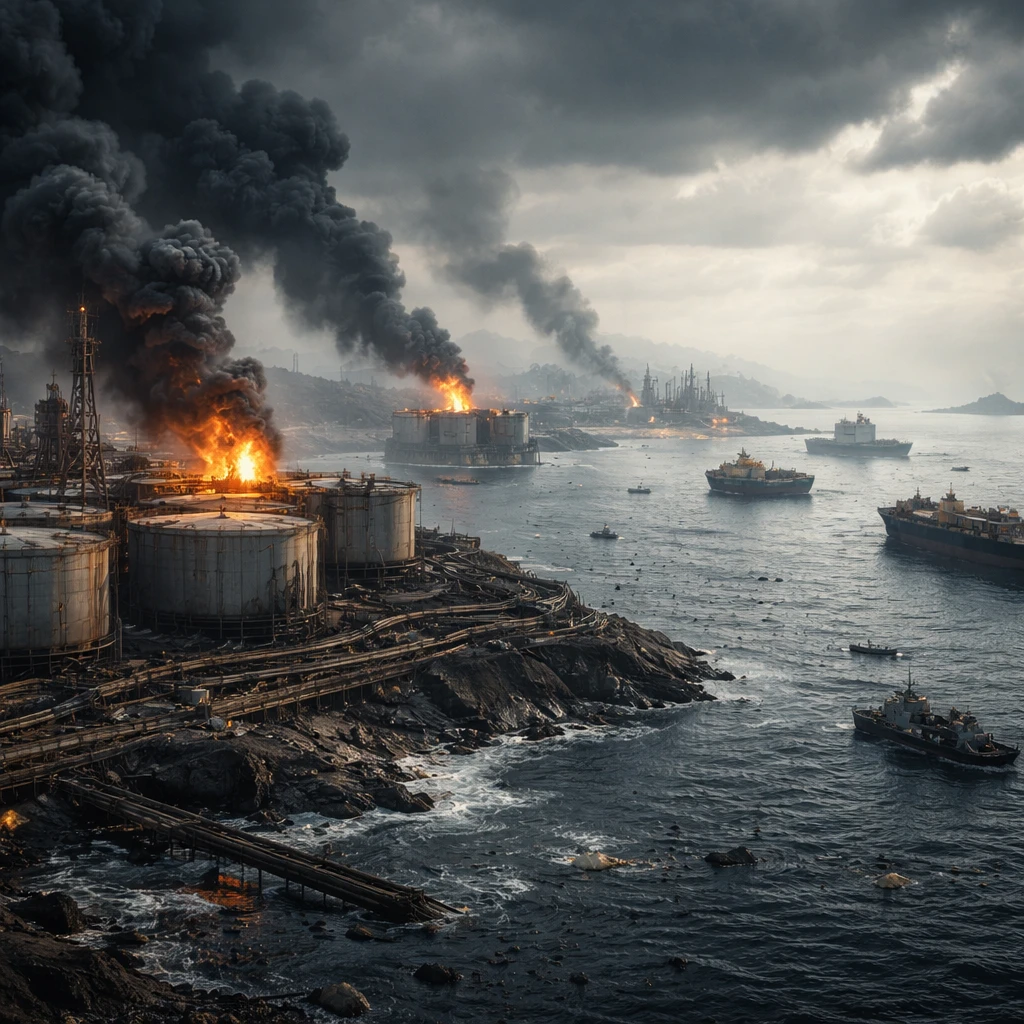
The intensifying military confrontation involving the United States and Israel on one side and Iran on the other has inflicted widespread damage on energy infrastructure and curtailed maritime movements through the Gulf's principal chokepoints.
International Energy Agency officials reported that more than 40 critical energy facilities have been damaged in the campaign, producing what the agency called the largest disruption to energy supplies in history. U.S. President Donald Trump issued an ultimatum demanding the Strait of Hormuz be reopened by the end of Tuesday; Iran rejected that demand and warned of additional attacks on Gulf infrastructure.
Iran
- U.S. forces struck military targets on Kharg Island on April 7. Kharg Island serves as Iran's principal oil export terminal.
- On March 18, Israeli forces attacked parts of the South Pars gas field and the Asaluyeh processing hub.
- Israeli strikes have also damaged fuel depots across Iran's mainland, including facilities in Tehran.
- The International Atomic Energy Agency confirmed that premises of the Bushehr nuclear power plant were struck.
Saudi Arabia
- Iran said it attacked the Jubail petrochemical complex on April 7.
- Since the war began, Saudi Arabia has reduced oil output by about 2 million barrels per day to roughly 8 million bpd.
- Operations at the 550,000-bpd Ras Tanura refinery were suspended.
- Some crude export shipments were partly diverted to Yanbu port on the Red Sea.
Iraq
- Basra Oil Company reported output from Iraq's main southern fields was around 900,000 bpd on April 7, down from about 1.3 million bpd at the beginning of March.
- Two drones struck the BP-operated North Rumaila oilfield, injuring three workers.
- Iraq resumed pipeline exports of crude from northern Kirkuk fields via Turkey and is planning overland exports to Syria.
Kuwait
- Kuwait Petroleum Corporation said Iranian drone attacks caused fires and severe damage to oil facilities.
- Kuwait reduced oil output and declared force majeure earlier in March.
- Units at Mina al-Ahmadi and Mina Abdullah refineries were hit.
- KPC said full capacity recovery could take three to four months.
Qatar
- Qatar declared force majeure on LNG shipments on March 4, affecting roughly 20% of global LNG trade.
- Damage to its LNG facilities cut about 17% of Qatar's export capacity.
- Shell's Pearl gas-to-liquids plant at Ras Laffan was shut.
United Arab Emirates
- The Habshan gas processing complex, one of the world's largest, shut on March 19 after damage from intercepted missile debris.
- On April 3, debris from additional interceptions killed one person and caused further damage to facilities.
- ADNOC adjusted LNG output in response to export disruptions.
- Borouge's petrochemicals plant was damaged by falling debris.
- TotalEnergies reported it lost 15% of its Middle East upstream output, including offshore the UAE.
Bahrain
- Bapco Energies declared force majeure after an attack on its 380,000-bpd Sitra refinery.
- An Iranian strike set a storage tank on fire on April 5, Bapco said.
- Gulf Petrochemical Industries Company said a unit caught fire after a drone attack on the same day.
Shipping and the Strait of Hormuz
Maritime traffic through the Strait of Hormuz has been severely curtailed since Iran announced a closure on March 2. The strait typically handles about 20% of global oil and liquefied natural gas flows. Tehran has threatened to lay mines in the Strait if its southern coast or islands are attacked and has warned its allies could close the Bab El-Mandeb Strait, an alternate route for Saudi oil exports.
- Iran barred vessels tied to the U.S., Israel and their allies, while allowing some ships from Pakistan, Iraq, China and India to pass.
- One French container carrier, CMA CGM, transited the Strait recently, but two Qatari LNG tankers were stopped on April 6.
- No LNG cargoes have exited the Gulf since the disruptions began.
- President Trump said the U.S. Navy could escort tankers, though the Navy has so far declined industry requests for escorts.
- On April 7, China and Russia vetoed a Bahraini resolution that would have encouraged coordinated efforts to protect commercial shipping in the Strait of Hormuz.
- The U.S. Energy Information Administration estimated it would take months to fully restore flows through the Strait after the conflict ends.
The combined effect of strikes on production, refining and LNG facilities, plus the near-halt of shipping through a major chokepoint, has created severe operational disruptions across the region. The International Energy Agency characterized the damage to more than 40 key energy assets as the largest supply disruption in history.
What is known and what remains uncertain
Reports from national oil companies, operators and international agencies provide a catalogue of specific hits to terminals, fields, processing hubs, refineries and petrochemical plants. However, the timeline for restoration of full output and shipping flows depends on the extent of physical damage and on unfolding security developments. Agencies have signalled recovery could take months in some cases, while immediate operational impacts include suspended refinery units, redirected export routes and declared force majeures.